Wednesday, June 10, 2009

Houghton study on OA benefits for the Netherlands is now out


This afternoon we went to the Dutch ministry of education, science and culture to present the report written by John Houghton on the Costs and Benefits of Research Communication in the Netherlands. You can read the press statement and the report here.

It was interesting to hear the responses by the various stakeholders in the process. The were quite positive on the findings in the report. The big questions remains: how to start the reshuffle in funding that is required to make this work. It is quite interesting to see this in the perspective of the UK and soon Denmark and Germany. The UK findings certainly pointed in the same direction.

The report was attracted quite a lot of media attention.

Friday, May 08, 2009

Data sharing statement in journal

The BMJ is asking authors to end their article with a Data sharing statement.
See: http://www.bmj.com/cgi/content/full/338/mar25_1/b1252
It does not oblige the author to actually share their data, but it is a first step in thinking about the underlying data and also to make the underlying data slightly more transparent. I wonder when further journals will follow.
(Off the SOAN blog.)

Thursday, May 07, 2009

Video on Digital Preservation


An absolutely brilliant video on digital preservation. How to make a slightly dull topic quite exciting :-) This was created by Digital Preservation Europe.
"To learn more about DPE or to access their suite of preservation resources and tools, please go to http://www.digitalpreservationeurope.org."

Friday, April 17, 2009

information behaviour of the researcher of the future

I just was pointed at a report commisioned by JISC and the British library on the information behaviour of the Google Generation in the future. This can be found at: http://www.bl.uk/news/pdf/googlegen.pdf. It has been around for a while (since January 2008) but still seems quite applicable.
One trend they discern is 'power browsing': quickly scanning materials across the broad collection of information on offer. Information literacy is and remains extremely important.
Interestingly they fear that there will be less of a role for the library. I am not sure that I share this worry. I feel that it is up to the library to change and offer a new physical space which matches the demand of the student and researcher of the future. Their walls no longer hold a monopoly so they must give the user a good reason to come and visit. And as the netgen is also a social generation, certainly offer them room for social interaction.

I do find the report is slightly more applicable to students than to researchers. Some points (e.g. power browsing) they acknowledge are not unique to the Google Generation but actually have been adopted by researchers of all generations.

Tuesday, April 07, 2009

How to cite tweets and keep them available...

Twitter is definitely taking off as a popular medium despite the brevity and 'media-poorness' of the messages. If you are going to train your students in correctly quoting the internet, how about tweets? In the article http://gunther-eysenbach.blogspot.com/2009/04/how-to-cite-twitter-how-to-cite-tweets.html the author links to some nice articles.

He also raises a far more challenging question. How to keep twitter messages retrievable. The author describes the 'Webcite' tool which will archive citations on the web for you.

To try it out I have just created a Webcitation of a tweet I sent out a few days ago. It is a little work, especially adding the metadata, but at least you are assured that the webpage will be retrievable. I do wonder how long the webcite service will be available.

Thursday, March 19, 2009

Is there one Generation Y?

I just skimmed through the ACRL 2009 strategic thinking guide. This is interesting input for my present work, although some points are related to the situation in America. I did find three interesting observations regarding students:
" • Increasingly, multiple generations make up the student enrollment at most colleges (either virtually or physically). This trend is likely to persist as the unemployed return to retool and reskill."
This combines nicely with the ideas regarding Life Long Learning on this side of the Atlantic...

"• We are all “becoming” Generation Y (also known as the Net or Millennial generation). New research shows that increased access to sophisticated technological social tools and increased connectivity via smart phones, laptops, and other handheld devices is changing the behavior of several generations; other generations are taking on the characteristics of Generation Y. Frequently cited generational differences are beginning to blur."
I like the 'we' in this quote. Does this mean that this is not a generation as in an age group, but rather a portion of the population? This would connect nicely with the findings that there are large differences within the young age group regarding technology uptake and attitude. This also matches the findings that older generations (e.g. the old X gen) are taking on social networking, gaming, twittering etc. more and more seriously...

"• The gadget-savvy Millennial students do not fully comprehend the complex networked
information world: “students may have confidence because they are unaware of the complexities involved [in using the Internet effectively] or just because they have grown up with technology. This potential gap between actual and perceived skills and literacy is important to understand and factor into strategies for teaching and learning at the institution.”
OK, I interpret this as follows, but correct me if I'm wrong: they think they are smart, but they do need some training in Information Literacy. This is a point which does keep on popping up.

Wednesday, March 11, 2009

Open and Shut?: Open Access: Whom would you back?

A very interesting blogposting and article by Richard Poynder. For all those out there trying to get an overview of the current state of affairs regarding Open Access: Green vs. Gold Road, Article Processing Charges vs. Institution Fee replacing the 'Big Deals'. It takes the discussion one step further than the first argument for Open Access: Accessibility. OA can also be used as a means to change the dependancy of Universities on publishers: Affordability. In the subscription model the library pays the institutional fees and the researchers are kept away from the pricing. At present a researcher simply chooses a journal by topic and of course citation index. Journal pricing does not play a role in selecting a journal to publish in. Simply changing the model to Open Access with an instution fee will consolidate this situation.

Open and Shut?: Open Access: Whom would you back?

Thursday, March 05, 2009

HBO Kennisbank Widget

Just a quick snippet out of my new job: The HBO (Universities of Applied Sciences) in the Netherlands are now also adopting repositories. Interestingly they were later than the research universities who each built their own repository. A number of HBOs have chosen to make use of a central repository service offered by SURF. This is called the HBO kennisbank. It is a big success, especially in collecting and offering Student theses.
You can access the HBO knowledge bank at: http://www.hbokennisbank.nl but you can also add the widget below to your blog/portal/website.


Tuesday, February 03, 2009

A Wordle off my blog


Wordle: My blog 3rd of feb 2009


Just tried out Wordle, this really is a quick and easy way to generate a tagcloud, really straightforward and very nice results!

Tuesday, January 20, 2009

New job at Surf


A blog entry for all the people out there that hadn't heard yet, or that don't follow my tweets. Starting the first of February I will be leaving Utrecht University and starting a new job at SURF foundation. Half of my time I will be a community manager for the SURFshare projects, ensuring that the information and experiences learned in the projects are exchanged amongst the projects and brought to all those interested, mainly in the field of higher education in the Netherlands.
If you haven't heard about SURFshare: it is an initiative to improve the access to scientific knowledge making use of IT facilities. Examples are projects in the field of Open Access publishing, Virtual spaces for researchers to collaborate in or projects that aim to improve the accessibility of research results from professional universities in the Netherlands.
The other half of my job I will be the community manager for the Knowledge Exchange. This is a collaboration between JISC (UK), DEFF (Denmark), DFG (Germany) and SURF (Netherlands) aims at making 'a layer of scholarly and scientific content openly available on the Internet'. One of my tasks will be to try and channel and exchange experiences learned in the various working groups that are working on one of many topics.

Utrecht is getting a VLTE=ELDO

A just read the brand new strategic plan for the IT facilities here at Utrecht University. After all these years we are actually getting a Virtual Learning and Teaching Environment (in Dutch an ELDO: Electronische Leer- en Doceeromgeving). I had trouble suppressing a small chuckle. Haven't we always had a VLTE? Haven't we been using WebCT and Blackboard as just that? The teacher-centreredness of both systems has always meant they have been used mainly as a teaching tool. Student learning usually takes place elsewhere.
Does this mean we are making a strategic choice of putting the teacher in the centre of the learning process? No, I don't think this is necessarily the case, in the general strategic plan of Utrecht University this is not mentioned.

Monday, January 19, 2009

Website Lecturenet is now online


Not only is the Lecturenet service now up and running, the website for the service is now also online. It can be found at: www.lecturenet.nl.
(There also will be a university url available soon...)
The website is only available in Dutch and isn't quite finished but aims to provide links to pedagogical advice on the use of Weblectures and also links to various reports on implementing Weblectures.

Monday, January 12, 2009

Feasibility study: automatically archiving and sharing learning objects from Blackboard


Last year I set up a pilot study with the University Library here at Utrecht University. Courses in Blackboard are normally only accessible to the teacher of the course and the students. After a few years they get cleared up. Any archives are not accessible to anybody other than the system admin. This means teachers cannot see each other's materials and learn from each other.
In a previous project (the KIP project) we discoverd teachers were not interested in adding metadata to improve the 'findability' of archived materials. So this time we decided on a different approach:
- We created archives of a number of courses using the Blackboard interface (this can be done in batch)
- These archives are ZIP files consisting of XML files describing the course, files, links and XML files descrbing these files and links.
- The library wrote a script which analysed these XML files, stored certain files and retrieved the associated metadata from the XML.
- The files and links were saved in DSpace in a separate repository.
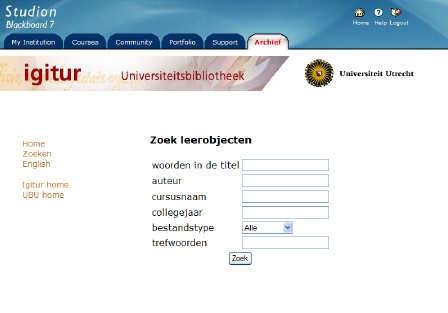
- A search interface was written so that teachers could search in the repository.

Once this was built I performed a test with six teachers at Social Sciences with various attitudes to computers and the sharing of knowledge. The results can be found in the following pdf document (in Dutch I am afraid).

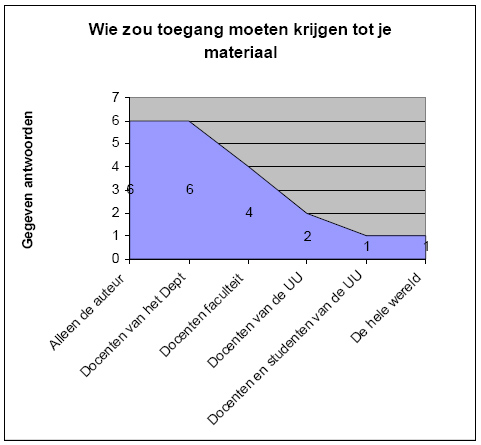
Who should have access to your teaching materials
A number of interesting findings arose. In general teachers were quite pleased to have this facility. They were not out to copy other teacher's materials but would like to be able to see what other teachers are teaching in their courses. There were not all that enthousiastic about sharing their materials with the whole world. They would like to know what others are doing with their materials.
On the technical side: It is technically possible. The Blackboard IMS packages contain a lot of information, not enough to fill all Dublin core fields, but it certainly is a good start.
This facility is not yet in production (other projects took priority) but it could be taken into production without too much work. All the difficult work has been done.

Tuesday, January 06, 2009

How many student theses public?


In the past year I have been responsible for a organising a system to archive all the students' master theses here at Social Sciences, Utrecht University. The university library programmed a very practical web interface which acts as a front end to the rather more complex interface of the repository itself. I must say I am very pleased with the system they came up with.
The challenge was to think up a procedure which would comply with all the checks the management required (had to be a real student, truly graduated, and indeed his/her real thesis). At the same time the teaching staff did not want to have spend any time on the process at all. This resulted in the workflow described here. (in Dutch I am afraid)
From June onwards the system was taken into production and a large number (587) theses were submitted. These were not all of the theses. We missed a number of the theses of students which had been handed in before the 1st of June. I also expect that the late adoption meant that a lot of teachers did not submit the theses they had received earlier on in the year. We still managed to collect 77% of all the theses. For a first attempt I am not certainly not dissatisfied, the coverage should go up in the coming years though.
I was very interested how many students would choose to make their thesis public and how many would choose to keep theirs private. 69.5% chose to make their thesis public. The main reason not to make it publically available was that they wished to submit the thesis as an article in a scientific journal and in many cases publishers will not accept it if it has been made public on an earlier date. Some students also indicated that they wish to continue in the field of research and do not want to others to take over their ideas... In fact even some abstracts were not made public for this very reason.
The report on the implementation can be found here (in Dutch too I am afraid).

Monday, December 15, 2008

Lecturenet service has started


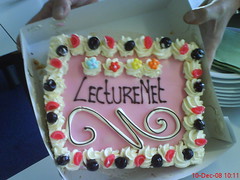
Officially the 'Lecturenet' service will not be starting until the first of January. We had a kick off meeting and had a cake to celebrate. There will be four recording sets available at Utrecht University for recordings. One for Arts and one for Social Sciences. The other two sets are available for all the departments of the university. All departments can request recordings at a fixed rate. Recordings are made by student assistants which are employed by a employment agency. The service is working hard on getting the website online with more information.
So finally a basic service has started, I do wonder how demand will develop.

Thursday, November 27, 2008

Scenario 2020: what will the virtual and real learning landscap look like?

In the run up to the Onderwijsdagen I was asked to think along in developing scenarios for the learning landscape in 2020. The resulting four scenarios were presented as a keynote at the Onderwijsdagen. Our group was asked to fill in the situation for an institution directed curriculum and a student owned VLE. It was a bit of a puzzle to match these two conditions but we came up with the following history:
Europe goes through an economic crisis in which Asia comes out as a winner. In the field of knowledge they truly are competetive with European education. This calls for drastic measures. The European education system is forced into a period of harsh competition. European governments rally and decide on a strong standardisation of curricula. A Bachelor degree in Psychology consists of the same modules in every country. To encourage competition and exchange students can choose to take each module wherever they please, they can attend a local university, take a module abroad or follow an online course. They receive coupons for their life of learning. (Naturally this also creates a trade in coupons). All courses are allowed, as long as they are certified. Institutions can employ coaches from a pool of teachers, which also have to be certified.
We took the exchange of standards much further, there will be more than just email and RSS protocols, many more exchange standards will have been agreed upon. There will be standards for the delivery of content, various communication tools and of course testing tools. This will allow students to 'plug' their course into their personal virtual living environment (PVLE) (facebook extended). As soon as they plug in their course the widgets required will be available for the student in their PVLE. In this age of fierce competition these PVLEs are being offered by commercial parties, Monroom is just an exmaple we came up with, but there are many more. Students are not interested in institution VLEs as they are constantly taking modules in different institutions, sometimes even simultaneously.

So this was our view, now all we need is 12 years of patience to see whether we got it right...

A number of students created a video to illustrate what 2020 would look like according to each of the four scenario's. Our video can be found here.
The overview of all scenario's (including the newspapers) can be found here.

Presentation on Weblectures at the Onderwijsdagen preconference

On Tuesday the 11th of November (yes, rather a while ago), I gave a presentation on the Weblectures pilot which ran at Utrecht University in 2007. This was part of a more technically minded preconference on implementing Weblectures. The two more interesting slides in this presentation (compared to previous presentations) are our findings on criteria for a recording system. Reliability proved to be a key criteria for us. One criteria which was notably absent was price of the system. Of course this is of some importance, but we also found out that there were so many more costs involved that this cost was only a small part of the total cost. The other criteria proved to be much more important.
The other interesting slide is the slide regarding organisation. Setting up an organisation for Weblectures requires getting people involved from all corners and departments of your institution. The trick is not to create an unwieldy large consultation body but to keep all the varied partners involved...

Wednesday, October 29, 2008

SURFmediacore presentation

Yesterday I attended the surfmediacore presentation. A long name for a soon to be available facility to store video's which can be accessed from a homegrown application using Webservices (REST calls to be precise). SURFnet will soon be calling for pilots to access this service. Institutions can connect with the service if they have a wish which is not a standard facility in Surfmedia.
An interesting meeting and off the cuff I suppose you could think along the following lines as an example of an application you could build:
1. A building block in Blackboard in which a teacher can directly upload a video in Blackboard and it will be directly embedded in the course.
2. Large uploads for the media libraries we have at present in our institutions. Possibly combined as a service with the university library. Drawback is the upload of copyrighted materials (same goes for 1.)
3. Alerting service for teachers. There has been an alerting service for years for researchers showing latest research. What about an alerting service for teachers showing the latest teaching materials which correspond to certain keywords/phrases. This is based on the ideas in the Zoep project. The university library could search the Surfmediacore collection and show the latest relevant video's as part of a larger alerting service. I do wonder whether you really need surfmediacore to do this. Probably the university could also do a harvest using the OAI exchange which is also available on the surfmediacore.

Utrecht University is now in the SURF-federation!

Finally it has been arranged: The Utrecht University authentication is now connected to the SURF-federation. The reason why I am so happy is that we can now advertise SURFmedia in our institution. No need to create an own account for teachers and now finally teachers can easily limit access to their video's: students can access them using their university ID. If you enter the url to the embedded video students are neatly requested to enter their ID. Sadly, if you enter the url of the page describing the video students do not get a clear request.
We are working on a teachers manual and then we can get on with advertising. The main limitation is of course the fact we cannot upload copyrighted materials. A large part of the videos used in classroom settings are copyrighted materials (which can legally be shown in a classroom, but cannot be copied to a streaming server....)

Monday, October 27, 2008

Who owns teaching materials?

Only a week ago I ran into an interesting question which arose for the first time. A member of the teaching staff had left university and removed course materials from his/her Blackboard course. Staff preparing the course site could not find the materials which were in place last year.
We have not got our Learning Objects repository in place yet, otherwise this would have been the perfect place to recover these documents. It does clearly show that a discussion on the intellectual property rights of teaching materials created by teachers is worth while. Actually: the discussion itself is not all the interesting, if a teacher has created materials while being employed by the university, the copyrights belong to the university. I practice however not everybody feels the same way about this and that is why it would be a good idea to raise this discussion.