A just read the brand new strategic plan for the IT facilities here at Utrecht University. After all these years we are actually getting a Virtual Learning and Teaching Environment (in Dutch an ELDO: Electronische Leer- en Doceeromgeving). I had trouble suppressing a small chuckle. Haven't we always had a VLTE? Haven't we been using WebCT and Blackboard as just that? The teacher-centreredness of both systems has always meant they have been used mainly as a teaching tool. Student learning usually takes place elsewhere.
Does this mean we are making a strategic choice of putting the teacher in the centre of the learning process? No, I don't think this is necessarily the case, in the general strategic plan of Utrecht University this is not mentioned.
Showing posts with label vle. Show all posts
Showing posts with label vle. Show all posts
Tuesday, January 20, 2009


Monday, January 12, 2009
Feasibility study: automatically archiving and sharing learning objects from Blackboard
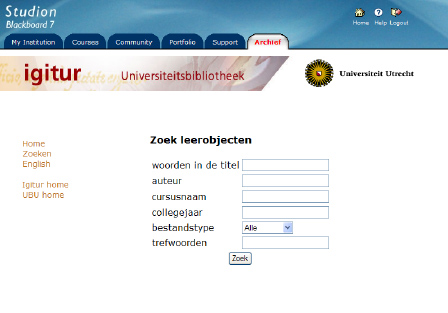
Last year I set up a pilot study with the University Library here at Utrecht University. Courses in Blackboard are normally only accessible to the teacher of the course and the students. After a few years they get cleared up. Any archives are not accessible to anybody other than the system admin. This means teachers cannot see each other's materials and learn from each other.
In a previous project (the KIP project) we discoverd teachers were not interested in adding metadata to improve the 'findability' of archived materials. So this time we decided on a different approach:
- We created archives of a number of courses using the Blackboard interface (this can be done in batch)
- These archives are ZIP files consisting of XML files describing the course, files, links and XML files descrbing these files and links.
- The library wrote a script which analysed these XML files, stored certain files and retrieved the associated metadata from the XML.
- The files and links were saved in DSpace in a separate repository.
- A search interface was written so that teachers could search in the repository.
Once this was built I performed a test with six teachers at Social Sciences with various attitudes to computers and the sharing of knowledge. The results can be found in the following pdf document (in Dutch I am afraid).
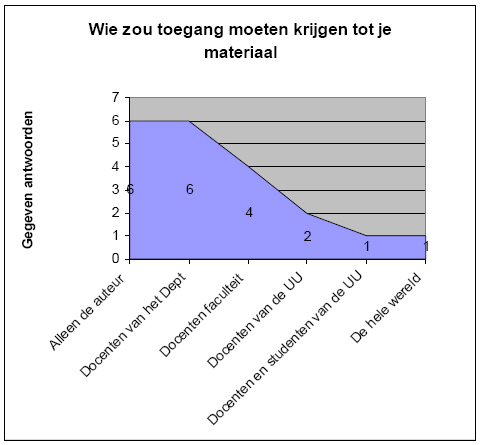
A number of interesting findings arose. In general teachers were quite pleased to have this facility. They were not out to copy other teacher's materials but would like to be able to see what other teachers are teaching in their courses. There were not all that enthousiastic about sharing their materials with the whole world. They would like to know what others are doing with their materials.
On the technical side: It is technically possible. The Blackboard IMS packages contain a lot of information, not enough to fill all Dublin core fields, but it certainly is a good start.
This facility is not yet in production (other projects took priority) but it could be taken into production without too much work. All the difficult work has been done.
Friday, July 11, 2008
Utrecht University has chosen for Blackboard as VLE

It is now (sort of) official: Utrecht University has chosen to use Blackboard as its Virtual Learning Environment. Blackboard is already in use at a number of departments besides WebCT en BSCW.
The decision was prepared by a project group which was asked to compare (the shortlisted options) Sharepoint and Blackboard Next Generation. Important arguments in making a choice where: Blackboard offers all the required functionalities out-of-the-box, whereas using Sharepoint would require a lot of programming and customising. This would not only make it a very expensive option in the short term, but also requires upkeep and adaptations in the longer term. Sharepoint was also considered less suitable due to the steep learning curve for staff. This is related to the fact that it is not purpose-built for teaching and learning and does not fit in the 'classroom metafor'.
The decision is notable if you take into account that Utrecht University will be using Sharepoint for the public website, intranet and (in the future) teamspaces.
Saturday, June 21, 2008
In Twente VLE team advises Blackboard
The quickscan report on Blackboard as a VLE for Twente university is now pulic and can be found at: http://www.utwente.nl/elo/. It is a very interesting report for the Dutch VLE watchers. After havng looked at Sakai and Sharepoint, both received a very critical quickscan. Neither were considered suitable as a VLE for Twente. And at the end of the process Blackboard popped up as an option, and very interestingly students had an important role in this decision. Based on this quickscan Blackboard has proven to be the best option as a VLE for Twente, though the decision will still have to be made by the university board.
Utrecht will be presenting its advice to the university board very soon, the question will be if they arrive at the same conclusion or advise reconstructing Sharepoint into a VLE....
Utrecht will be presenting its advice to the university board very soon, the question will be if they arrive at the same conclusion or advise reconstructing Sharepoint into a VLE....
Friday, June 06, 2008
One VLE: the preferences from Social Sciences

Here at Utrecht University we are in the process of deciding on one VLE for the university. I have been busy collecting opinions of teachers, students and supporting staff in the previous months. Our findings and some comments students made can be found here.
Some of the most surprising comments: they would rather have clear courses which are easy to navigate, teachers using the same headings for the same matters, don't mix personal with study related matters, the teacher is respected for his expertise: his/her contributions should be clearly distinguished from the contributions of fellow students...
Monday, May 19, 2008
Presentation Blackboard 9 - The next generation
Today Emmanuel Clemot, a Solutions Engineer from Blackboard came to Utrecht University to show off their plans for the Blackboard 9 - Next Generation product. We even got a prototype to look at, a short video will be available on the Blackboard website soon.
A few things that struck me:
Process
- First common APIs so both products can start using intermediate tools (community, content, portfolio and outcomes system).
- Then moving features into Blackboard 8 (is already out)
- And finally building a new shell to access either Vista, Learning system or one of the other tools mentioned above...
That really means as an institution you can choose to keep the old VLEs up and running and migrate gradually. I am not quite sure I would want to, but it is possible.
Look and Feel
Slightly more confusing than Blackboard, but not a lot. Teachers will be quite happy, they will recognise the system. The drag and drop looks good, the contextual menus are alright but they do hide options until teachers find them. Fortunately NO annoying Java Applets (they have learnt their lesson).
I had a big laugh about the WebCT view and the Blackboard classic view feature.
Features
What I like (some of its already in Bb 8) is social bookmarking (Scholar) continued, the facebook connection (though for Holland it is only a start), wikis and blog in the code, add a number of mashups, social learning space in community system, personisable pages, course homepage with more than only announcements (should Sakai or some other VLE sue them? ;-).
They claim Content System allows for student collaboration with versioning and comments. We do not use it at present and it made me rather curious.
All in all a good presentation and an interesting option for Utrecht University, certainly because it allows teachers a careful transition.
A few things that struck me:
Process
- First common APIs so both products can start using intermediate tools (community, content, portfolio and outcomes system).
- Then moving features into Blackboard 8 (is already out)
- And finally building a new shell to access either Vista, Learning system or one of the other tools mentioned above...
That really means as an institution you can choose to keep the old VLEs up and running and migrate gradually. I am not quite sure I would want to, but it is possible.
Look and Feel
Slightly more confusing than Blackboard, but not a lot. Teachers will be quite happy, they will recognise the system. The drag and drop looks good, the contextual menus are alright but they do hide options until teachers find them. Fortunately NO annoying Java Applets (they have learnt their lesson).
I had a big laugh about the WebCT view and the Blackboard classic view feature.
Features
What I like (some of its already in Bb 8) is social bookmarking (Scholar) continued, the facebook connection (though for Holland it is only a start), wikis and blog in the code, add a number of mashups, social learning space in community system, personisable pages, course homepage with more than only announcements (should Sakai or some other VLE sue them? ;-).
They claim Content System allows for student collaboration with versioning and comments. We do not use it at present and it made me rather curious.
All in all a good presentation and an interesting option for Utrecht University, certainly because it allows teachers a careful transition.
Sunday, May 11, 2008
Use of Blackboard at Utrecht University
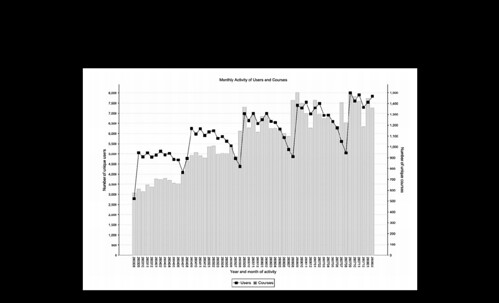
We have analysed the logs of the Blackboard server over the past few years and this gives an interesting insight into the use of the VLE. The results (in Dutch I am afraid) are reasonably comparable to outcomes of research at other universities. An interesting note is the fact that all courses at Social Sciences have been supported by Blackboard for a number of years now. That accounts for the early growth.
We have also tried to gain some insight in the use of different tools using the log data. Interestingly the use of discussion boards really has grown and is still growing. This doesn´t give an immediate answer as to how they are used as they are used for general FAQs, debating, collaboration, file sharing, etc.
All in all the results nicely mirror the use of Blackboard as a tool use to support all F2F learning, with the odd exploit into blended learning. The outcomes come at a great time as we are in the middle of an process to make a decision on a future single VLE for Utrecht University.
Monday, January 28, 2008
Just some new Open Source VLE names
And for all those out there looking at the broadest possible approach to a learning environment, and are into open source: I just heard about Zarafa (a linux based collaboration environment which will work together with Outlook and MS Exchange).
Taking it from the other side some clever people have built some extra features into the really popular Content Management System Joomla to turn it into a Learning environment. Although there are many out there that simply state: why bother if you have Moodle which does it all anyway.
PS: This company also offers a Sharepoint 2007 LMS, why do I feel that all sorts of lines are coming together ;-)
Taking it from the other side some clever people have built some extra features into the really popular Content Management System Joomla to turn it into a Learning environment. Although there are many out there that simply state: why bother if you have Moodle which does it all anyway.
PS: This company also offers a Sharepoint 2007 LMS, why do I feel that all sorts of lines are coming together ;-)
Tuesday, November 13, 2007
Preconference on Sharepoint as VLE

I am now attending a preconference at the SURF Onderwijsdagen on the use of Sharepoint in Dutch higher ed. It was very interesting to hear a description of the SHAPE Surf project. What made it really interesting was the embedding of the use of this collaborative environment in an 'action learning pedagogy'. Students were being trained as 'knowledge workers'. It certainly seems to be very suitable for this goal. On the other hand at the HAN courses are virtually unchanged and Sharepoint is used for content delivery. For that goal it seems simply too flexible and messy. So if you are going to change your teaching to a model containing a more active collaborative realistic approach, then Sharepoint should be quite useful.
Wednesday, November 07, 2007
WebCT troubles caused by firewall issues
What's new... If there is one recurring issue in implementing ICT tools for education it does seem to be firewalls getting in the way. This seems to have been the case for the WebCT troubles at Utrecht University. This should now have been solved. You can read the article (in Dutch) in the university magazine.
Thursday, October 04, 2007
Which VLE for Utrecht?
The latest news scoop is that the advice for the next VLE at Utrecht should be appearing soon (by December). I have heard the buzz going round in The Netherlands that we are having serious problems. I am pleased to say this certainly does not concern Blackboard. We are running this on a local server and it is running extremely satisfactorily. As far as WebCT is concerned, all those interested can read the article in our university magazine.
For me this situation does raise a number of questions as to what is truly important in a tool for the support of teaching and learning. I have noticed that some are engrossed by visions of a myriad of pedagogical models and features. I would like to take a step back and concentrate on the basics: what teachers and students need is a system which is reliable and easy to use. I have heard arguments that all systems should answer to these basic requirements, but I have sadly seen many examples to the contrary. I also feel that the large majority of teaching staff are not looking for a system that will do absolutely everything, but rather a straightforward system that will let them do exactly what they want to do quickly and easily. If we are trying to look for an efficient use of ICT in higher education, this is a very basic place to start.
For now we are waiting on the advice...
For me this situation does raise a number of questions as to what is truly important in a tool for the support of teaching and learning. I have noticed that some are engrossed by visions of a myriad of pedagogical models and features. I would like to take a step back and concentrate on the basics: what teachers and students need is a system which is reliable and easy to use. I have heard arguments that all systems should answer to these basic requirements, but I have sadly seen many examples to the contrary. I also feel that the large majority of teaching staff are not looking for a system that will do absolutely everything, but rather a straightforward system that will let them do exactly what they want to do quickly and easily. If we are trying to look for an efficient use of ICT in higher education, this is a very basic place to start.
For now we are waiting on the advice...
Tuesday, July 03, 2007
Twente has issued its Sakai report...
It is now public: the report on the examination whether Sakai could be a viable option for the University of Twente is now public. It can be found at: http://www.utwente.nl/elo/news/cbus_english_final/
There are a number of notable outcomes which are relevant for Utrecht University (which will also have to answer the same question in the coming year.) From the technical perspective it is interesting to note that it has been designed to be integrated in a Service Oriented Architecture, though this will naturally take some effort (as all integrations will). It should support various pedagogical scenario's although I do feel it has been designed for a teacher based style of learning (as most, if not all VLEs are at present). The one issue in Twente at the moment appears to be rooted in the Functional analysis/Educational use. There are still issues regarding usability and user experience which need to be addressed.
There are a number of notable outcomes which are relevant for Utrecht University (which will also have to answer the same question in the coming year.) From the technical perspective it is interesting to note that it has been designed to be integrated in a Service Oriented Architecture, though this will naturally take some effort (as all integrations will). It should support various pedagogical scenario's although I do feel it has been designed for a teacher based style of learning (as most, if not all VLEs are at present). The one issue in Twente at the moment appears to be rooted in the Functional analysis/Educational use. There are still issues regarding usability and user experience which need to be addressed.
Sunday, January 14, 2007
It's learning seminar

Last Thursday I attended a seminar on the norwegian VLE It's learning. All in all it was not extremely exciting. The most inspiring part was the talk by Wim Veen on the net-generation students. I hadn't heard one of his talks for a while and it was interesting to see that his homo zappiens had been incorporated into a lot more developments (for example the net-generation students). The ideas set out by a number of trend watchers are coming together. He also incorporated ideas on networked learning and the gift economy. Although some of the concepts sound idealistic, it does give the feeling that society and therefore learners are changing. Strangely enough learners are becoming more social and Dutch higher ed is becoming more competitive.
It's learning seems interesting as a VLE, but I do not know a lot about it. I must give it a try so at least if a say something about it, it will be grounded in truth ;-) My colleague Jos Jaspers is planning to give it a try, so I will definitely hear him out.
I was intrigued by the fact they are offering it's learning through the mobile phone. They are also incorporating a blog facility. Social Software is entering the VLE domain :-)
The presentations on It's learning were not all that exciting, it does appear to be a VLE like many others, although the incorporation of a portfolio in the system is certainly a bonus for the Dutch market. I missed the final demonstration of a link with Sharepoint which is an interesting facility a large number of Dutch institutions will be looking for with their respective VLE's.
One thing I did find very noticeable was the hosting model they offer. In principle they advise you to use their hosting. I can imagine this to be a good idea. At least this saves you a lot of hassle and you are always up to date and patched. Of course there are also disadvantages (stuck to their code, dependant on connections, data is elsewhere). I must note that you can also run a local installation if that is what you prefer.
Subscribe to:
Posts (Atom)

 RSS feed for this blog

