I left Utrecht University almost a year ago and I was very interested to hear that they had evaluated the first year of the more widely available Weblectures service at Utrecht University. The report (in Dutch) can be found here.
A very quick and dirty interpretation: Students and staff do not all fill in surveys ;-) response rate was 33%. Students are enthousiastic, teachers slightly less but they are too. Teachers are not changing their teaching to adapt to the new possibilities. They are interested in learning more about the opportunities on offer.
Showing posts with label recording lectures. Show all posts
Showing posts with label recording lectures. Show all posts
Monday, January 11, 2010


Monday, December 15, 2008
Lecturenet service has started
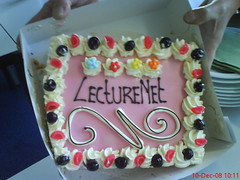
Officially the 'Lecturenet' service will not be starting until the first of January. We had a kick off meeting and had a cake to celebrate. There will be four recording sets available at Utrecht University for recordings. One for Arts and one for Social Sciences. The other two sets are available for all the departments of the university. All departments can request recordings at a fixed rate. Recordings are made by student assistants which are employed by a employment agency. The service is working hard on getting the website online with more information.
So finally a basic service has started, I do wonder how demand will develop.
Thursday, November 27, 2008
Presentation on Weblectures at the Onderwijsdagen preconference
On Tuesday the 11th of November (yes, rather a while ago), I gave a presentation on the Weblectures pilot which ran at Utrecht University in 2007. This was part of a more technically minded preconference on implementing Weblectures. The two more interesting slides in this presentation (compared to previous presentations) are our findings on criteria for a recording system. Reliability proved to be a key criteria for us. One criteria which was notably absent was price of the system. Of course this is of some importance, but we also found out that there were so many more costs involved that this cost was only a small part of the total cost. The other criteria proved to be much more important.
The other interesting slide is the slide regarding organisation. Setting up an organisation for Weblectures requires getting people involved from all corners and departments of your institution. The trick is not to create an unwieldy large consultation body but to keep all the varied partners involved...
The other interesting slide is the slide regarding organisation. Setting up an organisation for Weblectures requires getting people involved from all corners and departments of your institution. The trick is not to create an unwieldy large consultation body but to keep all the varied partners involved...
Friday, October 24, 2008
Do Weblectures require a new pedagogy?
I have been rather busy lately, and been away from my blog awhile. It is about time I posted some news. To start with I would like to respond to a discussion back in June which Rino Zandee posted on his blog (and Wilfred Rubens also wrote about) in response to an article in the NRC (and a posting on this blog).
Their position was: Weblectures require a new pedagogy.
I do not agree with them, but I think this is mainly a matter of definition. In the approach we have used at Utrecht University we have started to record lectures according to two models (both of which are called Weblectures):
1. Recording the F2F lecture for the students in the class. This was a very basic approach and has proven valuable. Students value the recordings as they can check part of the lectures, use them for revision and do not miss a lecture if they were ill. For students with several handicaps the recordings are extremely valuable as this allows them to follow the lecture again and improve their notes. For proof of this please read the full report.
Please note that trying to watch a full hour and a half of lecture is extremely boring, students only choose to do this if they really missed the lecture. We have never intended these weblectures as learning objects in their own right. In using this approach you do not need to change the pedagogy of the lecture, although of course a lecture can always be improved. In fact: teachers have improved their teaching by looking at their performance.
2. Creating a learning object specifically for online viewing. This is a completely different approach. An online lecture should be short, concise, rich in illustrations, 20 minutes max, preferably less. At least as important as the lecture is the embedding of this learning object in the learning process. Students do not generally learn by simply offering them information (a hint of a slight euphemism here ;-). They learn through activities in which they are required to apply the information acquired (assignments, discussions, essays and of course the classic exams). If this is your definition of a weblecture then yes: please do change your pedagogy before you stand in front of a camera.
Their position was: Weblectures require a new pedagogy.
I do not agree with them, but I think this is mainly a matter of definition. In the approach we have used at Utrecht University we have started to record lectures according to two models (both of which are called Weblectures):
1. Recording the F2F lecture for the students in the class. This was a very basic approach and has proven valuable. Students value the recordings as they can check part of the lectures, use them for revision and do not miss a lecture if they were ill. For students with several handicaps the recordings are extremely valuable as this allows them to follow the lecture again and improve their notes. For proof of this please read the full report.
Please note that trying to watch a full hour and a half of lecture is extremely boring, students only choose to do this if they really missed the lecture. We have never intended these weblectures as learning objects in their own right. In using this approach you do not need to change the pedagogy of the lecture, although of course a lecture can always be improved. In fact: teachers have improved their teaching by looking at their performance.
2. Creating a learning object specifically for online viewing. This is a completely different approach. An online lecture should be short, concise, rich in illustrations, 20 minutes max, preferably less. At least as important as the lecture is the embedding of this learning object in the learning process. Students do not generally learn by simply offering them information (a hint of a slight euphemism here ;-). They learn through activities in which they are required to apply the information acquired (assignments, discussions, essays and of course the classic exams). If this is your definition of a weblecture then yes: please do change your pedagogy before you stand in front of a camera.
Wednesday, September 17, 2008
A webbased editor for recorded lectures for teachers
An interesting selling point offered by Echo360. They are now offering their recording boxes. We had one concern when looking at this recording solution. The boxes are thin clients and they require a network connection to the server to operate. In several cases we have had to recordings in spots where there was no network connection present or the firewall ports where not open. This does limit the application of a capture box.
One thing I am intrigued by is the option of allowing teachers to edit their own presentation through a webeditor. This certainly does allow for easier adapting by teaching staff to their pedagogical approach. Editing a recording allows for easily creating reusable learning objects, rather than full lectures. At present our editing has to be done by (busy) audio visual staff. Of course allowing teachers to edit also means administration, giving each teacher access to his/her own recording.
For more information check out their website: http://www.echo360.com/verbatim/
One thing I am intrigued by is the option of allowing teachers to edit their own presentation through a webeditor. This certainly does allow for easier adapting by teaching staff to their pedagogical approach. Editing a recording allows for easily creating reusable learning objects, rather than full lectures. At present our editing has to be done by (busy) audio visual staff. Of course allowing teachers to edit also means administration, giving each teacher access to his/her own recording.
For more information check out their website: http://www.echo360.com/verbatim/
Tuesday, September 09, 2008
Presentation at Surfnet on Weblectures
Surfnet has just started a pilot in which institutions of higher education in the Netherlands can participate in evaluating three different systems for recording and broadcasting lectures: Mediasite, Presentations2Go and a solution built on Apple podcast server. I was a little saddened to see that the Apple podcast solution still does not offer true navigable content by slide. The video still is being delivered as picture within picture. I remember a presentation years ago where Apple explained this was possible but nobody had built it. Today I heard that it still isn't quite available yet...
I was asked to give a presentation on our findings regarding Rich Media (is it worthwhile?) and criteria we found important in the choice for a Rich Media system.
You can find my presentation below.
I was asked to give a presentation on our findings regarding Rich Media (is it worthwhile?) and criteria we found important in the choice for a Rich Media system.
You can find my presentation below.
Sunday, June 22, 2008
Article in NRC on Weblectures
It is rather frustrating to write a blog entry on a newspaper article which is not freely available online, In this saturday's NRC (Education and Science supplement) there is an article on recording lectures. In this article you can find references to the Dutch 'entrepeneurs' in this field (TU Delft and Triple-L) and to the findings we published at Utrecht University.
Sunday, June 15, 2008
Presentation at Biology on Weblectures
Wednesday the 13th of June I was asked to give a presentation on Weblectures at the Biology department. Elly Langewis was kind enough to record the audio during the presentation. Using slideshare I have created a slidecast, you can find it embedded below.
I am very interested in the outcomes of the evaluations after the final exam of the Biology course that has been recorded. In this course both weblectures and audio podcasts were offered. I am very intrigued how students have used these two different solutions and which they preferred.
At the end of the presentation I was not surprised to find that the teachers present were apprehensive. In the past the worry they conveyed was that students would not come to lectures anymore. The evaluations in previous courses quickly dispelled that concern. They found an other worry in its place: Weblectures would prevent students from acquiring the academic skill of sitting still and taking notes in two sittings of three quarters of an hour. This argument was a little strange for me. In evaluations students have answered that they do not make less notes due to Weblectures. As one of the teachers stated: in the old days we had to concentrate for three quarters of an hour, let them learn to do the same... It felt as a slight fear of modern technology and its possibilities. Fortunately slides, overhead sheets, powerpoints and video have already been incorporated into lecture halls, so I do feel that the teachers will need to have the chance to adjust to this new technology and make it their own. A forceful approach does not feel in place in a setting like this one.
I am very interested in the outcomes of the evaluations after the final exam of the Biology course that has been recorded. In this course both weblectures and audio podcasts were offered. I am very intrigued how students have used these two different solutions and which they preferred.
At the end of the presentation I was not surprised to find that the teachers present were apprehensive. In the past the worry they conveyed was that students would not come to lectures anymore. The evaluations in previous courses quickly dispelled that concern. They found an other worry in its place: Weblectures would prevent students from acquiring the academic skill of sitting still and taking notes in two sittings of three quarters of an hour. This argument was a little strange for me. In evaluations students have answered that they do not make less notes due to Weblectures. As one of the teachers stated: in the old days we had to concentrate for three quarters of an hour, let them learn to do the same... It felt as a slight fear of modern technology and its possibilities. Fortunately slides, overhead sheets, powerpoints and video have already been incorporated into lecture halls, so I do feel that the teachers will need to have the chance to adjust to this new technology and make it their own. A forceful approach does not feel in place in a setting like this one.

Sunday, May 25, 2008
Presentation of Accordent recording solution

Thursday JNV and GoTelecom were kind enough to organise a presentation of various technical solutions interesting to those recording lectures.
To start with we had a presentation of the Accordent solution for the recording of lectures. It was a pleasant surprise in many respects. I was impressed by the options for recording and editing a presentation. It does work cross platform. Monitoring is possible, though slightly less central to the recording than in the Mediasite box. By the way don't be limited by the fact they offer it in a big box, you can also get a portable box. One aspect that didn't quite seem to satisfy our demands was the possibility to administer and organise large numbers of recordings. As we are already running three recording boxes at present, we must think ahead and make sure we can find all the presentations.
Besides looking at Accordent, we also came to have a look at a very different approach to recording lectures. Rather than equiping every hall with an (expensive)recording box, you could also choose to screw in a video conferencing set which supports the sending of content as a separate stream and an other set which supports the sending of content as a separate VGA signal (for example a Lifesize box). Of course the total is more expensive than just a recording box, but it offers more facilities: the lecture hall is also equiped for video conferencing and video-linking to a neighbouring lecture hall. It will also facilitate remote monitoring of the capture.
And in the line of automatic capture we had a look at the Vaddio system. This allows for camera tracking of the speaker, either using presets or using track and trace. I am looking forward to glueing our speakers' portable mikes to a small transmitter which the camera can trace (although there are many other solutions).
So perhaps some interesting links for all those people out there working on the recording of lectures. And perhaps interesting input for a Webstroom community ;-)
Sunday, May 18, 2008
Final report Weblectures - experiences of one year of recording
The final report is now out and public. In 2007, with funding from the central IT policy department we set out a pilot for the recording and broadcasting of lectures. When I say we, I mean a collaboration of Social Sciences and Arts, the audiovisual department in the centre of town with the audiovisual department at the Uithof campus.
In the course of one year we recorded approximately 250 hours of lectures. We surveyed students from a number of courses, amounting up to over 1400 students.
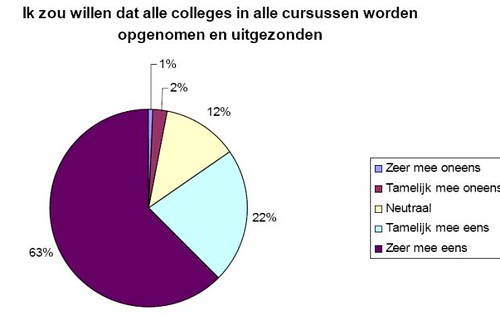
Their responses were extremely positive: recorded lectures were seen as a valuable addition to attending the lecture in person. Weblectures were viewed a lot, either just after the lecture, or as revision for the final exam.
You can find the surveys and all the responses from the students in this final report. We have also examined the use of Weblectures in education for parttime students; they were offered recordings of the lectures which were given to the students in full time enrollment. This proved to be a well received approach.
We used Apreso/Echo 360 in the year but also tested two other solutions: Mediasite and Presentations2Go. At the end of the report we give an overview over our findings and explain why we have chosen not to continue using Anystream Apreso/Echo 360.
Links:
- Project website
- The final report (in Dutch)
Sunday, May 11, 2008
Research into recording lectures for students with disabilities
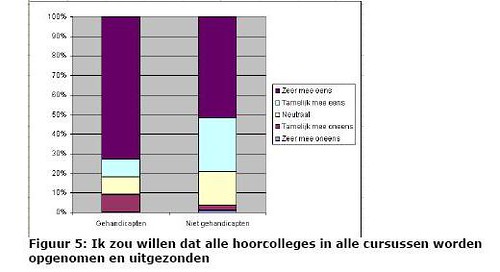
From September till November 2007 we recorded all the lectures in the first year Psychology course. One of the goals was to find out whether this facility would be valuable to the 23 students with disabilities taking this course (out of a total of 570 students). The disabilities were varied ranging between Dyslexia, Migraine, Hyperactivity or chronic fatige.
We collected data by conducting a written survey among all students and interviewing 15 of the students with a disability.
The results were very positive. All the students in the course were pleased with the facility. The students with disabilities could be split into two categories: the first was students having problem concentrating and taking notes during the lectures (e.g. Dyslexia, concentration disorder). They were very pleased to be able to watch the lectures again to write or improve their notes. The other category of students were students that weren't able to attend the lectures and could watch them at home in their own time. This also gave them the peace of mind that if they did have to miss a lecture due to their disability they could still watch what was discussed.
Follow these links for the summary and the full report (both in Dutch I am afraid).
Monday, January 14, 2008
Various solutions for recording lectures
As I have noticed there are a lot of people out there wanting to start recording lectures, but not quite sure where to start a few suggestions for tools for creating rich media presentations, Please note: these are presentations combining streaming video with html so the student can navigate through the presentation by choosing slides in the presentation.
Please note: this is a very personal view of a number of products. I cannot claim to be complete or completely informed. If anybody has any suggestions or corrections please do send a comment. This is based on the Dutch market for ICT in higher ed, in other countries there might well be other optoins.
A good place to start is Microsoft Producer: the software is free, most institutions will have a laptop and a digital video camera lying about. It is a very time consuming process but a great to get teachers and students to warm to the idea. You can even use the Surfnet Videotheek to stream the .wmv video produced.
If you intend to take the recording and broadcasting more seriously there are plenty of companies out on the market offering solutions. Expensive but very comprehensive is the Mediasite solution. Other solutions on offer are Apreso/Echo360, Accordent (no experience with it yet, should see a trial on Wednesday) Tegrity (no experience with that either) and Presentations2Go. Presentations2go is a Dutch product developed by Wageningen University, but now for sale. An interesting aspect of the presentations2go solution is the pricing model, the server software is expensive whereas the software for the recording sets is cheap. This encourages the use of more recording sets.
Googling about I ran into an Open Source solution for recording lectures. I have no idea how it works, but the pricing certainly is very competitive. It is called ePresence. If anybody has any experience using it I am certainly intrigued.
Please note: this is a very personal view of a number of products. I cannot claim to be complete or completely informed. If anybody has any suggestions or corrections please do send a comment. This is based on the Dutch market for ICT in higher ed, in other countries there might well be other optoins.
A good place to start is Microsoft Producer: the software is free, most institutions will have a laptop and a digital video camera lying about. It is a very time consuming process but a great to get teachers and students to warm to the idea. You can even use the Surfnet Videotheek to stream the .wmv video produced.
If you intend to take the recording and broadcasting more seriously there are plenty of companies out on the market offering solutions. Expensive but very comprehensive is the Mediasite solution. Other solutions on offer are Apreso/Echo360, Accordent (no experience with it yet, should see a trial on Wednesday) Tegrity (no experience with that either) and Presentations2Go. Presentations2go is a Dutch product developed by Wageningen University, but now for sale. An interesting aspect of the presentations2go solution is the pricing model, the server software is expensive whereas the software for the recording sets is cheap. This encourages the use of more recording sets.
Googling about I ran into an Open Source solution for recording lectures. I have no idea how it works, but the pricing certainly is very competitive. It is called ePresence. If anybody has any experience using it I am certainly intrigued.
Sunday, January 13, 2008
Recording lectures in 2008

In the year 2008 we intend to continue recording lectures at Utrecht University. The central IT policy department has offered funding to keep us going together with two faculties. This will keep the Weblectures project available. We have evaluated the experiences of students and teachers who used this facility. They were all very positive, most comments were about the reliability of the service: students get used to it and expect it work every time. If we wish to ensure a decent service which will work throughout the university a larger scale approach is required. Our main effort will be focussed on writing a plan to set up a structural service in 2009. We will be offering a final report on the Weblectures website.
On the technical side of things we will be not be using Apreso Classroom in 2008. We have decided to try out the mediasite mobile recorders in combination with the Mediasite EX server software through the Dutch reseller Mediamission. Apreso has proven to be a great solution to get us started and gain some experiences with the required hardware for recording lectures. The limitations which proved decisive for us where the lack of monitoring of the incoming signals, the fact that the hardware was not portable and the fact that editing is not possible at all. For a lot more money Mediasite does also offer some other facilities, e.g. live broadcasting. I will keep you posted on our experiences. We have already made our first recordings with the recording sets and are hard at work on getting the server up and running.
Friday, November 16, 2007
Weblectures in university magazine

A while back I was interviewed by the university magazine on the Weblectures project we are running here at Utrecht University. The article is now available in print and online. I was amused to see that the central debate: 'Will students still come to lectures?' was put on the poll. The results at this point in time can be found on the right. I find it quite noticeable that some students easily respond that they will no longer visit lectures, though once confronted with the facility they notice that visiting lectures is actually valuable and a recording does not replace attending the lecture live.
Friday, November 09, 2007
Twente has also been busy recording lectures
The University of Twente has also been recording lectures. They have written an article in the University Magazine. Again: the same findings. The most amusing comment (one I have also heard here in Utrecht in interviews with students) is the remark that this may mean that other students might not bother attending early lectures. Strangely enough I never manage to speak to these 'other' students ;-)
Wednesday, October 31, 2007
The HvA is also recording lectures...
And yet another article on the success of recording lectures. This is a report (in Dutch) of the findings at the Hogeschool van Amsterdam (Amsterdam Professional University). One thing that struck me is that in the fourth sentence organisational issues are classed before pedagogical issues. This for me does give the impression that the focus is changing on how recorded lectures are being regarded. They are being regarded as less of a pedagogical novelty and much more a facility which can be implemented a lot more broadly (as the TU Delft advertised lately).
Wednesday, May 09, 2007
Rights on recordings
I just found a webpage with some interesting answer to FAQs regarding rights for the recording of lecturers and the use of other fragments in your own recordings. It is a page in Dutch maintained by Surf DiReCt.
http://www.surffoundation.nl/smartsite.dws?id=13002
http://www.surffoundation.nl/smartsite.dws?id=13002
Monday, April 23, 2007
Internationalising our education - use of video
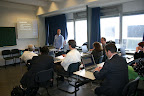
We had a seminar on Internationalising our education at Utrecht University last Thursday. It was great to see the efforts being made at the WUN (World Wide Universities Network) and Penn State. We still have a long way to go...
Together with Lex Hermans I gave a presentation on the use of video in distance education both for a-synchronous and synchronous learning. The slideshare is included below.
David Pilsbury also pointed out the Research channel, a collection of high quality videos covering some serious subject matter. This would require a tad more investment than the simple recordings we have being doing of late and would also require some serious commitment at all levels in the university. Great for your public relations though...
Together with Lex Hermans I gave a presentation on the use of video in distance education both for a-synchronous and synchronous learning. The slideshare is included below.
David Pilsbury also pointed out the Research channel, a collection of high quality videos covering some serious subject matter. This would require a tad more investment than the simple recordings we have being doing of late and would also require some serious commitment at all levels in the university. Great for your public relations though...
Sunday, April 15, 2007
Attending recorded lectures
An article on the Dutch Edusite pointed out that students still attend lectures when they are recorded, although the (notorious) law students do not always comply ;-)
Leidse student laat opgenomen college soms schieten
This is something we must give a try: we are going to record lectures and evaluate attendance anyway. We must see if under comparable circumstances law students show different behaviour to other students...
Leidse student laat opgenomen college soms schieten
This is something we must give a try: we are going to record lectures and evaluate attendance anyway. We must see if under comparable circumstances law students show different behaviour to other students...
Monday, January 22, 2007
Ruppert building, the aftermath
The Ruppert Building at Utrecht University was severly damaged during the s torm last Thursday. A building crane was blown over and wrecked a classroom and a number of offices. This means at least some classrooms will be unavailable for the time being. As a lot of teaching takes place in this building this means new locations have to be found at very short notice. I have a lot of respect for the people redoing the schedules at short notice.
There is an interesting repercussion: all of a sudden recording lectures could be a great asset in tackling the shortage of classrooms. A number of teachers have already approached with requests. We will have to see what is feasible at this short notice though, as we don't even have the recording sets up and running...
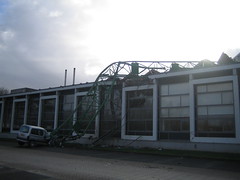 torm last Thursday. A building crane was blown over and wrecked a classroom and a number of offices. This means at least some classrooms will be unavailable for the time being. As a lot of teaching takes place in this building this means new locations have to be found at very short notice. I have a lot of respect for the people redoing the schedules at short notice.
There is an interesting repercussion: all of a sudden recording lectures could be a great asset in tackling the shortage of classrooms. A number of teachers have already approached with requests. We will have to see what is feasible at this short notice though, as we don't even have the recording sets up and running...
Subscribe to:
Posts (Atom)

 RSS feed for this blog

