On Tuesday the 11th of November (yes, rather a while ago), I gave a presentation on the Weblectures pilot which ran at Utrecht University in 2007. This was part of a more technically minded preconference on implementing Weblectures. The two more interesting slides in this presentation (compared to previous presentations) are our findings on criteria for a recording system. Reliability proved to be a key criteria for us. One criteria which was notably absent was price of the system. Of course this is of some importance, but we also found out that there were so many more costs involved that this cost was only a small part of the total cost. The other criteria proved to be much more important.
The other interesting slide is the slide regarding organisation. Setting up an organisation for Weblectures requires getting people involved from all corners and departments of your institution. The trick is not to create an unwieldy large consultation body but to keep all the varied partners involved...
Showing posts with label ict in higher education. Show all posts
Showing posts with label ict in higher education. Show all posts
Thursday, November 27, 2008


Friday, July 11, 2008
Utrecht University has chosen for Blackboard as VLE

It is now (sort of) official: Utrecht University has chosen to use Blackboard as its Virtual Learning Environment. Blackboard is already in use at a number of departments besides WebCT en BSCW.
The decision was prepared by a project group which was asked to compare (the shortlisted options) Sharepoint and Blackboard Next Generation. Important arguments in making a choice where: Blackboard offers all the required functionalities out-of-the-box, whereas using Sharepoint would require a lot of programming and customising. This would not only make it a very expensive option in the short term, but also requires upkeep and adaptations in the longer term. Sharepoint was also considered less suitable due to the steep learning curve for staff. This is related to the fact that it is not purpose-built for teaching and learning and does not fit in the 'classroom metafor'.
The decision is notable if you take into account that Utrecht University will be using Sharepoint for the public website, intranet and (in the future) teamspaces.
Sunday, June 22, 2008
Article in NRC on Weblectures
It is rather frustrating to write a blog entry on a newspaper article which is not freely available online, In this saturday's NRC (Education and Science supplement) there is an article on recording lectures. In this article you can find references to the Dutch 'entrepeneurs' in this field (TU Delft and Triple-L) and to the findings we published at Utrecht University.
Saturday, June 21, 2008
In Twente VLE team advises Blackboard
The quickscan report on Blackboard as a VLE for Twente university is now pulic and can be found at: http://www.utwente.nl/elo/. It is a very interesting report for the Dutch VLE watchers. After havng looked at Sakai and Sharepoint, both received a very critical quickscan. Neither were considered suitable as a VLE for Twente. And at the end of the process Blackboard popped up as an option, and very interestingly students had an important role in this decision. Based on this quickscan Blackboard has proven to be the best option as a VLE for Twente, though the decision will still have to be made by the university board.
Utrecht will be presenting its advice to the university board very soon, the question will be if they arrive at the same conclusion or advise reconstructing Sharepoint into a VLE....
Utrecht will be presenting its advice to the university board very soon, the question will be if they arrive at the same conclusion or advise reconstructing Sharepoint into a VLE....
Sunday, June 15, 2008
Presentation at Biology on Weblectures
Wednesday the 13th of June I was asked to give a presentation on Weblectures at the Biology department. Elly Langewis was kind enough to record the audio during the presentation. Using slideshare I have created a slidecast, you can find it embedded below.
I am very interested in the outcomes of the evaluations after the final exam of the Biology course that has been recorded. In this course both weblectures and audio podcasts were offered. I am very intrigued how students have used these two different solutions and which they preferred.
At the end of the presentation I was not surprised to find that the teachers present were apprehensive. In the past the worry they conveyed was that students would not come to lectures anymore. The evaluations in previous courses quickly dispelled that concern. They found an other worry in its place: Weblectures would prevent students from acquiring the academic skill of sitting still and taking notes in two sittings of three quarters of an hour. This argument was a little strange for me. In evaluations students have answered that they do not make less notes due to Weblectures. As one of the teachers stated: in the old days we had to concentrate for three quarters of an hour, let them learn to do the same... It felt as a slight fear of modern technology and its possibilities. Fortunately slides, overhead sheets, powerpoints and video have already been incorporated into lecture halls, so I do feel that the teachers will need to have the chance to adjust to this new technology and make it their own. A forceful approach does not feel in place in a setting like this one.
I am very interested in the outcomes of the evaluations after the final exam of the Biology course that has been recorded. In this course both weblectures and audio podcasts were offered. I am very intrigued how students have used these two different solutions and which they preferred.
At the end of the presentation I was not surprised to find that the teachers present were apprehensive. In the past the worry they conveyed was that students would not come to lectures anymore. The evaluations in previous courses quickly dispelled that concern. They found an other worry in its place: Weblectures would prevent students from acquiring the academic skill of sitting still and taking notes in two sittings of three quarters of an hour. This argument was a little strange for me. In evaluations students have answered that they do not make less notes due to Weblectures. As one of the teachers stated: in the old days we had to concentrate for three quarters of an hour, let them learn to do the same... It felt as a slight fear of modern technology and its possibilities. Fortunately slides, overhead sheets, powerpoints and video have already been incorporated into lecture halls, so I do feel that the teachers will need to have the chance to adjust to this new technology and make it their own. A forceful approach does not feel in place in a setting like this one.

Friday, June 06, 2008
One VLE: the preferences from Social Sciences

Here at Utrecht University we are in the process of deciding on one VLE for the university. I have been busy collecting opinions of teachers, students and supporting staff in the previous months. Our findings and some comments students made can be found here.
Some of the most surprising comments: they would rather have clear courses which are easy to navigate, teachers using the same headings for the same matters, don't mix personal with study related matters, the teacher is respected for his expertise: his/her contributions should be clearly distinguished from the contributions of fellow students...
Sunday, May 25, 2008
Presentation of Accordent recording solution

Thursday JNV and GoTelecom were kind enough to organise a presentation of various technical solutions interesting to those recording lectures.
To start with we had a presentation of the Accordent solution for the recording of lectures. It was a pleasant surprise in many respects. I was impressed by the options for recording and editing a presentation. It does work cross platform. Monitoring is possible, though slightly less central to the recording than in the Mediasite box. By the way don't be limited by the fact they offer it in a big box, you can also get a portable box. One aspect that didn't quite seem to satisfy our demands was the possibility to administer and organise large numbers of recordings. As we are already running three recording boxes at present, we must think ahead and make sure we can find all the presentations.
Besides looking at Accordent, we also came to have a look at a very different approach to recording lectures. Rather than equiping every hall with an (expensive)recording box, you could also choose to screw in a video conferencing set which supports the sending of content as a separate stream and an other set which supports the sending of content as a separate VGA signal (for example a Lifesize box). Of course the total is more expensive than just a recording box, but it offers more facilities: the lecture hall is also equiped for video conferencing and video-linking to a neighbouring lecture hall. It will also facilitate remote monitoring of the capture.
And in the line of automatic capture we had a look at the Vaddio system. This allows for camera tracking of the speaker, either using presets or using track and trace. I am looking forward to glueing our speakers' portable mikes to a small transmitter which the camera can trace (although there are many other solutions).
So perhaps some interesting links for all those people out there working on the recording of lectures. And perhaps interesting input for a Webstroom community ;-)
Sunday, May 18, 2008
Final report Weblectures - experiences of one year of recording
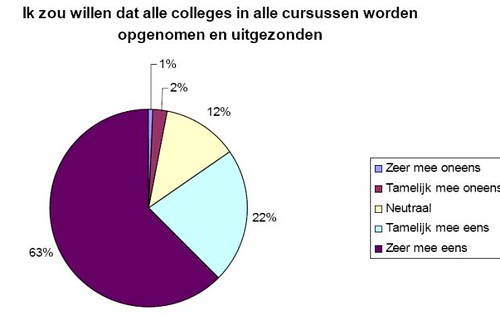
The final report is now out and public. In 2007, with funding from the central IT policy department we set out a pilot for the recording and broadcasting of lectures. When I say we, I mean a collaboration of Social Sciences and Arts, the audiovisual department in the centre of town with the audiovisual department at the Uithof campus.
In the course of one year we recorded approximately 250 hours of lectures. We surveyed students from a number of courses, amounting up to over 1400 students.
Their responses were extremely positive: recorded lectures were seen as a valuable addition to attending the lecture in person. Weblectures were viewed a lot, either just after the lecture, or as revision for the final exam.
You can find the surveys and all the responses from the students in this final report. We have also examined the use of Weblectures in education for parttime students; they were offered recordings of the lectures which were given to the students in full time enrollment. This proved to be a well received approach.
We used Apreso/Echo 360 in the year but also tested two other solutions: Mediasite and Presentations2Go. At the end of the report we give an overview over our findings and explain why we have chosen not to continue using Anystream Apreso/Echo 360.
Links:
- Project website
- The final report (in Dutch)
Wednesday, March 05, 2008
Innovatium,
Yesterday was my first visit to the Innovatium conference, here some very quick notes of my general impressions. The presentations came mainly from the field of professional universities in The Netherlands. The examples were often quite practical, some were more interesting for me than others. Again quite noticeable is the focus these institutions have on competences.
Sharepoint is a popular solution as a virtual learning (and working) environment. The professional universities are applying this system to address various problems (teamwork, sharing knowledge, presenting a curriculum portfolio which can serve for the accreditation of the courses, etc). Surfgroepen is regarded as a valuable tool because it is so open and can be opened up to external parties, whereas institution systems often have much more limited access. This for example will allow related companies to have access to a teamsite which plays a role in the learning process. A comment which reappeared in several sessions and in the hallways is the large amount of facilities on offer in sharepoint, this can lead to a confusing teamsite/workspace.
The last session I visited was given by Gijsbert Erkens from Educational studies at Utrecht University. Although I have helped him out in his course I never got round to really hearing what his intentions were in adding more and more learning ojects to his course module. The result is a large, varied and attractive collection of materials. Interestingly enough students appreciate the large collection of learning objects but they still have their primary attention directed at the summaries offered of the compulsory reading. He has also created snippets of the lecture recordings. These form an interesting application of this facility.
Sharepoint is a popular solution as a virtual learning (and working) environment. The professional universities are applying this system to address various problems (teamwork, sharing knowledge, presenting a curriculum portfolio which can serve for the accreditation of the courses, etc). Surfgroepen is regarded as a valuable tool because it is so open and can be opened up to external parties, whereas institution systems often have much more limited access. This for example will allow related companies to have access to a teamsite which plays a role in the learning process. A comment which reappeared in several sessions and in the hallways is the large amount of facilities on offer in sharepoint, this can lead to a confusing teamsite/workspace.
The last session I visited was given by Gijsbert Erkens from Educational studies at Utrecht University. Although I have helped him out in his course I never got round to really hearing what his intentions were in adding more and more learning ojects to his course module. The result is a large, varied and attractive collection of materials. Interestingly enough students appreciate the large collection of learning objects but they still have their primary attention directed at the summaries offered of the compulsory reading. He has also created snippets of the lecture recordings. These form an interesting application of this facility.
Wednesday, February 06, 2008
Oh dear, not more plaguerism...
Yesterday in a meeting of the directors of education at the faculty I heard a worrying complaint. We are trying to educate students in correct citation and not taking other's work and presenting this as you own. One of the aspects of this measure is the use of a tool to detect plaguerism. Sadly the complaint was uttered that too many cases of plaguerism where being detected and especially the follow up on each case was taking up time and resources. Nobody argued that we should stop checking for plaguerism, on the contrary. The sad fact is that students are still copying off the internet (without citing the source), and perhaps worse still: are entering other students' papers from previous years...
Monday, January 14, 2008
Various solutions for recording lectures
As I have noticed there are a lot of people out there wanting to start recording lectures, but not quite sure where to start a few suggestions for tools for creating rich media presentations, Please note: these are presentations combining streaming video with html so the student can navigate through the presentation by choosing slides in the presentation.
Please note: this is a very personal view of a number of products. I cannot claim to be complete or completely informed. If anybody has any suggestions or corrections please do send a comment. This is based on the Dutch market for ICT in higher ed, in other countries there might well be other optoins.
A good place to start is Microsoft Producer: the software is free, most institutions will have a laptop and a digital video camera lying about. It is a very time consuming process but a great to get teachers and students to warm to the idea. You can even use the Surfnet Videotheek to stream the .wmv video produced.
If you intend to take the recording and broadcasting more seriously there are plenty of companies out on the market offering solutions. Expensive but very comprehensive is the Mediasite solution. Other solutions on offer are Apreso/Echo360, Accordent (no experience with it yet, should see a trial on Wednesday) Tegrity (no experience with that either) and Presentations2Go. Presentations2go is a Dutch product developed by Wageningen University, but now for sale. An interesting aspect of the presentations2go solution is the pricing model, the server software is expensive whereas the software for the recording sets is cheap. This encourages the use of more recording sets.
Googling about I ran into an Open Source solution for recording lectures. I have no idea how it works, but the pricing certainly is very competitive. It is called ePresence. If anybody has any experience using it I am certainly intrigued.
Please note: this is a very personal view of a number of products. I cannot claim to be complete or completely informed. If anybody has any suggestions or corrections please do send a comment. This is based on the Dutch market for ICT in higher ed, in other countries there might well be other optoins.
A good place to start is Microsoft Producer: the software is free, most institutions will have a laptop and a digital video camera lying about. It is a very time consuming process but a great to get teachers and students to warm to the idea. You can even use the Surfnet Videotheek to stream the .wmv video produced.
If you intend to take the recording and broadcasting more seriously there are plenty of companies out on the market offering solutions. Expensive but very comprehensive is the Mediasite solution. Other solutions on offer are Apreso/Echo360, Accordent (no experience with it yet, should see a trial on Wednesday) Tegrity (no experience with that either) and Presentations2Go. Presentations2go is a Dutch product developed by Wageningen University, but now for sale. An interesting aspect of the presentations2go solution is the pricing model, the server software is expensive whereas the software for the recording sets is cheap. This encourages the use of more recording sets.
Googling about I ran into an Open Source solution for recording lectures. I have no idea how it works, but the pricing certainly is very competitive. It is called ePresence. If anybody has any experience using it I am certainly intrigued.
Sunday, January 13, 2008
Recording lectures in 2008

In the year 2008 we intend to continue recording lectures at Utrecht University. The central IT policy department has offered funding to keep us going together with two faculties. This will keep the Weblectures project available. We have evaluated the experiences of students and teachers who used this facility. They were all very positive, most comments were about the reliability of the service: students get used to it and expect it work every time. If we wish to ensure a decent service which will work throughout the university a larger scale approach is required. Our main effort will be focussed on writing a plan to set up a structural service in 2009. We will be offering a final report on the Weblectures website.
On the technical side of things we will be not be using Apreso Classroom in 2008. We have decided to try out the mediasite mobile recorders in combination with the Mediasite EX server software through the Dutch reseller Mediamission. Apreso has proven to be a great solution to get us started and gain some experiences with the required hardware for recording lectures. The limitations which proved decisive for us where the lack of monitoring of the incoming signals, the fact that the hardware was not portable and the fact that editing is not possible at all. For a lot more money Mediasite does also offer some other facilities, e.g. live broadcasting. I will keep you posted on our experiences. We have already made our first recordings with the recording sets and are hard at work on getting the server up and running.
Friday, December 14, 2007
General feelings on the Online Educa Conference in Berlin

I finally have found some time to get to cleaning up my blog and clearing up some old concepts I still had lying around.
To start off, some almost ancient history: My general feelings on the Online Educa conference. To start off, I was a little disappointed: I did not hear a lot of new things and I still feel the concept doesn't work: Four presentations in one session is a lousy concept. Usually 1 is worth while, 1 is a waste of time and two are usually not all that interesting or relevant. It was definitely worth while meeting up with the many Dutch at the conference. As so often I mainly gained inspiration through conversations rather than presentations.
And in an attempt to overlook a few developments and giving each their spot on Gartner's Hype Cycle:
- Podcasting is well and truly over its hype peak
- Web2.0 is here to stay, but it is over its hype peak
- Virtual worlds is running up to its hype peak
- Institutions are becoming more realistic about Services approach
- The general feeling regarding VLEs is 'agnostic'. Believing in one VLE is out of fashion
- Theories and technologies applicable to Informal Learning are still being applied to formal teaching situations (without judging whether they really work).
Wednesday, November 07, 2007
WebCT troubles caused by firewall issues
What's new... If there is one recurring issue in implementing ICT tools for education it does seem to be firewalls getting in the way. This seems to have been the case for the WebCT troubles at Utrecht University. This should now have been solved. You can read the article (in Dutch) in the university magazine.
Thursday, October 04, 2007
Which VLE for Utrecht?
The latest news scoop is that the advice for the next VLE at Utrecht should be appearing soon (by December). I have heard the buzz going round in The Netherlands that we are having serious problems. I am pleased to say this certainly does not concern Blackboard. We are running this on a local server and it is running extremely satisfactorily. As far as WebCT is concerned, all those interested can read the article in our university magazine.
For me this situation does raise a number of questions as to what is truly important in a tool for the support of teaching and learning. I have noticed that some are engrossed by visions of a myriad of pedagogical models and features. I would like to take a step back and concentrate on the basics: what teachers and students need is a system which is reliable and easy to use. I have heard arguments that all systems should answer to these basic requirements, but I have sadly seen many examples to the contrary. I also feel that the large majority of teaching staff are not looking for a system that will do absolutely everything, but rather a straightforward system that will let them do exactly what they want to do quickly and easily. If we are trying to look for an efficient use of ICT in higher education, this is a very basic place to start.
For now we are waiting on the advice...
For me this situation does raise a number of questions as to what is truly important in a tool for the support of teaching and learning. I have noticed that some are engrossed by visions of a myriad of pedagogical models and features. I would like to take a step back and concentrate on the basics: what teachers and students need is a system which is reliable and easy to use. I have heard arguments that all systems should answer to these basic requirements, but I have sadly seen many examples to the contrary. I also feel that the large majority of teaching staff are not looking for a system that will do absolutely everything, but rather a straightforward system that will let them do exactly what they want to do quickly and easily. If we are trying to look for an efficient use of ICT in higher education, this is a very basic place to start.
For now we are waiting on the advice...
Friday, June 01, 2007
Puzzling on for the Onderwijsdagen
I have been asked for the Programme Committee for the Onderwijsdagen. This is the large annual conference for ICT in higher education in The Netherlands, organised by SURF foundation. To give you an idea: this was last year's website: http://owd2006.surf.nl/owd2006/ This year the conference will be on the 13th and 14th of November.
I am filling in the tracks: Learning (learning theories in practice at the academic and professional universities in The Netherlands) and Social Software. I am not going to reveal our theme yet though ;-) I was just wondering if somebody has got some good suggestions we can incorporate in the programme...
I am filling in the tracks: Learning (learning theories in practice at the academic and professional universities in The Netherlands) and Social Software. I am not going to reveal our theme yet though ;-) I was just wondering if somebody has got some good suggestions we can incorporate in the programme...
Subscribe to:
Posts (Atom)

 RSS feed for this blog

