Showing posts with label ICTO. Show all posts

Thursday, September 27, 2007

A new year running Bb 7.2


It is about time I started keeping up my blog. The new year started almost a month ago and by now work is settling down a little. Fortunately everything went well. This summer we went through an upgrade of Blackboard from 6.3 to 7.2. This went really well. The interface is really the same for the teachers and students and we only ran into one problem: The course list was not editable above the first 25 courses. Thanks to a posting on Patrick Klaassen's blog, that was soon solved. Long live the community of Blackboard admins in the Netherlands.
We are also back on track recording lectures and training students in the use of portfolio's. Life as usual...

Wednesday, August 29, 2007

Second life lunch

This is a bit late, but I have been off on holiday and rather busy starting up the new year. So, better late than never, a report on a lunch session on Second Life: What is it and how could you use it in your teaching.... It took place at Utrecht University on the 12th of July.


For me the most interesting question raised was: How can you use Second Life in your education and what are the benefits. I did not really hear a satisfactory answer. I can imagine a virtual world being useful if you wish students to learn matter in which the 3D aspect is important (design, architecture, etc) and the freedom offered to create (impossible) structures.
The social aspect could be valuable but Second Life still appears to be more suited to 1 on 1, or 1 on few meetings. Teaching a large group requires keeping the group together. A humorous anecdote was the example in which a teacher kept walking off to a different place. Students which were not actively following the session would be left standing alone while the rest moved on. Second Life still is a little cumbersome at times and it is not always easy to find your way about.
Writing this I do realise that I am (intentionally) describing the use of a virtual world in teaching rather than learning. Learning is a process which can be a lot less structured, less dictated and will often be much more individual. This is something which could be done in Second Life.
A final remark concerns the number of users in Second Life. The Linden Labs company used to boast a large number (millions) of users in Second Life. In practice the number of regular visitors is a lot less. This only appears to be a few tenthousands, so it is not always as huge a buzz as it appeared to be at first.

Friday, July 13, 2007

In search of a new colleague

My direct colleague has just received a great job offer, so we are now looking for a new colleague at short notice. You can find the job description at: http://studion.fss.uu.nl/Organisatie/vacature_ondersteuner_studion.pdf. Please note: this is in Dutch as the applicant will also be expected to speak Dutch.

Thursday, July 05, 2007

Website Onderwijsdagen is now online


The website for the Onderwijsdagen is now online. The theme is the great tug of war between what is on offer and what really is demanded by teachers and students. There are great new pedagogical models out there describing whole new approaches to learning, but teachers and students are not always ready to adapt these new approaches and roles. And what is true of the beautiful vista's promised by using ict in your education? Is learning still not encouraged by a real life motivating teacher who is an inspiring subject matter expert? These are questions we want to address at this conference for ict in higher education in the Netherlands. We aim to match demand and what's on offer.

You can find the website at: http://owd2007.surf.nl/owd2007/ (only in Dutch I'm afraid).

World of Warcraft in a course


Every 8 weeks or so all the coordinators from the different departments at Utrecht University meet up and discuss the latest developments. Today we had Harald Warmelink on a visit (now just started a PhD in Delft). He was studying Multimedia before and attended a course which was taught in the massive multiplayer role playing game World of Warcraft. It was not only in WOW but also about WOW. Marinka Copier (the teacher) required the students to perform all sorts of tasks from simple to complex, from individual to group effort. The final assignment was to research an aspect of World of Warcraft. All the separate chapters have been added together to form a book, which can be found (hidden between other articles) at: http://sybil.nl/2007/content/category/4/19/27/

You can view Harald's presentation below:

Wednesday, May 09, 2007

Rights on recordings

I just found a webpage with some interesting answer to FAQs regarding rights for the recording of lecturers and the use of other fragments in your own recordings. It is a page in Dutch maintained by Surf DiReCt.
http://www.surffoundation.nl/smartsite.dws?id=13002

Friday, April 27, 2007

Article on the Next Generation VLE now definite


It is now finally official: My article on 'The New Generation VLE' has now been made public. This article is based on the findings at the Educause conference in Dallas Texas, last October. The main message is that there are the first beginnings of a new generation of VLE's. They can be characterised by the fact that they are no longer a 'walled garden' dominated by the teacher, but rather a more open environment in which students and teachers can work together with persons, materials and other webservices outside of the classroom or even institution. And of course the VLE can be approached through various devices and allows for modern delivery of media.


Various vendors and institutions are working towards this solution, but none of them are there yet. There are promising developments in the field of Open Source and commercial parties (Blackboard especially) and the adoption of a Service Oriented Architecture could also be very helpful in working towards an integrated VLE with all these functionalities.

The article can be found on the WIKI at: http://82.192.89.182/~wiki/index.php/Hoofdstuk_Nieuwe_generatie_ELWO


I am sorry to say that the article is only available in Dutch at present. I am afraid that I will not find time to translate it in the near future. If anybody does require an English translation, please let me know.

Monday, April 23, 2007

Internationalising our education - use of video


We had a seminar on Internationalising our education at Utrecht University last Thursday. It was great to see the efforts being made at the WUN (World Wide Universities Network) and Penn State. We still have a long way to go...

Together with Lex Hermans I gave a presentation on the use of video in distance education both for a-synchronous and synchronous learning. The slideshare is included below.


David Pilsbury also pointed out the Research channel, a collection of high quality videos covering some serious subject matter. This would require a tad more investment than the simple recordings we have being doing of late and would also require some serious commitment at all levels in the university. Great for your public relations though...

Sunday, April 15, 2007

Attending recorded lectures

An article on the Dutch Edusite pointed out that students still attend lectures when they are recorded, although the (notorious) law students do not always comply ;-)

Leidse student laat opgenomen college soms schieten

This is something we must give a try: we are going to record lectures and evaluate attendance anyway. We must see if under comparable circumstances law students show different behaviour to other students...

Friday, April 06, 2007

Sakai SIG meeting, Oracle gives its views


Last Wednesday the 4th of April we had a meeting of the SAKAI Special interest group at SURF in Utrecht. I couldn't attend the whole meeting but I was glad I could at least listen to the presentation given by Peter Bavinck of Oracle. He gave Oracle's plans on their Academic Enterprise Initiative. This is (my interpretation) an iniative to create a SOA framework which will cooperate with the Sakai framework and which can easily exchange information (for example from the Peoplesoft SIS).

See the blog and website.


Sometimes the smallest titbits of information can be extremely useful. I had been mucking about with the portfolio in Sakai but was stumped by the request for .xsd schema's. In the meeting someone tipped the xsd weaver. It seems brilliant, create your own forms online, save them locally and then add them to Sakai. (I haven't tried the last step out yet, but the rest works!).

The Hogeschool Utrecht is looking for a replacement for their Cascade system. Taking a quick look at their design I was surprised to see that they had not yet looked into LAMS, as they are looking for a system to deliver case based learning through a series of learning activities. And this can be integrated into all sorts of VLEs (not just Sakai ;-)

Monday, March 12, 2007

8 days a week, ironing is a chore

Last Thursday was the annual symposium organised by IVLOS at Utrecht University. The theme was 8 days a week, how students and staff can manage to do learning and teaching in the amount of time that seems available for this task. I am pleased to see that the IVLOS has picked up on this (see article by Robert Jan Simons on Edusite). As far as students are concerned the picture is pretty obvious: Students in the Netherlands are trying to combine studying (approximately a meagre 20 hours a week) with all sorts of jobs to add to their grant and support their lifestyle.

Inez Groen gave a presentation (again) on the Einstein Generation. The story did not contain much new information, but it was interesting to hear it again and to add it unto experiences I had gained lately. One interesting aspect was the attitude the new generation of students has regarding university. University is now commonly called school. Spoilt as they are with all the wealth they have been surrounded with they are used to having many choices available. They will choose the easy choice, they expect to be involved and engrossed in the study they have chosen for. (Please note: this does not necessarily mean they are lazy!) They expect good teaching. The teacher should certainly be a subject matter expert, otherwise they might as well spend their time on the internet where you can find almost anything.

And IT is extremely boring, it is a tool not unlike an iron. You plug it in and it works. This does not mean you should not use IT, it means you should only use it if it makes sense, IT for IT's sake is only fascinating for digital immigrants, duh!

Staff on the other hand are suffering from the demand for a more involved style of teaching. In many cases this has been translated into giving the students many more assignments. Sadly this means teachers have an awful lot more checking of papers to get through. There was a session specially directed at this problem which I certainly enjoyed. What about letting students doing the teaching in turn. They are the ones that are setting up the presentation, organising excersises and getting the students involved. It seemed to work really well. It brought back happy memories from a class I attended using the same formula. It was definitely the most interesting and involving module I followed during my masters'.

Monday, February 12, 2007

Swedes on a visit


Last Thursday we had a group of Swedes on a visit to Utrecht University. They were on a trip from the NSHU. Renée Filius and I organised a round table and we discussed a number of propositions on ict in education. We did not disagree on many points though. One major difference between Sweden and the Netherlands appears to be their experience in distance learning. Another difference is their focus on getting everybody involved in education. This is something which has received a lot less attention in the Netherlands of late, though I hope the new government will focus more funding on this. So not just life long learning, but learning for everybody.


After the round table we listened to some comparisons on student participation in decision making and forming the curriculum in higher ed. I was very impressed by the amount of attention that is directed at this.

Apreso recording set in use


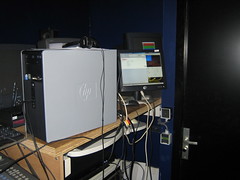
This is a photo of the Apreso recording set in use. It is hidden away in the booth behind the Theatron lecture hall (the largest lecture hall we have seating 500 students). It has already been put to good use as in its maiden week of recording. It has already recorded six! lectures.
The audio visual staff are very happy with its ease of use. Recording is very straight forward.

We have not got round to publishing yet, but this has nothing to do with the Apreso set up, but is simply related to local firewall settings...

We are already thinking ahead as we are getting a number of requests for recordings. What can we record and what can't we manage? What are the priorities? How can we turn this temporary set up into something more portable if we are going to have to lug it around?

Monday, February 05, 2007

A pictorial representation of the Next generation VLE


So following up on my last post: what should the next generation VLE look like?

To give you a clue I have added a pictorial representation of the next generation VLE.

In my opinion it should offer engaging visual content and interaction on matters which interest the net-generation student (for example climate change). It should allow networks to be formed between students, teachers, but also outsiders e.g. professionals, experts and students from around the world. It should be open ended and allow interaction with all sorts of tools like blogs, image and video repositories, social bookmarking (hence the tagcloud) , blogs, (lifelong) portfolios and profile sites and many, many more. These tools can be incorporated using webservices (and RSS feeds are included as an example). All this should be delivered not only on a computer but on all sorts of mobile devices...

If you feel I have left anything out please let me know!

A pictorial representation of an old generation VLE


When writing my chapter on the next generation VLE I felt the need to collect all the information I had amassed into an image/schema. This is the first image I built:


It is a pictorial representation of the older generation VLE. This is a stereotype, in fact most VLE's are already much more modern than this representation would suggest.They are strongly text based. The teacher controls what happens in the VLE, interaction is mainly the teacher telling the students what to do, there is no room for interaction between students unless the teacher decides it might be necessary. The VLE is a closed environment and offers no real interaction with the outside world. Simply getting a guest lecturer into the system is quite a job...
And all this is built to be delivered on a computer, and nothing else....

Monday, January 22, 2007

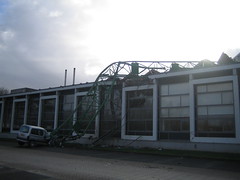
Ruppert building, the aftermath

The Ruppert Building at Utrecht University was severly damaged during the storm last Thursday. A building crane was blown over and wrecked a classroom and a number of offices. This means at least some classrooms will be unavailable for the time being. As a lot of teaching takes place in this building this means new locations have to be found at very short notice. I have a lot of respect for the people redoing the schedules at short notice.

There is an interesting repercussion: all of a sudden recording lectures could be a great asset in tackling the shortage of classrooms. A number of teachers have already approached with requests. We will have to see what is feasible at this short notice though, as we don't even have the recording sets up and running...

Wednesday, January 17, 2007

Training teachers

In the Blackboard meeting we also discussed the training of teachers using Blackboard (although the findings were not strictly related to Blacboard. Willibrord Huisman gave a good presentation

on their experiences in training teachers. A number of things were quite recognizable and also worth repeating here.
  • Just putting stuff on the web doesn' t work (naturally ;-)
  • When a teacher comes with a question it is normally in the middle of a course and not in the design stage. This means that is not really worth pointing out the fact they should have thought of it earlier. You can better find some sort of solution to help them out.
  • What is the primary background a teacher will use when starting to teach? Their own experiences as a student! This is rather like raising children. How you raise your children will always be based on your own upbringing, in one way or the other. This does pose the question how long it will take for the new teachers to adopt a new pedagogy for a new generation of students...
  • Is there such a thing as Digital Pedagogy? In practice this is usually a phrase that is coined from later going backwards. From use in practice looking back on the design process. This was his opinion at least. I think he may be right in practice. I personally do not believe in a digital pedagogy even if you work in the correct order. It is very important to take digital opportunities into account when designing your course, but in the end it is humans taking your course with their specific learning styles. I argue that this even holds true if you are designing a course for the net-generation. Of course they will learn differently and be able to use digital tools much more effectively in their learning.
  • Willibrord had made some very entertaining fact sheets and as a visual learning I was very charmed by the drawings. The drawing pictured here is describing the use of a discussion board as depating tool. I can advise you to have a look at the fact sheet (it is in Dutch).

Sunday, January 14, 2007

It's learning seminar


Last Thursday I attended a seminar on the norwegian VLE It's learning. All in all it was not extremely exciting. The most inspiring part was the talk by Wim Veen on the net-generation students. I hadn't heard one of his talks for a while and it was interesting to see that his homo zappiens had been incorporated into a lot more developments (for example the net-generation students). The ideas set out by a number of trend watchers are coming together. He also incorporated ideas on networked learning and the gift economy. Although some of the concepts sound idealistic, it does give the feeling that society and therefore learners are changing. Strangely enough learners are becoming more social and Dutch higher ed is becoming more competitive.

It's learning seems interesting as a VLE, but I do not know a lot about it. I must give it a try so at least if a say something about it, it will be grounded in truth ;-) My colleague Jos Jaspers is planning to give it a try, so I will definitely hear him out.
I was intrigued by the fact they are offering it's learning through the mobile phone. They are also incorporating a blog facility. Social Software is entering the VLE domain :-)

The presentations on It's learning were not all that exciting, it does appear to be a VLE like many others, although the incorporation of a portfolio in the system is certainly a bonus for the Dutch market. I missed the final demonstration of a link with Sharepoint which is an interesting facility a large number of Dutch institutions will be looking for with their respective VLE's.
One thing I did find very noticeable was the hosting model they offer. In principle they advise you to use their hosting. I can imagine this to be a good idea. At least this saves you a lot of hassle and you are always up to date and patched. Of course there are also disadvantages (stuck to their code, dependant on connections, data is elsewhere). I must note that you can also run a local installation if that is what you prefer.

Tuesday, January 02, 2007

Recording Lectures at Utrecht University


The last weeks before Christmas were an exciting time. I was busy writing an application for funding for a pilot for the recording of lectures at Utrecht University. And I can now announce the good news: The application has been accepted and we can now start up the project. We have chosen the following approach:


  • Utrecht University has lectures at two locations: the town centre and the out of town campus. Two recording sets will be available: one for each location.

  • Only one playback set will be set up. This may seem obvious to some, but others that know Utrecht University will understand the significance of this fact.

  • This is a pilot for one year. This will give us the chance to gain some more experience not only with the software, but more importantly on the effects this has on learning and teaching.

  • We have chosen to try out the Apreso Classroom solution for a year. We are very intrigued how it will work out. It appears to be a fairly straightforward solution with good connections to both Blackboard and WebCT.

For all those interested in our findings: it will be a while before we have a set up and running, so please bear with us...

Monday, December 04, 2006

Sakai at Educause 2006

It was quite amusing to read Chuck Severance's description of where Sakai stood at the past Educause. I have been writing a chapter on the next generation VLE at Educause and came to the same conclusion. I must quote him :-)
It is no longer the cool product, it should now be a serious product which can compete with commercial products...