Monday, January 22, 2007

Ruppert building, the aftermath

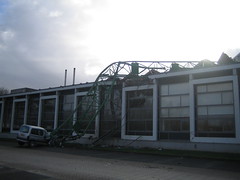
The Ruppert Building at Utrecht University was severly damaged during the storm last Thursday. A building crane was blown over and wrecked a classroom and a number of offices. This means at least some classrooms will be unavailable for the time being. As a lot of teaching takes place in this building this means new locations have to be found at very short notice. I have a lot of respect for the people redoing the schedules at short notice.

There is an interesting repercussion: all of a sudden recording lectures could be a great asset in tackling the shortage of classrooms. A number of teachers have already approached with requests. We will have to see what is feasible at this short notice though, as we don't even have the recording sets up and running...

Wednesday, January 17, 2007

Two starting periods at universities

An interesting item was in the Dutch papers. They are running the first experiments allowing students to also take their final exams in January rather than only in May as is the case at present. It seems like a great idea for the students in their final year at secondary school as they can pace their learning better.
On the other hand it does set a challenge for Dutch higher ed in the long run. This means perhaps offering some or all Bachelor modules twice annually. This is going to tax the teaching staff and the organisation further. It may on the other hand also imply a greater demand for reusing learning materials and teaching activities. Of course you can also be snobby and decide you are such a popular course that you will only offer your course once annually. Students will simply wait and gain some real life experience before starting your course.

Training teachers

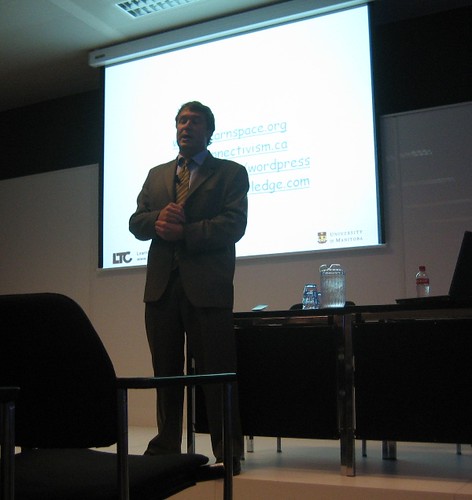
In the Blackboard meeting we also discussed the training of teachers using Blackboard (although the findings were not strictly related to Blacboard. Willibrord Huisman gave a good presentation

on their experiences in training teachers. A number of things were quite recognizable and also worth repeating here.
  • Just putting stuff on the web doesn' t work (naturally ;-)
  • When a teacher comes with a question it is normally in the middle of a course and not in the design stage. This means that is not really worth pointing out the fact they should have thought of it earlier. You can better find some sort of solution to help them out.
  • What is the primary background a teacher will use when starting to teach? Their own experiences as a student! This is rather like raising children. How you raise your children will always be based on your own upbringing, in one way or the other. This does pose the question how long it will take for the new teachers to adopt a new pedagogy for a new generation of students...
  • Is there such a thing as Digital Pedagogy? In practice this is usually a phrase that is coined from later going backwards. From use in practice looking back on the design process. This was his opinion at least. I think he may be right in practice. I personally do not believe in a digital pedagogy even if you work in the correct order. It is very important to take digital opportunities into account when designing your course, but in the end it is humans taking your course with their specific learning styles. I argue that this even holds true if you are designing a course for the net-generation. Of course they will learn differently and be able to use digital tools much more effectively in their learning.
  • Willibrord had made some very entertaining fact sheets and as a visual learning I was very charmed by the drawings. The drawing pictured here is describing the use of a discussion board as depating tool. I can advise you to have a look at the fact sheet (it is in Dutch).

Using Blackboard - let's manual together..

Yesterday there was a meeting of the Dutch Blackboard usergroup. Are large number of institutions are preparing on the switch to Bb 7.x. Everybody is wondering how much work it will be to rewrite all their manuals. An initiative has been started to share manuals. Although everybody does have their own procedures (especially login) and their own mix of building blocks, there is a lot of material which should be easy to exchange. I wonder how this will work in practice.

Sunday, January 14, 2007

It's learning seminar


Last Thursday I attended a seminar on the norwegian VLE It's learning. All in all it was not extremely exciting. The most inspiring part was the talk by Wim Veen on the net-generation students. I hadn't heard one of his talks for a while and it was interesting to see that his homo zappiens had been incorporated into a lot more developments (for example the net-generation students). The ideas set out by a number of trend watchers are coming together. He also incorporated ideas on networked learning and the gift economy. Although some of the concepts sound idealistic, it does give the feeling that society and therefore learners are changing. Strangely enough learners are becoming more social and Dutch higher ed is becoming more competitive.

It's learning seems interesting as a VLE, but I do not know a lot about it. I must give it a try so at least if a say something about it, it will be grounded in truth ;-) My colleague Jos Jaspers is planning to give it a try, so I will definitely hear him out.
I was intrigued by the fact they are offering it's learning through the mobile phone. They are also incorporating a blog facility. Social Software is entering the VLE domain :-)

The presentations on It's learning were not all that exciting, it does appear to be a VLE like many others, although the incorporation of a portfolio in the system is certainly a bonus for the Dutch market. I missed the final demonstration of a link with Sharepoint which is an interesting facility a large number of Dutch institutions will be looking for with their respective VLE's.
One thing I did find very noticeable was the hosting model they offer. In principle they advise you to use their hosting. I can imagine this to be a good idea. At least this saves you a lot of hassle and you are always up to date and patched. Of course there are also disadvantages (stuck to their code, dependant on connections, data is elsewhere). I must note that you can also run a local installation if that is what you prefer.
Tuesday, January 02, 2007

I've been tagged


Wilfred Rubens has been kind enough to tag me... This means I will now write five things that would otherwise not appear on my blog and continue the by tagging five other bloggers. OK, so here we go...

  1. When I was young I used to play Judo, but it wasn't quite my sport. I was more of a defensive player than the aggressive kind, it took me rugby to discover the charm of offensive action.


  2. At secondary school I also took an exam in music. One part of the exam was performing various pieces of music on stage. Not long ago I ran into a really old photo on the web... You can find it here.


  3. I spent a number of summers picking tomatoes as a job, it was fun but dirty work. Up tot this day, I still prefer buying tomatoes without a stalk, because then I won't be confronted with the pugnant smell.


  4. I do not really have a social science background, it is just that I did not want to limit myself to hard science alone. However I did seriously enjoy the minor Physical Geography I took during my studies, and it came to great use on a field trip to Scotland with a bunch a students.


  5. The latest album I got for Christmas is an old classic: Goo by Sonic Youth, I have played it a lot (when the kids weren't around) and it brings back happy memories.

So, that actually was not that easy. I noticed that I share a lot on my blog so most information can be found there after all.

This tagging is an interesting project and seems a celebration of the TIME award given to all bloggers and other web users that contribute rather than just consume on the web.

Just a note on the side: The starters of this project are claiming they want to follow the progress of a meme, a unit of cultural entity. I just looked up Meme in Wikipedia and I am not quite sure if the project itself really is a Meme. It is certainly not an entity in itself, and blogging is merely a tool available to replicate a Meme. So what is a Meme? One example that springs to my mind are the lonely girl videos on YouTube. They really have gone round and are now receiving responses and satirical reactions...

So now it is time to select a number of bloggers to continue this project. I will now invite:

Gerard Dummer, Moqub, Patrick Klaassen, and Willem van Valkenburg

Good luck...

Recording Lectures at Utrecht University


The last weeks before Christmas were an exciting time. I was busy writing an application for funding for a pilot for the recording of lectures at Utrecht University. And I can now announce the good news: The application has been accepted and we can now start up the project. We have chosen the following approach:


  • Utrecht University has lectures at two locations: the town centre and the out of town campus. Two recording sets will be available: one for each location.

  • Only one playback set will be set up. This may seem obvious to some, but others that know Utrecht University will understand the significance of this fact.

  • This is a pilot for one year. This will give us the chance to gain some more experience not only with the software, but more importantly on the effects this has on learning and teaching.

  • We have chosen to try out the Apreso Classroom solution for a year. We are very intrigued how it will work out. It appears to be a fairly straightforward solution with good connections to both Blackboard and WebCT.

For all those interested in our findings: it will be a while before we have a set up and running, so please bear with us...

Starting the new year in cold style

After a very busy year at work, I decided it was time for personal matters and what better time to start, than on New Year's day. So we drove down to 's-Gravenzande and joined the 'Nieuwjaarsduik' (New Year's dive) which was organised there. It was great fun and a great way to kick start your body into the new year. Actually the waiting was colder than the dive itself.
I must give thanks to the organising committee. It was organised well and it was not too busy, so it was also safe and enjoyable for the kids :-)
For more photographs visit: http://www.frisseduik.nl/

Wednesday, December 13, 2006

Attending a lecture even though it is recorded

I just ran into a brilliant ditty on some of the surpising consequences of recording and broadcasting lectures. Do have a look at:
http://h20325.www2.hp.com/blogs/highered/archive/2006/10/20/1769.html

The comment was placed by somebody who remains nameless but I simply must quote it here:

One of the funny uses of the video: one student, whenever he fell asleep and woke up in the middle of the class, he wrote down the time so that (apparently), when the video came out, he can index into the video to know when he woke up and when he was sleeping!

But seriously: the rest of the article does point at a number of aspects which appear regularly in articles on recorded lectures: attendance does not drop significantly, students behaviour during the lecture is different, students find it great if they cannot attend a lecture. In fact today at Eindhoven (see my previous posting) Michiel mentioned that the dropping out of a series of lectures appeared to lessen as students could cover a lecture they had missed, rather than giving up on the series entirely. This might be an interesting aspect for more complex subjects (e.g. statistics) in which for some students missing one lecture, means missing the whole jist of the subject. Please note: this is conjecture, but worth an examination none the less.

Recording lectures on a larger scale


Today we (a number of people from Utrecht University, Amsterdam and Maastricht) visited the Eindhoven University of Technology to see their approach for recording lectures. It was a very valuable and interesting talk. Many thanks to Michiel Schok for giving us some of his scarce time.

There were a number of interesting lessons I recognised from the approach in Eindhoven:
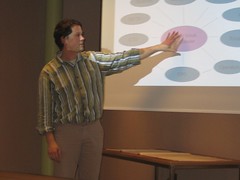
  • There are a lot of different parties that need to be involved (just have a look at the slide Michiel is showing off here ;-)
  • In Eindhoven they have chosen to go for a broad approach: they are managing to capture 50 hours of lectures every week using three capture sets. Respect!
  • Try to work with fixed sets, this saves a lot of hassle and allows for easier recording. This does mean you have to take the assigning of specific lecture halls into account.
  • A discussion arose regarding the pedagogical implications of recording and broadcasting lectures. Interestingly the main arguments for the present use of recording lectures at Eindhoven is to allow the current student to review their lecture, view a missed lecture and to get new groups to be able to view lectures they were otherwise unable to attend.
    The discussion arose whether this was a bad thing. Personally I do not believe this to be a bad approach at all. This does in fact mimic the adoption pattern of VLE's over the past years. New technology is being used as an extra facility to enhance learning and few teachers are using this as a substitute to a lecture itself, yet.
    I believe that teachers need the chance to get used to this new technology with all the advantages (and disadvantages) it has to offer. There are bound to be a few early adopters who will pick up on the possibilities and innovation will grow from there on. For a widespread innovative use of this technology I believe the use will first have to become 'economical' for the teacher. In this calculation I would include cost (hours invested by the teacher) versus output (learning outcomes and time saved).
    So for now I would strive for a broad adoption at a basic level. If I see the enthousiasm with which students are responding in Eindhoven (and to our small scale pilot) it definitely makes it worth while.
  • Eindhoven is using the Mediasite hardware and software. As I had already learned from earlier quotes, this is by no means a cheap solution. However, the manual operation of the recording sets is also an expensive part of the financial picture. This encourages me further to work towards an operator free recording of lectures. Only in that manner can you manage to cost effectively record a lot of lectures. The quality of the camera work will be less, but you can also offer customers the option of paying more for a lecture which has been recorded by an operator.
  • I was wondering how important the features Live Streaming and Editing where. I was interested to hear that these were not being used much at all in Eindhoven.

So all in all a very interesting visit. Many thanks again to Michiel.

Monday, December 04, 2006

Sakai at Educause 2006

It was quite amusing to read Chuck Severance's description of where Sakai stood at the past Educause. I have been writing a chapter on the next generation VLE at Educause and came to the same conclusion. I must quote him :-)
It is no longer the cool product, it should now be a serious product which can compete with commercial products...

Attack on the Bb patent....

I just was catching up on some blogs when I saw a posting on the Dutch Sakai blog. Sakai has announced it will be filing for a reexamination of all 44 claims in the Blackboard patent. They are filing this together with Moodle and Atutor. This is a very interesting development. They are obviously not going to wait or trust Blackboard (who claimed they were not planning to charge Open Source products...)

Recording a lecture - a pilot

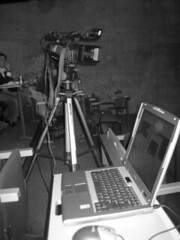
This is the set up we used last week for recording a lecture for a Bachelor Module on Child Care (Pedagogiek). I was extremely lucky to be able to use such a good quality camera with a good lens, as it makes all the difference to the video quality. I was mucking about with Microsoft Producer, but it is very limited (free though :-). It does take a lot of time on preparation, actual recording and production. We are definitely going to look for a less time consuming solution for structural use.

I will not show you an example yet, because I have promised the lecturer I would not flout it about. I do think that is a shame, not only because the recording (certainly the second hour) is quite good, but also because her lecture was very good.
Things brings up one of the many questions which arise from recording and broadcasting lectures. How freely do you want to share the materials? I am not going to push this point just yet, because it is extremely clear that the teachers I am talking to will first need to get used to seeing themself played back on video and more importantly: see how students respond and see what this does to their learning behaviour....
To be continued...

How about scaling up the interface

I just was sent this link which shows the creative use of a touchscreen. For one thing it is very creative and pretty. But it also set me thinking. Why on earth are we fiddling around with a silly little mouse getting RSI? Is it not much more natural to be able to manipulate your desktop using larger motions? Of course you don't want a computer this size everywhere, but this being at my desk would not seem such a silly idea at all.
PS: I just read that the operating system and programmes wouldn't be on the computer itself but on a datastick. That of course already exists and makes perfect sense. Finally all my programmes with me, everywhere....

Thursday, November 23, 2006

How about an aggregated blog for conference reporting?

At the last onderwijsdagen a number of bloggers published together on a group blog. This does mean you have to write a separate story for the group blog and for your own blog...

How about creating a blog that consists of contributions of different bloggers on one subject (defined by a tag). This means that at a conference everybody can happily blog their own blog, but the common postings can be presented on a single blog (and of course you can subscribe to the feed). The articles can be read on this blog, or you can refer to the contributors blog the posting came from. This would require a moderator for the blog who does the mashups on the side and who defines which rss feeds will be searched for the relevant tag. You could also leave this open and let anybody add their blog to the list,

Of course there are a number of variations to this that already exist. Is see that Wordpress has a similar function but this does not (yet) appear to select on tag..
See http://www.ozpolitics.info/blog/?p=87

And you can create your own aggregated feed
http://blog.unto.net/miscellaneous/aggregated-blog-and-news-feeds/

Or what about all sorts of group blogs:
http://www.masternewmedia.org/news/2005/05/16/group_and_multiuser_blog_platforms.htm

Wednesday, November 15, 2006

International Cooperation in the exchange of knowledge

It was very interesting to hear the plans of the Knowledge exchange. Pierre Gorrissen has actually recorded this session so I do not really have to repeat the contents (sadly I can't find the recording on the web. In short the project is now 1 year on and two to go. It is a collaboration of a number of national organisations which each are slightly differently organised: JISC (UK), SURF (NL), DFG (Germany), DEFF (Denmark). They are focussing on the exchange of knowledge in various fields. Two I was especially interested in were repositories (research and learning objects). Driver is a programme directed at connecting the repositories between these countries.
I was also very pleased to hear they are looking at the E-framework and I was especially pleased that there has been interest from the US on this topic as Educause is also joining these talks. If they are trying to set up standards for the exchange of services it is vital that the home country of some of the largest companies for e-learning products is getting involved. It is good to see that the US is not turning a blind eye but sees the need to think in terms of the linking up of services.

Presentation on the use of a Blog and Wiki at a conference

Together with Eja Kliphuis and Gerard Dümmer I gave a presentation at the ' Onderwijsdagen' on our experiences of using a Blog and a Wiki during our visit to the Educause conference last October. You can find Gerards presentation here. You will notice my slides are missing. The most important findings were that it was a big success. This is certainly also due to the excellent wireless connections which were available during the conference.
As a number of people in the Dutch delegation were not used to writing together in a Wiki we decided on a less revolutionary approach. Nobody edited each other's postings, but added these under the postings which were already available. To give you an idea what this looks like visit an example of a posting.

All in all it was a very well attended session and it was great fun to actually give a presentation myself at the Onderwijsdagen.

Onderwijsdagen 2006


I have just spent two days at the Dutch days for ICT in higher education. It was great fun to be back and see a number of interesting sessions. There was a whole track dedicated to the net-generation learner and in several key notes the notion kept turning up. It was very inspiring to hear Diana Oblinger speak again.
George Siemens is said to have given a great preconference on connective learning. I visited his session later in the conference and it was very quick but clear. It is an interesting concept, although perhaps not as new as one would think at first. It contains many aspects already incorporated in principles like networked learning, Communities of Practice and Social learning theories.
I think I find the most interesting shift the idea that Knowledge is in the network and not in the mind. I suppose that depends on what your definition of knowledge is. Personally I believe that information is not knowledge, knowledge is internalized information. Simply being surrounded by knowledge does not make yourself knowledgeable. Skills are required to attain knowledge and knowledge builds on earlier knowledge.
Implications of his theory are that it is important to know where you can find information and value information. Students must be trained to achieve a place in several networks (multidisciplinary) and be trained to quickly select and filter and apply information and turn this into knowledge. This is where concepts of power do come back although the criteria of what makes a powerful person are different. Try to become an important node in the network. You can achieve a prominent place by being the first to enter information into the network or by being a bridge and carrying information across boundaries.

My old blogs

I have just cleared up my old blogs and moved them. For anybody that is interested: they can now be found at:

This will now be the blog to follow....

Monday, November 13, 2006

Embedding a very charming You Tube video

A great little video I found on YouTube. I suppose it is more of an experiment than anything else, but it is definitely worth watching...