Today Emmanuel Clemot, a Solutions Engineer from Blackboard came to Utrecht University to show off their plans for the Blackboard 9 - Next Generation product. We even got a prototype to look at, a short video will be available on the Blackboard website soon.
A few things that struck me:
Process
- First common APIs so both products can start using intermediate tools (community, content, portfolio and outcomes system).
- Then moving features into Blackboard 8 (is already out)
- And finally building a new shell to access either Vista, Learning system or one of the other tools mentioned above...
That really means as an institution you can choose to keep the old VLEs up and running and migrate gradually. I am not quite sure I would want to, but it is possible.
Look and Feel
Slightly more confusing than Blackboard, but not a lot. Teachers will be quite happy, they will recognise the system. The drag and drop looks good, the contextual menus are alright but they do hide options until teachers find them. Fortunately NO annoying Java Applets (they have learnt their lesson).
I had a big laugh about the WebCT view and the Blackboard classic view feature.
Features
What I like (some of its already in Bb 8) is social bookmarking (Scholar) continued, the facebook connection (though for Holland it is only a start), wikis and blog in the code, add a number of mashups, social learning space in community system, personisable pages, course homepage with more than only announcements (should Sakai or some other VLE sue them? ;-).
They claim Content System allows for student collaboration with versioning and comments. We do not use it at present and it made me rather curious.
All in all a good presentation and an interesting option for Utrecht University, certainly because it allows teachers a careful transition.
Monday, May 19, 2008


Sunday, May 18, 2008
Final report Weblectures - experiences of one year of recording
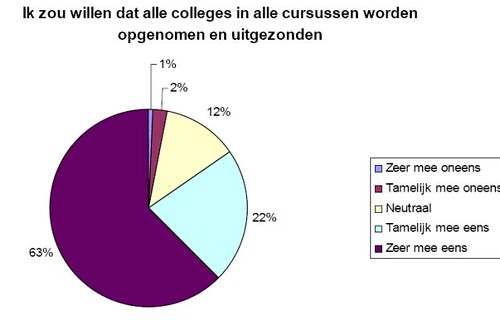
The final report is now out and public. In 2007, with funding from the central IT policy department we set out a pilot for the recording and broadcasting of lectures. When I say we, I mean a collaboration of Social Sciences and Arts, the audiovisual department in the centre of town with the audiovisual department at the Uithof campus.
In the course of one year we recorded approximately 250 hours of lectures. We surveyed students from a number of courses, amounting up to over 1400 students.
Their responses were extremely positive: recorded lectures were seen as a valuable addition to attending the lecture in person. Weblectures were viewed a lot, either just after the lecture, or as revision for the final exam.
You can find the surveys and all the responses from the students in this final report. We have also examined the use of Weblectures in education for parttime students; they were offered recordings of the lectures which were given to the students in full time enrollment. This proved to be a well received approach.
We used Apreso/Echo 360 in the year but also tested two other solutions: Mediasite and Presentations2Go. At the end of the report we give an overview over our findings and explain why we have chosen not to continue using Anystream Apreso/Echo 360.
Links:
- Project website
- The final report (in Dutch)
Back from the Ardeche

As most readers wil have noticed, it has been very, very quiet on my blog during the past few months. There are a number of reasons for this. For one: I moved house back in February. Although it was only a short move and there was not a lot that needed doing to the house, it still took up a lot of my time (and still does).
At work I have been very busy in a number of projects, some of the final reports are now appearing, but in other projects I am still very busy. To give you an idea:
- Recording lectures for students with a handicap
- Recording lectures: report over 2007
- Use of blackboard at Utrecht University
- Automated archiving of teaching materials in Blackboard
- One VLE/portfolio and assessment/evaluation tool for Utrecht University (trying to find out the point of view from the Social Sciences faculty)
- Archiving students thesis's in a library archive
- etc...
And you must also relax every now and then, so we spent a week in the Ardeche with some fellow potholers. Although I did not do a lot a caving I did my first canyon and had a great time. We went for a few walks around Vallon Pont d'Arc. Walking part of a GR we bumped into this sign which goes to prove that it can be a lot busier in summer ;-)
Roger Scruton in Utrecht on higher and lower art
Thursday the 15th of May Roger Scruton gave a lecture on higher and lower art at the Academy building in the centre of Utrecht. It was organised by studium generale.
I attended the lecture with two friends from my reading group. It was great to see Scruton in real life. Years back we read his book 'Modern Philosophy' and it was great to see him in action and hear more about his background and ideas.

Central to his ideas is in my opinion the preposition that there are a set of traditional morals and values everybody should aspire to. These morals are strongly rooted in the Christian tradition, with two central pillars: sacrifice and irony. Under irony he classes a broad concept: being able to stand back and view ones attitudes and behaviour with the view of the outsider. As an example he gave the story from the new testament: those who are without sin, throw the first stone.
The reason I am writing about him in this blog, is that he posed a number of very traditional ideas about teaching and learning. Teaching should be available to those that have the intelligence, a pupil is a black box that should be filled with knowledge, the teacher is holder of knowledge and should be respected. He did not support teaching models in which the student should collect information or learn independently. In his set of values a teacher is central to learning.
Truly understanding art requires being taught the information required to fully appreciate the story behind a work of art. Children should be taught to appreciate high art. Strangely enough he could not define what high art was, other than: what has proven to have survived the test of time. On the other hand: what the majority of people appreciate at present does certainly not have to be high art, it often is not. Relativism does not get his support.
Looking back on his lecture my general impression was that his view of the world is looking backward into a small scale, quaint countryside with traditional values. The community is very important. I have trouble applying his ideas to a global society in which various cultures have different morals, information is not strictly bound to persons and groups of people are packed together in geographical space.
I attended the lecture with two friends from my reading group. It was great to see Scruton in real life. Years back we read his book 'Modern Philosophy' and it was great to see him in action and hear more about his background and ideas.
Central to his ideas is in my opinion the preposition that there are a set of traditional morals and values everybody should aspire to. These morals are strongly rooted in the Christian tradition, with two central pillars: sacrifice and irony. Under irony he classes a broad concept: being able to stand back and view ones attitudes and behaviour with the view of the outsider. As an example he gave the story from the new testament: those who are without sin, throw the first stone.
The reason I am writing about him in this blog, is that he posed a number of very traditional ideas about teaching and learning. Teaching should be available to those that have the intelligence, a pupil is a black box that should be filled with knowledge, the teacher is holder of knowledge and should be respected. He did not support teaching models in which the student should collect information or learn independently. In his set of values a teacher is central to learning.
Truly understanding art requires being taught the information required to fully appreciate the story behind a work of art. Children should be taught to appreciate high art. Strangely enough he could not define what high art was, other than: what has proven to have survived the test of time. On the other hand: what the majority of people appreciate at present does certainly not have to be high art, it often is not. Relativism does not get his support.
Looking back on his lecture my general impression was that his view of the world is looking backward into a small scale, quaint countryside with traditional values. The community is very important. I have trouble applying his ideas to a global society in which various cultures have different morals, information is not strictly bound to persons and groups of people are packed together in geographical space.
Sunday, May 11, 2008
Research into recording lectures for students with disabilities
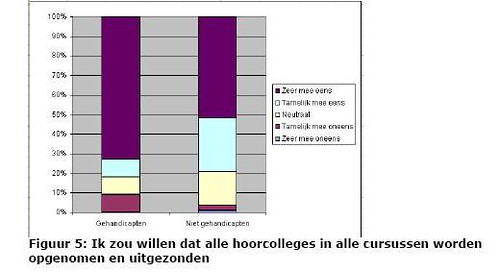
From September till November 2007 we recorded all the lectures in the first year Psychology course. One of the goals was to find out whether this facility would be valuable to the 23 students with disabilities taking this course (out of a total of 570 students). The disabilities were varied ranging between Dyslexia, Migraine, Hyperactivity or chronic fatige.
We collected data by conducting a written survey among all students and interviewing 15 of the students with a disability.
The results were very positive. All the students in the course were pleased with the facility. The students with disabilities could be split into two categories: the first was students having problem concentrating and taking notes during the lectures (e.g. Dyslexia, concentration disorder). They were very pleased to be able to watch the lectures again to write or improve their notes. The other category of students were students that weren't able to attend the lectures and could watch them at home in their own time. This also gave them the peace of mind that if they did have to miss a lecture due to their disability they could still watch what was discussed.
Follow these links for the summary and the full report (both in Dutch I am afraid).
Lecture on Internationalising education

At the annual 'Onderwijsparade' at Utrecht University (back on the 3rd of March) the organisers had invited Marijk van der Wende (CHEPS and VU) to talk about Internationalising Education. You can read an account (in Dutch) at the UU website.
At present Dutch government is focussing strongly on improving international cooperation at all the universities and all the universities are of course following suit. However, for many institutions it would be wise to sit back and first define the goal(s) of the internationalising efforts. Are you out to generate more income through foreign students, are you out to share knowledge and research or are you trying to attract and bind excellent students and researchers from around the globe?
The four approaches she defined were:
- mutual understanding (university as an institute of education)
- skilled migration (university as an employer)
- capacity building (socially engaged university)
- revenue generating (higher ed as an export product)
It was an inspiring lecture, it is a shame the slides aren't on the internet somewhere....
Use of Blackboard at Utrecht University
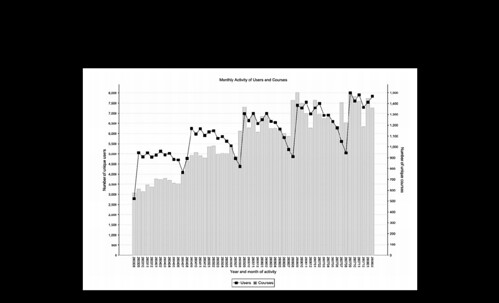
We have analysed the logs of the Blackboard server over the past few years and this gives an interesting insight into the use of the VLE. The results (in Dutch I am afraid) are reasonably comparable to outcomes of research at other universities. An interesting note is the fact that all courses at Social Sciences have been supported by Blackboard for a number of years now. That accounts for the early growth.
We have also tried to gain some insight in the use of different tools using the log data. Interestingly the use of discussion boards really has grown and is still growing. This doesn´t give an immediate answer as to how they are used as they are used for general FAQs, debating, collaboration, file sharing, etc.
All in all the results nicely mirror the use of Blackboard as a tool use to support all F2F learning, with the odd exploit into blended learning. The outcomes come at a great time as we are in the middle of an process to make a decision on a future single VLE for Utrecht University.
Workshop designing a Knowledge portal

Last Thursday the 8th Renee Filius asked me to help me out in a workshop. I did and it was great fun. I do enjoy getting people inspired and watching ideas rub off and start to live a life of their own. The challenge was to redesign a website (vraag Sofie) for personel advisors and experts on social security employed at universities in The Netherlands. The idea was to facilitate the exchange of information and knowledge through a portal. The challenge is to find a way in which the audience can and will easily participate. There are plenty of technical solutions, but are the users ready to rewrite each other's texts in a wiki for instance?
The photo's are out there on Flickr and if you look carefully you will notice I took them using my new Sony Ericsson mobile which has a quite reasonable lens and chip.
Wednesday, March 05, 2008
Innovatium,
Yesterday was my first visit to the Innovatium conference, here some very quick notes of my general impressions. The presentations came mainly from the field of professional universities in The Netherlands. The examples were often quite practical, some were more interesting for me than others. Again quite noticeable is the focus these institutions have on competences.
Sharepoint is a popular solution as a virtual learning (and working) environment. The professional universities are applying this system to address various problems (teamwork, sharing knowledge, presenting a curriculum portfolio which can serve for the accreditation of the courses, etc). Surfgroepen is regarded as a valuable tool because it is so open and can be opened up to external parties, whereas institution systems often have much more limited access. This for example will allow related companies to have access to a teamsite which plays a role in the learning process. A comment which reappeared in several sessions and in the hallways is the large amount of facilities on offer in sharepoint, this can lead to a confusing teamsite/workspace.
The last session I visited was given by Gijsbert Erkens from Educational studies at Utrecht University. Although I have helped him out in his course I never got round to really hearing what his intentions were in adding more and more learning ojects to his course module. The result is a large, varied and attractive collection of materials. Interestingly enough students appreciate the large collection of learning objects but they still have their primary attention directed at the summaries offered of the compulsory reading. He has also created snippets of the lecture recordings. These form an interesting application of this facility.
Friday, February 08, 2008
The first news regarding Bb next generation 9.0
On Willem van Valkenburg's blog I ran into the very first news regarding the long awaited next generation product presented by Blackboard. This was posted on a blog maintained by the Midland User group. Blackboard 9.0 is what was code named Omni and is the product that is supposed to satisfy Blackboard and WebCT customers. This is all very preliminary and I wonder if Blackboard aporves the fact that an institution has been leaking information, they can be rather secretive.
The release has been planned for January 2009. As far as features are concerned, this is what the Midland User Group lists on their blog:
[start quote]
New user interface - sections that can be dragged and ddropped around on the page, different pane for editing and viewing.
Engagement
* bought a communications company, so looking at provision of bulk SMS, email and voice messages through Bb
* page shown with wiki and chat in one area - very much the look of learning objects!
* iGoogle integration
* facebook integration
* RSS
Assessment
* instructor and student dashboard - shows you what is new, who is late, who has submitted work,
* assignment tool redesigned to match more clearly to learning outcomes, can deploy rubrics for marking
* portfolio - new system taking best of all three available systems, launch later than Bb 9.0
Openness
* APIs opened up
* enable multiple platforms to run together - moodle and sakai can be added seemlessly (single sign on) and with access to course documents across both
* iPhone interface, other mobile devices in planning
[end quote]
All in all quite interesting although it doesn't quite feel like a next generation VLE to me. It probably is a next generation product for the Blackboard company though. A few thoughts:
- I hope the drag and drop isn't relying on Java applets running on the client, we saw what issues that gave in WebCT Vista.
- iGoogle is nice, facebook is not all that interesting for the Dutch students, linking to Moodle and Sakai is surprising, mobile support was inevitable, otherwise not a lot of surprises.
One of the major things that does not make it a next generation VLE is the lack of the support of learning in a community through groupwork,sharing materials, openness to outsiders (becoming a member of a worldwide (scientific) community). There are a few items there but it will take a little more. On the other hand it will also take more to change the way teachers teach....
Thursday, February 07, 2008
Implementing a new VLE as a motor for change???
On the new surfspace site I ran into an interesting article in the University of Twente magazine (sorry, it is in Dutch). In this article Pløn Verhagen and Petra Fisser contest the very frequently stated causal relationship: New VLE > Improved pedagogy.
I can't agree more: if you wish to change teaching, change the teaching and don't expect teaching to change simply by implementing a new tool. Of course if you do wish to change the teaching one aspect of the change process is making sure that the necessary tools are available and in working order. However, do not start with the tools and expect the rest to change automatically.
I can't agree more: if you wish to change teaching, change the teaching and don't expect teaching to change simply by implementing a new tool. Of course if you do wish to change the teaching one aspect of the change process is making sure that the necessary tools are available and in working order. However, do not start with the tools and expect the rest to change automatically.
Wednesday, February 06, 2008
Oh dear, not more plaguerism...
Yesterday in a meeting of the directors of education at the faculty I heard a worrying complaint. We are trying to educate students in correct citation and not taking other's work and presenting this as you own. One of the aspects of this measure is the use of a tool to detect plaguerism. Sadly the complaint was uttered that too many cases of plaguerism where being detected and especially the follow up on each case was taking up time and resources. Nobody argued that we should stop checking for plaguerism, on the contrary. The sad fact is that students are still copying off the internet (without citing the source), and perhaps worse still: are entering other students' papers from previous years...
Monday, January 28, 2008
Just some new Open Source VLE names
And for all those out there looking at the broadest possible approach to a learning environment, and are into open source: I just heard about Zarafa (a linux based collaboration environment which will work together with Outlook and MS Exchange).
Taking it from the other side some clever people have built some extra features into the really popular Content Management System Joomla to turn it into a Learning environment. Although there are many out there that simply state: why bother if you have Moodle which does it all anyway.
PS: This company also offers a Sharepoint 2007 LMS, why do I feel that all sorts of lines are coming together ;-)
Sunday, January 20, 2008
More experiences using the Asus Eee

I have now gained some more experience on the use of my Asus Eee. It really does work a treat. I especially appreciate the VGA out, with its accompanying software. This allows you to go up to 1600 by 1280 pixels and will clearly show you which of the screens you are sending the signal to. (Beats banging on the Fn F5 combination and waiting for the beamer to pick up the signal).
I have also got the Utrecht University VPN working. I have not used the Cisco VPN client but installed VPNC. It took some puzzling and if I can find the time I might write it all down. If anybody is having troubles, do contact me.
Monday, January 14, 2008
Various solutions for recording lectures
As I have noticed there are a lot of people out there wanting to start recording lectures, but not quite sure where to start a few suggestions for tools for creating rich media presentations, Please note: these are presentations combining streaming video with html so the student can navigate through the presentation by choosing slides in the presentation.
Please note: this is a very personal view of a number of products. I cannot claim to be complete or completely informed. If anybody has any suggestions or corrections please do send a comment. This is based on the Dutch market for ICT in higher ed, in other countries there might well be other optoins.
A good place to start is Microsoft Producer: the software is free, most institutions will have a laptop and a digital video camera lying about. It is a very time consuming process but a great to get teachers and students to warm to the idea. You can even use the Surfnet Videotheek to stream the .wmv video produced.
If you intend to take the recording and broadcasting more seriously there are plenty of companies out on the market offering solutions. Expensive but very comprehensive is the Mediasite solution. Other solutions on offer are Apreso/Echo360, Accordent (no experience with it yet, should see a trial on Wednesday) Tegrity (no experience with that either) and Presentations2Go. Presentations2go is a Dutch product developed by Wageningen University, but now for sale. An interesting aspect of the presentations2go solution is the pricing model, the server software is expensive whereas the software for the recording sets is cheap. This encourages the use of more recording sets.
Googling about I ran into an Open Source solution for recording lectures. I have no idea how it works, but the pricing certainly is very competitive. It is called ePresence. If anybody has any experience using it I am certainly intrigued.
Sunday, January 13, 2008
Recording lectures in 2008

In the year 2008 we intend to continue recording lectures at Utrecht University. The central IT policy department has offered funding to keep us going together with two faculties. This will keep the Weblectures project available. We have evaluated the experiences of students and teachers who used this facility. They were all very positive, most comments were about the reliability of the service: students get used to it and expect it work every time. If we wish to ensure a decent service which will work throughout the university a larger scale approach is required. Our main effort will be focussed on writing a plan to set up a structural service in 2009. We will be offering a final report on the Weblectures website.
On the technical side of things we will be not be using Apreso Classroom in 2008. We have decided to try out the mediasite mobile recorders in combination with the Mediasite EX server software through the Dutch reseller Mediamission. Apreso has proven to be a great solution to get us started and gain some experiences with the required hardware for recording lectures. The limitations which proved decisive for us where the lack of monitoring of the incoming signals, the fact that the hardware was not portable and the fact that editing is not possible at all. For a lot more money Mediasite does also offer some other facilities, e.g. live broadcasting. I will keep you posted on our experiences. We have already made our first recordings with the recording sets and are hard at work on getting the server up and running.
Cold dip to start off the new year
Just clearing up some old news: I started off the new year on a fresh start: we took a dip in the North Sea... With a great big thank you to the life savers at 's Gravenzande which make this possible every year. Follow this link to get to the photo's.
Monday, December 17, 2007
Experiences with the Asus Eee

Back in December was the big day: I got my Asus Eee in the post, all the way from Taiwan. It isn't on sale in The Netherlands yet. It really is tiny. I have dropped it in my bag and forgotten it was there. The keyboard is not a problem, it just takes some getting used to. The screen could be bigger, but is quite reasonable for most websites. The storage is not very large, but who cares if you can push in an SD card, which neatly disappears in the slot and can stay in there when you move it about. The webcam is straightforward but works a treat. The Skype has been updated and quite probably should work with the webcam, nobody has skyped me yet, so if there are any volunteers?
Sadly the built in webcam capturing software seems to work, but the outputted video (.ogg format) doesn't make sense, it is far to long and slow.
The big bonus is that it truly works out of the box with its built in Open Source software. If all Linux was this easy a lot more users would be using it. Out of the box you get a browser, a mailclient, messaging software, skype, open office antivirus, video and audioplayer, picture manager, a number of games (some of them educational) and some other things. The drawback is that it does take a little puzzling to get other programs running. For example: I am have trouble getting our university vpn installed. A commercial party has finally decided to offer a computer running on open source software preinstalled. It is certainly easy to get started with.
One of the reasons I have not got round to writing this earlier is that everybody kept grabbing it out of my hands. Especially the kids are great fans. They love it for its small size, all the built in games and Pidgin messenger. it has already featured on Wilfred and Pierre's Blogs and already has found its way to Flickr...
Friday, December 14, 2007
General feelings on the Online Educa Conference in Berlin

I finally have found some time to get to cleaning up my blog and clearing up some old concepts I still had lying around.
To start off, some almost ancient history: My general feelings on the Online Educa conference. To start off, I was a little disappointed: I did not hear a lot of new things and I still feel the concept doesn't work: Four presentations in one session is a lousy concept. Usually 1 is worth while, 1 is a waste of time and two are usually not all that interesting or relevant. It was definitely worth while meeting up with the many Dutch at the conference. As so often I mainly gained inspiration through conversations rather than presentations.
And in an attempt to overlook a few developments and giving each their spot on Gartner's Hype Cycle:
- Podcasting is well and truly over its hype peak
- Web2.0 is here to stay, but it is over its hype peak
- Virtual worlds is running up to its hype peak
- Institutions are becoming more realistic about Services approach
- The general feeling regarding VLEs is 'agnostic'. Believing in one VLE is out of fashion
- Theories and technologies applicable to Informal Learning are still being applied to formal teaching situations (without judging whether they really work).
Friday, November 30, 2007
Virtual Worlds - some valuable findings to take home
Yesterday I visited a session on Virtual Worlds. It did not seem really exciting at the time, but after having had some time to digest, there were some points I would like to jot down for my own memory.
- Sun Microsystems is developing a virtual world which will be called Wonderland.
- Surprisingly Second Life has been used for language learning. I guess that the exchange of language was mainly in text and not the spoken word, but it was not discussed further.
- People are expecting Web2.0 to be followed by Web3D, I am not sure I agree at this point in time...
- They gave the sensible advise: Only use 3D when it really adds value to learning and teaching, otherwise it is a pain. A mix (hybrid model) is much more likely using 3D tools in certain tasks and other tools in others. For example combining the use of Xing.com and Second life.
- An important step will be adding content and integrating other media in the virtual environment.
It will become truly personal if your avatar's expressions are fed by input from your webcam. This will make avatars a lot more lively and make the virtual world much more real. This feature will surely be available in the future. (With special thanks to inspiration from a business proposal in the Dragon's Den programme on the Beeb.)
- 'Just building a stadium (ed: in a virtual world) is not enough. You have to organise it's use'.
- Perhaps a smaller and more straightforward meeting place than Second Life can be offered by Qwaq.
As a clear example of the use of Second Life they suggested training oil-rig staff on escape routes during emergencies. It certainly seems to extremely suited to this use. Running around on an oil rig with virtual fires all around is a lot safer than in real life.
Moodle in distance ed
Eric Clarke, with a lovely Irish accent, from the Royal College of Surgeons in Dublin delivered a session on the use of Moodle (and how much it costs to run). Yes, for all those out there still going after Open Source because it is free: Sorry to disappoint you, but there are enough other costs in keeping a VLE up and running. He gives a lovely description: 'What are we really going on about: is it all about lawsuits and : 'My VLE is bigger than yours' or is about teaching and learning?
The use of Moodle is a great success, but he gave us the warning: do take third party support, network and servers into account (180K euros and that's without the costs of user support.) The problems they are now facing are ironically their heavy reliance on Moodle, and the large amount of materials and tools on offer which confuse students without structure.
The use of Moodle is a great success, but he gave us the warning: do take third party support, network and servers into account (180K euros and that's without the costs of user support.) The problems they are now facing are ironically their heavy reliance on Moodle, and the large amount of materials and tools on offer which confuse students without structure.
Research into a new VLE for the OU


Steven Verjans from the Open University in The Netherlands has been researching their demands for a VLE. Strangely enough this is taking place as they just have starting deploying Blackboard. They find that Blackboard is, however, strongely based on the classroom metafor and not suitable for their teaching. Students don't meet in a classroom in the OU setting and learn independently and self paced.
Quite understandably the OU is not thinking on a short term adoption, but rather thinking three years ahead.
They appear to have a preference for an open source framework approach allowing for webservices. I do get the slight impression at this point the preference is based on technological innovative solution, rather than students' basic demands.
Thursday, November 29, 2007
Podcasts, why bother?
In the final session here at Online Educa today I was surprised to see that in the three presentations universities are focussing on pod- and especially vodcasting rather than streaming video. The true benefit in my eyes lies in offering materials which can be listened to or watched on the move. On the other hand, it might be a better target to let students to create streaming material which can be shared.
Some of the speakers had taken this into account. Especially the example from the Geography department (impala)attracted my attention: giving students pod- and voldcasts to take with them on fieldwork seems a very suitable application.
An other advantage is that students can relatively easily contribute materials. This has been used to allow citizens to join in various debates in Europe. And now its time for a drink :-)
E-learning for kids, worldwide learning content for kids
An interesting note at the end of one of the sessions is the e-learning for kids initiative. The aim is to develop courseware for for children aged 5 to 12 years worldwide. This connects nicely with the one laptop per child initiative. Noticeably this does not appear to be webbased but they have chosen to run materials locally.
Thoughts on the broad VLE, from VTE to open groupspace
Conference lunches are a great place to develop ideas. Here at Online Educa Berlin I had a lunch with Robert Jan Simons and Wilfred Rubens and we discussed the demands on a VLE at Utrecht University. My position is that we need a broad solution, as offered at Wageningen University. On the one end a classic VLE for teacher use (I suppose you could even describe it as a Virtual Teaching Environment, a VTE) which offers teachers the control they need to offer instruction. On the other end we need an open groupware environment which will offer students the room to learn, accumulate and share knowledge. Which of these extremes you wish to use depends on the pedaogical model in use in the course. In fact I know courses in which both models are used in the same course but at different points in time. Through api's (webparts building blocks, etc) the classic VTE/VLE and the groupware environment can be connected. Additional external web2.0 tools could also be integrated in this groupware environment which offer connections to the outside world. This is essential in creating an open environment for knowledge sharing.
I held an Asus EEE!
A great big thank to Gill Chester for allowing me to hold and fiddle about on her Asus EEE. It really is very small, but is astonishing how much fits on the screen and still remains quite legible. The keys take a bit of getting used to, but I can imagine I could get used to it. So all I need is some patience, I hope it will be out in the Netherlands before Christmas. It does not appear to be in the shops here in Germany yet.
Andrew Keen's keynote: is Web2.0 the cult of the amateurs?

Andrew starts off his keynote that there is nothing wrong with technology as such. He argues that the ideas behind the Web2.0 however are a danger to the distribution of wisdom. The wisdom produced in Web2.0 is the wisdom of the crowds. He claims that Google lets users decide what wisdom is. I do certainly not agree on this point: What is shown in Google is certainly not neccessarily wisdom.
He goes on by complaining that Wikipedia entries are just as long on irrelevant subjects as on subjects he finds interesting. This makes me wonder whether I would interested in whatever he finds interesting.
The challenge is how to select which information is correct. Students must be trained in medialiteracy, knowing what is correct in the media. This is not a new call, in fact there are teachers training first year students in this skill.
He argues Harvard professors should be busy publishing on the internet. On the other hand this is already possible, so what is his point...
In his retoric internet is a place with its own dynamics, although technology did not receive this dubious honouw. Though the content on the internet is nothing more than contribution by individuals. Would it not be better to focus on the indivivuals and the social processes between individuals when constructing knowledge?
iKids rather than eKids
The final comments of Patricia Ceysens' keynote were the most interesting. She claims her children will not be eKids but rather iKids.
These iKids have individual needs, however they need to learn in a social context. They want to be interactive. Futhermore they live in a culture of images. They must learn 'Interculturality' as this is a necessity in this age of cultural conflicts. It connected nicely with the ideas on the Net-generation and the Einstein generation.
These iKids have individual needs, however they need to learn in a social context. They want to be interactive. Futhermore they live in a culture of images. They must learn 'Interculturality' as this is a necessity in this age of cultural conflicts. It connected nicely with the ideas on the Net-generation and the Einstein generation.
Hole in the wall in real life

It was quite suitable, after all the buzz on the hole in the wall project, to hear Professor Sugata Mitra speak on technology and the application of ICT in education. After a keynote on the envoy of the minister on implementation of ICT in ed in Ghana, Sugata defended a very different appraoch. Rather than working on teachers and ICT facilities, Sugata argues that children are capable of learning on their own. They are capable of learning the basic ICT skill of browsing the internet. Children may be able to learn a language on their own, if they want to! Children in the south of India even managed to learn Biotechnology, being triggered to learn on their own, rather than being taught. Put these computers in public spaces rather than in the classroom. Children used their networks to extend their learning.
The final hypothesis: Can children complete the schooling on their own! still remains unanswered.
Saturday, November 17, 2007
Instructivism vs free learning - the cultural dimension
Walking through the university magazine I ran into a short comment in an article by a researcher just down the hall from me. I was especially amused as this added an extra perspective to instructivism vs. free learning debate which popped up (again) at the Onderwijsdagen.
The researcher in question, Mayo Aziza, is doing research on language learning under children from Turkish or Morrocan parents in the Netherlands.
Her comment is:
"Het Nederlandse onderwijs met zijn sterke gerichtheid op zelf dingen ontdekken werkt voor kinderen met een taalachterstand averechts. Die kinderen hebben behoefte aan instructie, maar dat past niet in onze onderwijsfilosofie."
I would translate this as follows:
"The Dutch education system, with its strong focus on discovering things for themselves has the opposite effect for children with a language deficit. Those children need instruction, but this does not fit in with the principles underlying our education."
To add to the debate I wonder whether we are taking the cultural dimension into consideration when we are thinking about different approaches to teaching and learning. There are people that argue that certain types of knowledge and skills can best be taught through instruction, whereas others are best discovered in a more free setting. I would like to argue for also taking the differing cultural background into account when defending the preferred educational model. There must be researchers out there that have been looking at this aspect in more detail.
Friday, November 16, 2007
Weblectures in university magazine

A while back I was interviewed by the university magazine on the Weblectures project we are running here at Utrecht University. The article is now available in print and online. I was amused to see that the central debate: 'Will students still come to lectures?' was put on the poll. The results at this point in time can be found on the right. I find it quite noticeable that some students easily respond that they will no longer visit lectures, though once confronted with the facility they notice that visiting lectures is actually valuable and a recording does not replace attending the lecture live.
Follow up on Stephen's keynote

The recording of the keynote at the onderwijsdagen is now online and can be found at:
http://videotheek.surfnet.nl/play_proxy/mmc/39829/downes.wmv.
Wilfred Rubens has written a review of this criticism in the elearning site. Paul Kirschner has written a response (both in Dutch). They can be found at:
http://www.e-learning.nl/subpage.aspx?l1=2&subaction=details&newsid=1671
Wednesday, November 14, 2007
The SMS wall actually did work!
It took some effort and some perseverence on the part of Pierre, but in the end the SMS wall did work and was put to good use in the debate Wilfred gave on the more ethical questions regarding the use of blogs and wiki's in education. I heard he will be posting about that soon.

Do we need professors?
As a last session at the Onderwijsdagen I went and listened to Jacob van Kokswijk, this session had been arranged by a sponsor. I suppose it was a good resume: examples from other sessions came back: he named new findings regarding the links between short term and long term memory, and subsequent theory on students learning differently. Just as Stephen had done he mentoined the hole in the wall as an example of children learning of their own accord (informal learning).
As an example of people becoming organised in multiple virtual social networks he named the Google Open Social api. This is just an example of how we are all becoming connected and sharing knowledge. By the way: I am not quite sure I wish all my networks to be the same. Certain network sites are for certain goals...
But all this was leading up to the conclusion that teaching is going to have to change. However he offers no proof that old learning works (nor does he name proof for a different position). He has picked up all the news circling the web without wondering how applicable all these findings are. It brought me back to the question: do students want to have their learning taking place in their free-time space? This is a point Antoine van der Beemt questioned in his presentation.
For me the question 'do we need professors' was certainly not answered in this presentation. I believe we do still need some kind of professor even if it is a team leader (as in the example of the Kaos Pilot pedagogy....
Teemu Arina's session on slow pedagogy, an alternative in this age of speed

In his session Teemu argues for room for serendipity adaptability in learning. Teaching should provide students which adapt and adjust their processes. He offers various snippets of information and theories, but does not connect these, but as he explained later: 'Leaves this up to his audience to select the theories they find relevant.'
His session followed a philosophical approach analysing words and their meanings.
'How to cope in this age of information overload?' Marshall MacLuhan claims we can solve this challenge by pattern recognition.
Another point he argues is that in learning we should give room for serendipity: planning everything leaves no room for unintended outcomes. There should be more attention for slow pedagogy, we should concentrate on the learning process rather than the outcome of learning. By focussing on the outcomes we leave too little room for serendipity.
Motivation and engagement as basis for Kaos Pilots

I have just attended an inspiring session by Christer Lidzelius on the Kaos Pilots at the SURF onderwijsdagen. The subtitle is: 'Where creativity and innovation go to school'.
Very noticeable is the that in Kaos Pilots the primary purpose is: social improvement through personal growth. Students are selected for the three year bachelors' course not an academic merit but on passion. Students are assessed in a two day workshop on potential. In these two days they receive lots of direct feedback. 35 students remain.
In the course all learning takes place in projects. Faculty are teamleaders/coaches. Subject matter is based around three themes: Cultural Diversity, Sustainability, Social Leadership: a good leader is capable of making others leaders. The underlying pedagogical models are pretty straightforward. Focus is on the student, the world and values. The use of ICT not a specific role in teaching or learning, it is simply used as a tool in projects. The final project after three years is a project to improve things in society.
All in all I found it a very inspiring session, especially due to its focus on social improvement.
Tuesday, November 13, 2007
Blogs in education, success stories
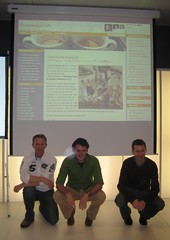
Shame it's quiet in this session at the end of the first day of the Onderwijsdagen. In this session Rene Jansen from the UvA describes plenty of examples of application of web2.0 tools in higher ed. Blogs have been used for reflection on learning. This does spurn a discussion on whether you can use a blog for reflection, and can you do this on a public blog?
A nice conclusion from a research by Martin Kloos is that social software individual tools do not offer sufficient features to accomodate a community of practice, though a combination will work.
Two of Rene's students also explain their experiences. They have set up a knowledgecafe to share and grow together by setting up a groupsblog. Blogging was an important tool in developing skills in collecting and aggregating and reflecting on knowledge. 'Publicating-light' as they called it.
Stephen Downes' keynote... wow
Stephen Downes just gave a very passionate attack on the paper by Kirschner, Sweller and Clark: Why Minimal Guidance During Instruction Does Not Work: An Analysis of the Failure of Constructivist, Discovery, Problem-Based, Experiential, and Inquiry-Based Teaching. He was quite enigmatic that many arguments were not correct. I will not try to repeat his argument here, it is much better to watch the recording which has been made and hopefully will come online soon.
I think it was quite a surprise for many attendees that know Stephen from his blog and his views on sharing knowledge and standards, to hear an entire lecture on his pedagogical views that underlie his attitude to openness and sharing.
Tomorrow Paul Kirschner will be presenting a session (in Dutch) in which he will lead the debate between an advocate for the instructional approach vs. an advocate for the open approach to learning. This may be an interesting or surprising follow up for this keynote.
Preconference on Sharepoint as VLE

I am now attending a preconference at the SURF Onderwijsdagen on the use of Sharepoint in Dutch higher ed. It was very interesting to hear a description of the SHAPE Surf project. What made it really interesting was the embedding of the use of this collaborative environment in an 'action learning pedagogy'. Students were being trained as 'knowledge workers'. It certainly seems to be very suitable for this goal. On the other hand at the HAN courses are virtually unchanged and Sharepoint is used for content delivery. For that goal it seems simply too flexible and messy. So if you are going to change your teaching to a model containing a more active collaborative realistic approach, then Sharepoint should be quite useful.
Friday, November 09, 2007
Twente has also been busy recording lectures
The University of Twente has also been recording lectures. They have written an article in the University Magazine. Again: the same findings. The most amusing comment (one I have also heard here in Utrecht in interviews with students) is the remark that this may mean that other students might not bother attending early lectures. Strangely enough I never manage to speak to these 'other' students ;-)
Wednesday, November 07, 2007
A pipe for the Onderwijsdagen
Finally got round to reading some of my feeds and it paid off. From Stephen Downes blog I found a reference to just the tool I was looking for: Yahoo/Google pipes. I must give it a try and see if it can be put to use as a feed aggregator for conference reporting. Let's see if I can get all the edubloggers to subscribe...
And it worked! Brilliant stuff. We have now got a pipe combining postings from various bloggers which contain 'onderwijsdagen or owd2007' in the description (the body of the message) or the title. Most RSS feeds do not also send tags in a standard format so filtering by tag or category isn't possible for all postings.
You can find the pipe at: http://pipes.yahoo.com/owd2007/woPVKnaN3BGQwHbenkartA
If you want your blog added, do send me a comment (you may even already be in the list feeds)
WebCT troubles caused by firewall issues
What's new... If there is one recurring issue in implementing ICT tools for education it does seem to be firewalls getting in the way. This seems to have been the case for the WebCT troubles at Utrecht University. This should now have been solved. You can read the article (in Dutch) in the university magazine.
Wednesday, October 31, 2007
The HvA is also recording lectures...
And yet another article on the success of recording lectures. This is a report (in Dutch) of the findings at the Hogeschool van Amsterdam (Amsterdam Professional University). One thing that struck me is that in the fourth sentence organisational issues are classed before pedagogical issues. This for me does give the impression that the focus is changing on how recorded lectures are being regarded. They are being regarded as less of a pedagogical novelty and much more a facility which can be implemented a lot more broadly (as the TU Delft advertised lately).
Asus Mini notebook: an interesting inbetween
I am a very loyal user of a Palm TX, but it is simply to small for writing and browsing. On the other hand, lugging a notebook about is a pain (for my right shoulder mainly). So I was fascinated to see that Asus is working hard on the Eee notebook. What makes it interesting for me:
- Very portable
- Cheap
- Does the basics when I am on the move (reading and writing emails, checking feeds, writing blog, writing out matters)
Of course it is not a full blown PC. I was interested to see they are planning to drop it in the educational market. If you see what we expect our students to do, it may well be too limited (statistical analysis is one thing it will not (yet) do. On the other hand: if you see what our students want to do it is probably quite suitable: to be connected and share at all times through messenger or videocall through skype, type out basic reports, browse and watch Youtube and connect with iPod.
I think I am going to give it a try when it comes out here in The Netherlands. Many vids ar already available at Youtube. Here's one to give you an idea.
Thursday, October 04, 2007
Which VLE for Utrecht?
The latest news scoop is that the advice for the next VLE at Utrecht should be appearing soon (by December). I have heard the buzz going round in The Netherlands that we are having serious problems. I am pleased to say this certainly does not concern Blackboard. We are running this on a local server and it is running extremely satisfactorily. As far as WebCT is concerned, all those interested can read the article in our university magazine.
For me this situation does raise a number of questions as to what is truly important in a tool for the support of teaching and learning. I have noticed that some are engrossed by visions of a myriad of pedagogical models and features. I would like to take a step back and concentrate on the basics: what teachers and students need is a system which is reliable and easy to use. I have heard arguments that all systems should answer to these basic requirements, but I have sadly seen many examples to the contrary. I also feel that the large majority of teaching staff are not looking for a system that will do absolutely everything, but rather a straightforward system that will let them do exactly what they want to do quickly and easily. If we are trying to look for an efficient use of ICT in higher education, this is a very basic place to start.
For now we are waiting on the advice...
Thursday, September 27, 2007
Technorati test
I am just testing out the possibility of using the Technorati search service to search all blogs for a specific tag. As I want to do this regularly I have just set up an account. Click to find my Technorati Profile.
A new year running Bb 7.2

It is about time I started keeping up my blog. The new year started almost a month ago and by now work is settling down a little. Fortunately everything went well. This summer we went through an upgrade of Blackboard from 6.3 to 7.2. This went really well. The interface is really the same for the teachers and students and we only ran into one problem: The course list was not editable above the first 25 courses. Thanks to a posting on Patrick Klaassen's blog, that was soon solved. Long live the community of Blackboard admins in the Netherlands.
We are also back on track recording lectures and training students in the use of portfolio's. Life as usual...
Blackboard scholar goes for Social Networking
I just read a Blackboard release regarding Scholar: it has a number of improved features. I am slightly surprised by some of the features as it appears as if they are trying to create a social networking site, rather than a well integrated site to share bookmarks and materials. If this is the way they want to go, I feel it should be much more strongly integrated into Blackboard itself, rather than a separate service elsewhere.
You can find the information at: http://wiki.scholar.com/display/SCLR/New+Features
You can find the information at: http://wiki.scholar.com/display/SCLR/New+Features
Thursday, August 30, 2007
A dog to give you a different perspective on power

We have just bought ourselves a dog. He is from the compound, but does not seem to have suffered too many trauma's. I will not bore all of you with all the details, it seems to be a mix with a lot of Wetterhoun. The one thing that struck me, as a first time dog owner, is the extreme relationship you build up with a dog. A dog requires a strict and straight alpha male boss. In return you receive extreme trust and obedience. Although there are many parallels in human relations the extent in which this holds true surprised me. This is not something I had picked up by just reading a book, but I am picking up by first hand experience.
Slight case of Mountain Sickness
Some suffer from home sickness, but I suffer from the opposite. After a great holiday in the Pyrenees it is not always easy to return to your desk and get on with every day life. As a happy reminder this is the definite pinnacle of my hols. A scramble up the Gran Encantat, one of the two peaks which makes up Els Encantats. We didn't make it to the top as the route became rather steep and exposed without decent points to fix a rope. This is the view down between our legs looking down on the lower ridges.

Wednesday, August 29, 2007
Second life lunch
This is a bit late, but I have been off on holiday and rather busy starting up the new year. So, better late than never, a report on a lunch session on Second Life: What is it and how could you use it in your teaching.... It took place at Utrecht University on the 12th of July.
For me the most interesting question raised was: How can you use Second Life in your education and what are the benefits. I did not really hear a satisfactory answer. I can imagine a virtual world being useful if you wish students to learn matter in which the 3D aspect is important (design, architecture, etc) and the freedom offered to create (impossible) structures.
The social aspect could be valuable but Second Life still appears to be more suited to 1 on 1, or 1 on few meetings. Teaching a large group requires keeping the group together. A humorous anecdote was the example in which a teacher kept walking off to a different place. Students which were not actively following the session would be left standing alone while the rest moved on. Second Life still is a little cumbersome at times and it is not always easy to find your way about.
Writing this I do realise that I am (intentionally) describing the use of a virtual world in teaching rather than learning. Learning is a process which can be a lot less structured, less dictated and will often be much more individual. This is something which could be done in Second Life.
A final remark concerns the number of users in Second Life. The Linden Labs company used to boast a large number (millions) of users in Second Life. In practice the number of regular visitors is a lot less. This only appears to be a few tenthousands, so it is not always as huge a buzz as it appeared to be at first.
Friday, July 13, 2007
In search of a new colleague
My direct colleague has just received a great job offer, so we are now looking for a new colleague at short notice. You can find the job description at: http://studion.fss.uu.nl/Organisatie/vacature_ondersteuner_studion.pdf. Please note: this is in Dutch as the applicant will also be expected to speak Dutch.
Thursday, July 05, 2007
Website Onderwijsdagen is now online
The website for the Onderwijsdagen is now online. The theme is the great tug of war between what is on offer and what really is demanded by teachers and students. There are great new pedagogical models out there describing whole new approaches to learning, but teachers and students are not always ready to adapt these new approaches and roles. And what is true of the beautiful vista's promised by using ict in your education? Is learning still not encouraged by a real life motivating teacher who is an inspiring subject matter expert? These are questions we want to address at this conference for ict in higher education in the Netherlands. We aim to match demand and what's on offer.
You can find the website at: http://owd2007.surf.nl/owd2007/ (only in Dutch I'm afraid).
World of Warcraft in a course

Every 8 weeks or so all the coordinators from the different departments at Utrecht University meet up and discuss the latest developments. Today we had Harald Warmelink on a visit (now just started a PhD in Delft). He was studying Multimedia before and attended a course which was taught in the massive multiplayer role playing game World of Warcraft. It was not only in WOW but also about WOW. Marinka Copier (the teacher) required the students to perform all sorts of tasks from simple to complex, from individual to group effort. The final assignment was to research an aspect of World of Warcraft. All the separate chapters have been added together to form a book, which can be found (hidden between other articles) at: http://sybil.nl/2007/content/category/4/19/27/
You can view Harald's presentation below:
Tuesday, July 03, 2007
Blackboard usergroup meeting: portal the Wageningen example
Last Friday I missed the Blackboard usergroup meeting on portals. One solution was specially relevant for Utrecht: the use of a Sharepoint portal linked to Blackboard for the courses. Reading Willem van Valkenburg's description of their session (in Dutch I'm afraid) I am quite impressed. It sounds well thought out: I think it would be wise to pay Wageningen university a visit.
Twente has issued its Sakai report...
It is now public: the report on the examination whether Sakai could be a viable option for the University of Twente is now public. It can be found at: http://www.utwente.nl/elo/news/cbus_english_final/
There are a number of notable outcomes which are relevant for Utrecht University (which will also have to answer the same question in the coming year.) From the technical perspective it is interesting to note that it has been designed to be integrated in a Service Oriented Architecture, though this will naturally take some effort (as all integrations will). It should support various pedagogical scenario's although I do feel it has been designed for a teacher based style of learning (as most, if not all VLEs are at present). The one issue in Twente at the moment appears to be rooted in the Functional analysis/Educational use. There are still issues regarding usability and user experience which need to be addressed.
There are a number of notable outcomes which are relevant for Utrecht University (which will also have to answer the same question in the coming year.) From the technical perspective it is interesting to note that it has been designed to be integrated in a Service Oriented Architecture, though this will naturally take some effort (as all integrations will). It should support various pedagogical scenario's although I do feel it has been designed for a teacher based style of learning (as most, if not all VLEs are at present). The one issue in Twente at the moment appears to be rooted in the Functional analysis/Educational use. There are still issues regarding usability and user experience which need to be addressed.
A very damp yet enjoyable morris weekend
I have returned (and recovered) from a very fun Morris weekend organised by Fox Morris in Bretforton (of all places). It was my first visit to the Cotswolds, I must say: they are very quaint. It was quite a change to be surrounded by mixed sides almost all dancing Border morris. I have never seen so many Blacked up faces in one spot. Amongst others there were: Foxs morris, Stone the Crows, Exmoor, Pink bunnies 'from a place warmer than here'. It was a shame the weather was rather lousy but otherwise it was very enjoyable.
Here a video compilation of all the various teams in action, and a show of how to rip your pants...
Here a video compilation of all the various teams in action, and a show of how to rip your pants...
Thursday, June 28, 2007
Clustrmap on my blog
As a true geographer I am always intrigued where my visitors are coming from. On Arina Teemu's blog I found the Clustrmap badge, so I simply had to add this to my list of badges.... So now I hope they come from afar ;-)
Wednesday, June 13, 2007
Getting an other forum into Sakai
Still want to use good old phpBB? It has been ported to Java (and is now called JForum) and can be used in Sakai. It is almost strange to see an very well known interface in a completely different package. Sadly it does not support nested replies but works on a chronological ordering.
LaGuardia Portfolio
LaGuardia are now running a portfolio in another system (based around Blackboard) and were kind enough to come and present their findings at the Sakai user conference.
It was fascinating to hear about their vision on using the ePortfolio as a tool for empowerment for the students in Queens, NYC. They are from a very specific background and this is a tool to turn them into digital authors in a world dominated by white working class authors. It is very clearly a showcase portfolio including written papers and sometimes even reflections on these papers. The visual aspects are very important to give a feeling of ownership. Students are being used as ePortfolio consultants to help each other. In ePortfolio classes students are very satisfied with Critical thinking, collaborative learning, creative writing.
All in all a very inspiring session showing a very interesting application of a portfolio.
LAMS V2 and Sakai
Many interesting new options in LAMS V2, shame James Dalziel couldn't make it in person. One interesting change is the change in approach allowing for a combination of online and offline activities. Reports and materials used in offline activities can be included in the LAMS flow of activities. Export to portfolio is possible: this simply produces a zip package with html report of activities. Branching and conditionality is coming up in V2.1.
Technically: service based architecture which will allow it to work with various VLEs. Gradebook is not integrated yet, but there are looking at it. There is a new more complex option they are looking at: dragging and dropping Sakai tools in the LAMS authoring environment.
They have set up a LAMS community for sharing sequences and rate and comment on each other's sequences.
Learning styles in Sakai and the OCWtool
I just visited a rapid session covering learning styles theory, do have a look at the powerpoint, there are some slides there which argue for recording lectures. (By the way: the session was being recorded with UvA's Mediasite recording set).
Using control theory address the following demands that students have:
- Belonging
- Freedom
- Power
- Fun
Also start them off and show them around the course (interesting point for addressing some of the Camtools issues). Let students help each other.
Referred to Howard Gardner's theory: 8 intelligences.
They (Claremont College) used an authoring tool (Softchalk, not free, is cheap) to create scorm packages which were mediarich and interactive and were imported into Sakai (and could also have been imported into Bb or WebCT). They have also tried Melete.
If you wish students to be able to follow the course in their own manner, change the teacher centred design: you can at least offer a tool in which a student can track their progress and add what they have found and used in the way of course materials/tests, etc. perhaps based around the course goals...
Sadly here again bad news about the Sakai interface: it is not easy to navigate and use and non-intuitive. The basic UI is lousy! It does make me wonder what the RSmart interface looks like. Teachers claim: Bb is easiest, WebCT next and Sakai figures at bottom of popularity list...
Interestingly there was also a call for a student based rather than a teacher based VLE.
Tuesday, June 12, 2007
Evaluation tool in Sakai
The University of Tubingen is using an evaluation tool built by the company Ostrakon. It offers the opportunity to evaluate the data over various courses, teachers, questions etc... This tool offers all the advantages of a separate evaluation tool over various courses. It was interesting because they are working on integrating it in Sakai.
By the way, it was quite a relief to see that a number of the tips for a good evaluation approach are already in use at Utrecht.
By the way, it was quite a relief to see that a number of the tips for a good evaluation approach are already in use at Utrecht.
Tools in Sakai
Unicon is a commercial partner of Sakai and showed off its new Auto Submit tool. This just goes to show that commercial partners are profitting from the Sakai tools and producing new variations (comparable to the Building Blocks in Bb).
The grade book has been improved on various aspects, one of the interesting options is the option to be able to adjust the standard download of the Grade Book (once off, you need a Java programmer to do it for your institution). More good news in the release 2.5: uploading grades, grading by sections in the course, student view of the grade book and other small improvements.
The grade book has been improved on various aspects, one of the interesting options is the option to be able to adjust the standard download of the Grade Book (once off, you need a Java programmer to do it for your institution). More good news in the release 2.5: uploading grades, grading by sections in the course, student view of the grade book and other small improvements.
Sakai and OSP
You can run Sakai and you get OSP for free, but this is not enough to get your students able to enter a portfolio. As an admin you first have to design the forms which need to be used. Bas Kuiper from the UvA gave a presentation on this...
OSP offers the facility of free form or template presentations. When creating an template based protfolio you need to create an XSD form, which can be done using XSDweaver (see earlier post on this blog) do not use spaces in xml element names! You then use the xsd as a basis for a form in Sakai. Get this right before you start, once in use this can be difficult to change. Now you can build the portfolio template, defining which fields you want added to the template. Add a stylesheet.
So you see lots it does require some gobbledeegoock. Think in terms of xsd, xml, xsl, xslt, xalan... This something only the administrator has to worry about, the students get a simple interface.
In simple terms: the students get straightforward forms to fill in and OSP will generate a series of html pages. For more information have a look at:
http://osportfolio.org
Sakai user conference, starting up
I am visiting the Sakai User conference which is just around the corner in Amsterdam this year. It is a great opportunity to view what is happening around Sakai. I just visited a session by Cambridge presenting their Camtools. It was a very interesting session though most of their findings where not specific to Sakai but more generally related to the use of a VLE in a teacher training course. One fascinating reflection was offered by a student who claimed to be a digital native: a member of the search generation: 'So what's this breadcrumb bar? I want to search in the whole system rather than first have to understand the hierarchy. I do not want to put my resources in a closed system which I can not access next year.'
I just picked up on the end of a presentation of Syracuse on using Proficiencies in the courses. It was interesting to hear of an institution outside of the Netherlands who is also thinking in these terms ;-) A very valid remark was the question: who should design the Rubrick and how impelling should it be? Or would you rather offer the teacher the freedom to develop their own. Interesting to see that you can link proficiencies to specific activities (e.g. assignment) in a course section.
I just picked up on the end of a presentation of Syracuse on using Proficiencies in the courses. It was interesting to hear of an institution outside of the Netherlands who is also thinking in these terms ;-) A very valid remark was the question: who should design the Rubrick and how impelling should it be? Or would you rather offer the teacher the freedom to develop their own. Interesting to see that you can link proficiencies to specific activities (e.g. assignment) in a course section.
Friday, June 08, 2007
Onderwijsrepository workshop
I am waiting for a harvest of the Repository of Learning materials into the Lorenet database, so I have some time to spare ;-) I am at a workshop at Surfnet presenting their new repository service. They have chosen to use Fedora as their repository service. They have chosen a really straightforward understandable page to enter all the required metadata. I must say it looks very clear, the descriptions are obvious, this is something I could confront my teachers with. On the other hand: I would rather not confront them with this information... They also offer the option not to include the actual file but only a link to the learning asset. This gives us the opportunity to refer to streaming media files on their server or rich media assets which consist of various types of content combined.
I do believe it would be worth while to offer teaching staff the opportunity to search for learning materials in the VLE and add these to their course with only one click.
I do believe it would be worth while to offer teaching staff the opportunity to search for learning materials in the VLE and add these to their course with only one click.
Friday, June 01, 2007
Puzzling on for the Onderwijsdagen
I have been asked for the Programme Committee for the Onderwijsdagen. This is the large annual conference for ICT in higher education in The Netherlands, organised by SURF foundation. To give you an idea: this was last year's website: http://owd2006.surf.nl/owd2006/ This year the conference will be on the 13th and 14th of November.
I am filling in the tracks: Learning (learning theories in practice at the academic and professional universities in The Netherlands) and Social Software. I am not going to reveal our theme yet though ;-) I was just wondering if somebody has got some good suggestions we can incorporate in the programme...
I am filling in the tracks: Learning (learning theories in practice at the academic and professional universities in The Netherlands) and Social Software. I am not going to reveal our theme yet though ;-) I was just wondering if somebody has got some good suggestions we can incorporate in the programme...
Thursday, May 31, 2007
Which other Twitters want to be my friend?
A thank you to Wilfred for being my friend ;-)
But seriously, I thought I would try the Twitter badge which shows my friends on Twitter. It really does work and certainly is a lot more interesting than just my own mucking about. The one thing I did notice was that it was a pain to find out just who is on Twitter. Of course I can start inviting everybody, but I just want to find those already on twitter...
But seriously, I thought I would try the Twitter badge which shows my friends on Twitter. It really does work and certainly is a lot more interesting than just my own mucking about. The one thing I did notice was that it was a pain to find out just who is on Twitter. Of course I can start inviting everybody, but I just want to find those already on twitter...
Wednesday, May 30, 2007
Google map on my blog
With thanks to a posting by Pierre, I gave MyMaps a try. It is extreeeeemely simple. It took me about 10 minutes to build a map and to squeeze it onto this blog!
So here it is: a few places of work I am cycling between regularly...
So here it is: a few places of work I am cycling between regularly...
Creative Commons finally on this blog
It took a while bit I have finally got round to reading the fine print and selecting the most suitable licensing for this blog. You will now find a small logo in the column on the right.

The background is that all the information on this blog can be shared and used as long as you correctly attribute this to the author. This is an open expression of the more inherent underlying idea regarding social software: it is valuable to share information, in sharing you can set up communities and networks in which everybody can profit. It is no longer the information itself which is important, but rather the skill in building up a network, assessing the value of information and reflecting on information.
The background is that all the information on this blog can be shared and used as long as you correctly attribute this to the author. This is an open expression of the more inherent underlying idea regarding social software: it is valuable to share information, in sharing you can set up communities and networks in which everybody can profit. It is no longer the information itself which is important, but rather the skill in building up a network, assessing the value of information and reflecting on information.
Tuesday, May 29, 2007
Meeting of the Blackboard User Group

Last Friday we had a meeting of the Blackboard user group in Utrecht. To view the programme and the presentations visit: http://studion.fss.uu.nl/training/gebruikersdag
Other's remarks can be found at: http://weblog.leidenuniv.nl/bb/bbusergroup/2007/05/verslag_blackboard_en_web20_bijeenkomst.php
It was a small gathering the day before the Whitsun long weekend, but never the less quite interesting. It was good to see that there are initiatives out there to get social software into the classroom. They do not necessarily have to be in Blackboard, as this can be a very closed environment as compared to the more open environment which is more suited to more open student of the next generation.
I was slightly disappointed to see Scholar in action, it was not a easy and intuitive as I had hoped, On the other hand, I have given the learning objects building block a try and that was really easy to use and showed results quickly. Shame about the price though...
The final message that did linger was Robert Jan's frogs: this may be an innovation which will require some slow warming up to. It certainly does not seem to be something all teachers are rushing to adopt.
Twitter badge
In case you are wondering what I am doing at every possible moment of the day, you can always watch my Twitter badge, now added in the column on the right....
PS: I don't promise I will keep it up all that regularly, I am just not techy enough for that sort of stuff ;-)
If anybody wants to sign up as my friend I can try out the badge with friends too :-)
PS: I don't promise I will keep it up all that regularly, I am just not techy enough for that sort of stuff ;-)
If anybody wants to sign up as my friend I can try out the badge with friends too :-)
Tuesday, May 22, 2007
Discussion on 'New Learning'
Yesterday Tumult Debat organised a debate on the latest debatable Dutch hype in Dutch education: the so-called 'Nieuwe Leren' which could be translated as the 'New Learning', which has been the subject of a lot of debate lately in the Dutch media.
Last Saturday the Volkskrant ran an article on the 'New Learning' and one thing which became quite apparent is that it encompasses a collection of different theories and principles.... Robert Jan Simons gave a clear description. This point came up regularly during the debate.
In the debate Paul Kirschner and Monique Boekaerts gave their views on a number of principles of instruction and learning design which where clear and not very debatable. The listeners however where often from schools and clearly had ideas rooted in practice. Some were clear advocates whereas others clearly preffered a traditional style of teaching. If there was one thing that could be learnt from the debate it is that:
- New learning is really New teaching
- Learning theory is not a direct instruction on how to teach
- There is not one clear instruction how you should teach a bunch of students as they differ (where have I heard that before).
- The underlying principles may be brilliant, but if you don't do it well (invest money) it will not work as well as promised.
Tuesday, May 15, 2007
Blackboard Usergroup meeting in Utrecht

On friday the 25th of May we (Studion Support) will be hosting the next meeting of the Dutch Blackboard Usergroup. This meeting will be directed at 'Blackboard and Web2.0' or better still: 'Blackboard and Education2.0'. After a broad introduction in the Net-gen student and what Web2.0 is, we will be looking at various possibilities of using Web2.0 tools in conjunction with Blackboard.
Of course we will be looking at the first tool in the Blackboard Beyond Initiative (Scholar) but will also be looking at other tools (blogs especially) which other institutions in the Netherlands have been experimenting with.
For more information (including the programme and information on how to register) please visit: http://studion.fss.uu.nl/training/gebruikersgroep
Wednesday, May 09, 2007
Rights on recordings
I just found a webpage with some interesting answer to FAQs regarding rights for the recording of lecturers and the use of other fragments in your own recordings. It is a page in Dutch maintained by Surf DiReCt.
http://www.surffoundation.nl/smartsite.dws?id=13002
http://www.surffoundation.nl/smartsite.dws?id=13002
Friday, April 27, 2007
Article on the Next Generation VLE now definite

It is now finally official: My article on 'The New Generation VLE' has now been made public. This article is based on the findings at the Educause conference in Dallas Texas, last October. The main message is that there are the first beginnings of a new generation of VLE's. They can be characterised by the fact that they are no longer a 'walled garden' dominated by the teacher, but rather a more open environment in which students and teachers can work together with persons, materials and other webservices outside of the classroom or even institution. And of course the VLE can be approached through various devices and allows for modern delivery of media.
Various vendors and institutions are working towards this solution, but none of them are there yet. There are promising developments in the field of Open Source and commercial parties (Blackboard especially) and the adoption of a Service Oriented Architecture could also be very helpful in working towards an integrated VLE with all these functionalities.
The article can be found on the WIKI at: http://82.192.89.182/~wiki/index.php/Hoofdstuk_Nieuwe_generatie_ELWO
I am sorry to say that the article is only available in Dutch at present. I am afraid that I will not find time to translate it in the near future. If anybody does require an English translation, please let me know.
Monday, April 23, 2007
Internationalising our education - use of video
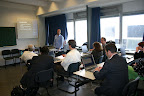
We had a seminar on Internationalising our education at Utrecht University last Thursday. It was great to see the efforts being made at the WUN (World Wide Universities Network) and Penn State. We still have a long way to go...
Together with Lex Hermans I gave a presentation on the use of video in distance education both for a-synchronous and synchronous learning. The slideshare is included below.
David Pilsbury also pointed out the Research channel, a collection of high quality videos covering some serious subject matter. This would require a tad more investment than the simple recordings we have being doing of late and would also require some serious commitment at all levels in the university. Great for your public relations though...
Sunday, April 15, 2007
Blackboard and Vista
A quick note for my own use, sorry guys ;-) As we had noticed Microsoft Vista and Blackboard do not always work together well. See Willem van Valkenburg's blog for a list of problems acknowledged by Blackboard.
Attending recorded lectures
An article on the Dutch Edusite pointed out that students still attend lectures when they are recorded, although the (notorious) law students do not always comply ;-)
Leidse student laat opgenomen college soms schieten
This is something we must give a try: we are going to record lectures and evaluate attendance anyway. We must see if under comparable circumstances law students show different behaviour to other students...
Leidse student laat opgenomen college soms schieten
This is something we must give a try: we are going to record lectures and evaluate attendance anyway. We must see if under comparable circumstances law students show different behaviour to other students...
Friday, April 06, 2007
Presenting away for Weblectures
Yes, I know it is getting a bit boring: this blog is getting filled up with the weblectures project. I suppose this is only a correct representation on how I am spending my working hours at present...
The project is now really underway. The buzz is obviously spreading at Utrecht University. I have given presentations for the ICT in ed representatives of all the faculties and for the Heads of Education at Social Sciences. The university board visited Social Sciences and requested a presentation, so that is what I delivered. You will find the presentation here (long live Slideshare). If the embedded presentation won't load visit http://www.slideshare.net/kgrussell/weblectures-presentation-for-university-board/1
Next week there will be a seminar on internationalising our education and we will be present of course ;-).
It is very interesting to see the interest expressed by different departments within the university. It is also interesting to see the differences in motivation. Chemistry wanted to give some part time students a chance to watch lectures, Social Sciences' Graduate School is collaborating in a distance learning programme and they are creating short lectures specifically for this purpose in our studio. Maths wants to document lectures so students can view whenever they want, at any point in their studies, Studium Generale offers public lectures which they want to be accessible to a wider audience, students are bugging teachers to have their lectures recorded so they can revise before exams, and so on....
Kick off meeting project group Weblectures
We had a kick off meeting for the project group (and a few other interested staff members) of the Weblectures project. Although the project started back in January it was good to take the time to stand back and look at what everybody had accomplished in only a short time. I am extremely chuffed to see how far we have come! Of course we are not there yet and it isn't perfect but we definitely out on the road recording. (A careful estimate is 30 lectures recorded to date).
For more information on the project visit http://gathering.let.uu.nl/weblectures soon to be moved to http://www.uu.nl/weblectures
Sakai SIG meeting, Oracle gives its views
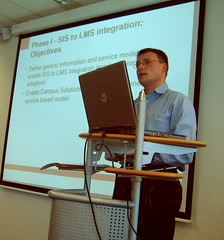
Last Wednesday the 4th of April we had a meeting of the SAKAI Special interest group at SURF in Utrecht. I couldn't attend the whole meeting but I was glad I could at least listen to the presentation given by Peter Bavinck of Oracle. He gave Oracle's plans on their Academic Enterprise Initiative. This is (my interpretation) an iniative to create a SOA framework which will cooperate with the Sakai framework and which can easily exchange information (for example from the Peoplesoft SIS).
Sometimes the smallest titbits of information can be extremely useful. I had been mucking about with the portfolio in Sakai but was stumped by the request for .xsd schema's. In the meeting someone tipped the xsd weaver. It seems brilliant, create your own forms online, save them locally and then add them to Sakai. (I haven't tried the last step out yet, but the rest works!).
The Hogeschool Utrecht is looking for a replacement for their Cascade system. Taking a quick look at their design I was surprised to see that they had not yet looked into LAMS, as they are looking for a system to deliver case based learning through a series of learning activities. And this can be integrated into all sorts of VLEs (not just Sakai ;-)
Blackboard User group meeting on Building Blocks
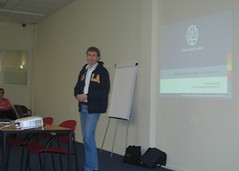
I attended a very interesting meeting on Blackboard Building Blocks organised by the Dutch Blackboard usergroup. It was held Thursday the 29th of March (yes I have some catching up to do:-).
What struck me most was the amount of initiative being put into the development of Building Blocks. If you see what various institutions are creating it is great. Some building blocks are large and very complex and require separate databases (there is even a 'Setter Getter': a building block which collects the settings you need when updating your building block.) One specific example is the Blackboard Management System which has been created by ROC Midden Nederland and Leiden University (also proudly presented at the Nice conference).
On the other hand this made me wonder why these extensive features are not included in the core code of Blackboard. I am pleased to see that Blackboard attended the meeting and I hope they will take the wishes of the Dutch e-learning market into account. This does pose questions as to who ownes the ideas and the code, would it not be fair to reward/gratify the developers that spent so much time developing the building block.
The Dutch situation:
We are at times decentralised, hence the BMS, have large courses (500 plus students) which we subdivide into groups (requires extensive group management and group grading) and we do a lot of Collaborative Learning in our courses. These are just a few differences which make the features available in Blackboard insufficient at times.
Subscribe to:
Posts (Atom)

 RSS feed for this blog

