Showing posts with label repository learning objects. Show all posts

Monday, January 12, 2009

Feasibility study: automatically archiving and sharing learning objects from Blackboard


Last year I set up a pilot study with the University Library here at Utrecht University. Courses in Blackboard are normally only accessible to the teacher of the course and the students. After a few years they get cleared up. Any archives are not accessible to anybody other than the system admin. This means teachers cannot see each other's materials and learn from each other.
In a previous project (the KIP project) we discoverd teachers were not interested in adding metadata to improve the 'findability' of archived materials. So this time we decided on a different approach:
- We created archives of a number of courses using the Blackboard interface (this can be done in batch)
- These archives are ZIP files consisting of XML files describing the course, files, links and XML files descrbing these files and links.
- The library wrote a script which analysed these XML files, stored certain files and retrieved the associated metadata from the XML.
- The files and links were saved in DSpace in a separate repository.
- A search interface was written so that teachers could search in the repository.

Once this was built I performed a test with six teachers at Social Sciences with various attitudes to computers and the sharing of knowledge. The results can be found in the following pdf document (in Dutch I am afraid).
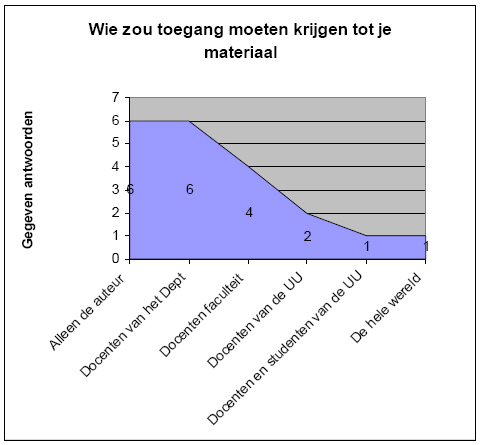
Who should have access to your teaching materials
A number of interesting findings arose. In general teachers were quite pleased to have this facility. They were not out to copy other teacher's materials but would like to be able to see what other teachers are teaching in their courses. There were not all that enthousiastic about sharing their materials with the whole world. They would like to know what others are doing with their materials.
On the technical side: It is technically possible. The Blackboard IMS packages contain a lot of information, not enough to fill all Dublin core fields, but it certainly is a good start.
This facility is not yet in production (other projects took priority) but it could be taken into production without too much work. All the difficult work has been done.

Wednesday, October 29, 2008

SURFmediacore presentation

Yesterday I attended the surfmediacore presentation. A long name for a soon to be available facility to store video's which can be accessed from a homegrown application using Webservices (REST calls to be precise). SURFnet will soon be calling for pilots to access this service. Institutions can connect with the service if they have a wish which is not a standard facility in Surfmedia.
An interesting meeting and off the cuff I suppose you could think along the following lines as an example of an application you could build:
1. A building block in Blackboard in which a teacher can directly upload a video in Blackboard and it will be directly embedded in the course.
2. Large uploads for the media libraries we have at present in our institutions. Possibly combined as a service with the university library. Drawback is the upload of copyrighted materials (same goes for 1.)
3. Alerting service for teachers. There has been an alerting service for years for researchers showing latest research. What about an alerting service for teachers showing the latest teaching materials which correspond to certain keywords/phrases. This is based on the ideas in the Zoep project. The university library could search the Surfmediacore collection and show the latest relevant video's as part of a larger alerting service. I do wonder whether you really need surfmediacore to do this. Probably the university could also do a harvest using the OAI exchange which is also available on the surfmediacore.

Monday, October 27, 2008

Who owns teaching materials?

Only a week ago I ran into an interesting question which arose for the first time. A member of the teaching staff had left university and removed course materials from his/her Blackboard course. Staff preparing the course site could not find the materials which were in place last year.
We have not got our Learning Objects repository in place yet, otherwise this would have been the perfect place to recover these documents. It does clearly show that a discussion on the intellectual property rights of teaching materials created by teachers is worth while. Actually: the discussion itself is not all the interesting, if a teacher has created materials while being employed by the university, the copyrights belong to the university. I practice however not everybody feels the same way about this and that is why it would be a good idea to raise this discussion.

Friday, June 08, 2007

Onderwijsrepository workshop

I am waiting for a harvest of the Repository of Learning materials into the Lorenet database, so I have some time to spare ;-) I am at a workshop at Surfnet presenting their new repository service. They have chosen to use Fedora as their repository service. They have chosen a really straightforward understandable page to enter all the required metadata. I must say it looks very clear, the descriptions are obvious, this is something I could confront my teachers with. On the other hand: I would rather not confront them with this information... They also offer the option not to include the actual file but only a link to the learning asset. This gives us the opportunity to refer to streaming media files on their server or rich media assets which consist of various types of content combined.
I do believe it would be worth while to offer teaching staff the opportunity to search for learning materials in the VLE and add these to their course with only one click.

Tuesday, March 06, 2007

Repository on offer...

Surfnet and Kennisnet are two organisations supporting respectively lower and higher ed in The Netherlands. They organised a meeting in which they offered a new repository facility for schools or colleges that might be interested. Moqub has also written about this meeting.
First of all I think it is a very good initiative. It offers schools a chance to try out a new technology they do not yet support. This also has been offered by Surfnet in the past (Breeze for videoconferencing) or JISC (Turnitin for plaguerism detection).
For Utrecht University the offer is less relevant as we are already running DSpace as a repository. Our challenge is to get learning materials into DSpace...