Sunday, May 18, 2008

Back from the Ardeche


As most readers wil have noticed, it has been very, very quiet on my blog during the past few months. There are a number of reasons for this. For one: I moved house back in February. Although it was only a short move and there was not a lot that needed doing to the house, it still took up a lot of my time (and still does).
At work I have been very busy in a number of projects, some of the final reports are now appearing, but in other projects I am still very busy. To give you an idea:
- Recording lectures for students with a handicap
- Recording lectures: report over 2007
- Use of blackboard at Utrecht University
- Automated archiving of teaching materials in Blackboard
- One VLE/portfolio and assessment/evaluation tool for Utrecht University (trying to find out the point of view from the Social Sciences faculty)
- Archiving students thesis's in a library archive
- etc...

And you must also relax every now and then, so we spent a week in the Ardeche with some fellow potholers. Although I did not do a lot a caving I did my first canyon and had a great time. We went for a few walks around Vallon Pont d'Arc. Walking part of a GR we bumped into this sign which goes to prove that it can be a lot busier in summer ;-)

Roger Scruton in Utrecht on higher and lower art

Thursday the 15th of May Roger Scruton gave a lecture on higher and lower art at the Academy building in the centre of Utrecht. It was organised by studium generale.
I attended the lecture with two friends from my reading group. It was great to see Scruton in real life. Years back we read his book 'Modern Philosophy' and it was great to see him in action and hear more about his background and ideas.
Roger Scruton

Central to his ideas is in my opinion the preposition that there are a set of traditional morals and values everybody should aspire to. These morals are strongly rooted in the Christian tradition, with two central pillars: sacrifice and irony. Under irony he classes a broad concept: being able to stand back and view ones attitudes and behaviour with the view of the outsider. As an example he gave the story from the new testament: those who are without sin, throw the first stone.

The reason I am writing about him in this blog, is that he posed a number of very traditional ideas about teaching and learning. Teaching should be available to those that have the intelligence, a pupil is a black box that should be filled with knowledge, the teacher is holder of knowledge and should be respected. He did not support teaching models in which the student should collect information or learn independently. In his set of values a teacher is central to learning.

Truly understanding art requires being taught the information required to fully appreciate the story behind a work of art. Children should be taught to appreciate high art. Strangely enough he could not define what high art was, other than: what has proven to have survived the test of time. On the other hand: what the majority of people appreciate at present does certainly not have to be high art, it often is not. Relativism does not get his support.
Looking back on his lecture my general impression was that his view of the world is looking backward into a small scale, quaint countryside with traditional values. The community is very important. I have trouble applying his ideas to a global society in which various cultures have different morals, information is not strictly bound to persons and groups of people are packed together in geographical space.

Sunday, May 11, 2008

Research into recording lectures for students with disabilities


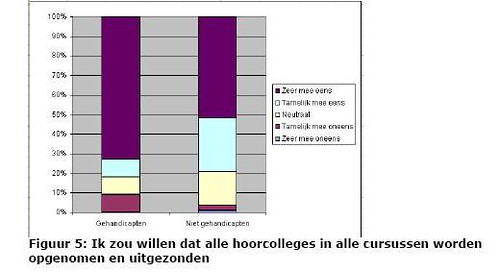
From September till November 2007 we recorded all the lectures in the first year Psychology course. One of the goals was to find out whether this facility would be valuable to the 23 students with disabilities taking this course (out of a total of 570 students). The disabilities were varied ranging between Dyslexia, Migraine, Hyperactivity or chronic fatige.
We collected data by conducting a written survey among all students and interviewing 15 of the students with a disability.
The results were very positive. All the students in the course were pleased with the facility. The students with disabilities could be split into two categories: the first was students having problem concentrating and taking notes during the lectures (e.g. Dyslexia, concentration disorder). They were very pleased to be able to watch the lectures again to write or improve their notes. The other category of students were students that weren't able to attend the lectures and could watch them at home in their own time. This also gave them the peace of mind that if they did have to miss a lecture due to their disability they could still watch what was discussed.
Follow these links for the summary and the full report (both in Dutch I am afraid).

Lecture on Internationalising education


At the annual 'Onderwijsparade' at Utrecht University (back on the 3rd of March) the organisers had invited Marijk van der Wende (CHEPS and VU) to talk about Internationalising Education. You can read an account (in Dutch) at the UU website.
At present Dutch government is focussing strongly on improving international cooperation at all the universities and all the universities are of course following suit. However, for many institutions it would be wise to sit back and first define the goal(s) of the internationalising efforts. Are you out to generate more income through foreign students, are you out to share knowledge and research or are you trying to attract and bind excellent students and researchers from around the globe?
The four approaches she defined were:
- mutual understanding (university as an institute of education)
- skilled migration (university as an employer)
- capacity building (socially engaged university)
- revenue generating (higher ed as an export product)
It was an inspiring lecture, it is a shame the slides aren't on the internet somewhere....

Use of Blackboard at Utrecht University


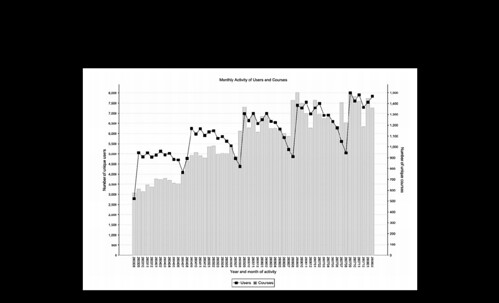
We have analysed the logs of the Blackboard server over the past few years and this gives an interesting insight into the use of the VLE. The results (in Dutch I am afraid) are reasonably comparable to outcomes of research at other universities. An interesting note is the fact that all courses at Social Sciences have been supported by Blackboard for a number of years now. That accounts for the early growth.
We have also tried to gain some insight in the use of different tools using the log data. Interestingly the use of discussion boards really has grown and is still growing. This doesn´t give an immediate answer as to how they are used as they are used for general FAQs, debating, collaboration, file sharing, etc.
All in all the results nicely mirror the use of Blackboard as a tool use to support all F2F learning, with the odd exploit into blended learning. The outcomes come at a great time as we are in the middle of an process to make a decision on a future single VLE for Utrecht University.

Workshop designing a Knowledge portal


Last Thursday the 8th Renee Filius asked me to help me out in a workshop. I did and it was great fun. I do enjoy getting people inspired and watching ideas rub off and start to live a life of their own. The challenge was to redesign a website (vraag Sofie) for personel advisors and experts on social security employed at universities in The Netherlands. The idea was to facilitate the exchange of information and knowledge through a portal. The challenge is to find a way in which the audience can and will easily participate. There are plenty of technical solutions, but are the users ready to rewrite each other's texts in a wiki for instance?

The photo's are out there on Flickr and if you look carefully you will notice I took them using my new Sony Ericsson mobile which has a quite reasonable lens and chip.

Wednesday, March 05, 2008

Innovatium,

Yesterday was my first visit to the Innovatium conference, here some very quick notes of my general impressions. The presentations came mainly from the field of professional universities in The Netherlands. The examples were often quite practical, some were more interesting for me than others. Again quite noticeable is the focus these institutions have on competences.
Sharepoint is a popular solution as a virtual learning (and working) environment. The professional universities are applying this system to address various problems (teamwork, sharing knowledge, presenting a curriculum portfolio which can serve for the accreditation of the courses, etc). Surfgroepen is regarded as a valuable tool because it is so open and can be opened up to external parties, whereas institution systems often have much more limited access. This for example will allow related companies to have access to a teamsite which plays a role in the learning process. A comment which reappeared in several sessions and in the hallways is the large amount of facilities on offer in sharepoint, this can lead to a confusing teamsite/workspace.
The last session I visited was given by Gijsbert Erkens from Educational studies at Utrecht University. Although I have helped him out in his course I never got round to really hearing what his intentions were in adding more and more learning ojects to his course module. The result is a large, varied and attractive collection of materials. Interestingly enough students appreciate the large collection of learning objects but they still have their primary attention directed at the summaries offered of the compulsory reading. He has also created snippets of the lecture recordings. These form an interesting application of this facility.

Friday, February 08, 2008

The first news regarding Bb next generation 9.0

On Willem van Valkenburg's blog I ran into the very first news regarding the long awaited next generation product presented by Blackboard. This was posted on a blog maintained by the Midland User group. Blackboard 9.0 is what was code named Omni and is the product that is supposed to satisfy Blackboard and WebCT customers. This is all very preliminary and I wonder if Blackboard aporves the fact that an institution has been leaking information, they can be rather secretive.
The release has been planned for January 2009. As far as features are concerned, this is what the Midland User Group lists on their blog:
[start quote]

New user interface - sections that can be dragged and ddropped around on the page, different pane for editing and viewing.

Engagement
* bought a communications company, so looking at provision of bulk SMS, email and voice messages through Bb
* page shown with wiki and chat in one area - very much the look of learning objects!
* iGoogle integration
* facebook integration
* RSS

Assessment
* instructor and student dashboard - shows you what is new, who is late, who has submitted work,
* assignment tool redesigned to match more clearly to learning outcomes, can deploy rubrics for marking
* portfolio - new system taking best of all three available systems, launch later than Bb 9.0

Openness
* APIs opened up
* enable multiple platforms to run together - moodle and sakai can be added seemlessly (single sign on) and with access to course documents across both
* iPhone interface, other mobile devices in planning

[end quote]
All in all quite interesting although it doesn't quite feel like a next generation VLE to me. It probably is a next generation product for the Blackboard company though. A few thoughts:
- I hope the drag and drop isn't relying on Java applets running on the client, we saw what issues that gave in WebCT Vista.
- iGoogle is nice, facebook is not all that interesting for the Dutch students, linking to Moodle and Sakai is surprising, mobile support was inevitable, otherwise not a lot of surprises.
One of the major things that does not make it a next generation VLE is the lack of the support of learning in a community through groupwork,sharing materials, openness to outsiders (becoming a member of a worldwide (scientific) community). There are a few items there but it will take a little more. On the other hand it will also take more to change the way teachers teach....

Thursday, February 07, 2008

Implementing a new VLE as a motor for change???

On the new surfspace site I ran into an interesting article in the University of Twente magazine (sorry, it is in Dutch). In this article Pløn Verhagen and Petra Fisser contest the very frequently stated causal relationship: New VLE > Improved pedagogy.
I can't agree more: if you wish to change teaching, change the teaching and don't expect teaching to change simply by implementing a new tool. Of course if you do wish to change the teaching one aspect of the change process is making sure that the necessary tools are available and in working order. However, do not start with the tools and expect the rest to change automatically.

Wednesday, February 06, 2008

Oh dear, not more plaguerism...

Yesterday in a meeting of the directors of education at the faculty I heard a worrying complaint. We are trying to educate students in correct citation and not taking other's work and presenting this as you own. One of the aspects of this measure is the use of a tool to detect plaguerism. Sadly the complaint was uttered that too many cases of plaguerism where being detected and especially the follow up on each case was taking up time and resources. Nobody argued that we should stop checking for plaguerism, on the contrary. The sad fact is that students are still copying off the internet (without citing the source), and perhaps worse still: are entering other students' papers from previous years...

Monday, January 28, 2008

Just some new Open Source VLE names

And for all those out there looking at the broadest possible approach to a learning environment, and are into open source: I just heard about Zarafa (a linux based collaboration environment which will work together with Outlook and MS Exchange).
Taking it from the other side some clever people have built some extra features into the really popular Content Management System Joomla to turn it into a Learning environment. Although there are many out there that simply state: why bother if you have Moodle which does it all anyway.
PS: This company also offers a Sharepoint 2007 LMS, why do I feel that all sorts of lines are coming together ;-)

Sunday, January 20, 2008

More experiences using the Asus Eee

double screen use of VGA output

I have now gained some more experience on the use of my Asus Eee. It really does work a treat. I especially appreciate the VGA out, with its accompanying software. This allows you to go up to 1600 by 1280 pixels and will clearly show you which of the screens you are sending the signal to. (Beats banging on the Fn F5 combination and waiting for the beamer to pick up the signal).

I have also got the Utrecht University VPN working. I have not used the Cisco VPN client but installed VPNC. It took some puzzling and if I can find the time I might write it all down. If anybody is having troubles, do contact me.

Monday, January 14, 2008

Various solutions for recording lectures

As I have noticed there are a lot of people out there wanting to start recording lectures, but not quite sure where to start a few suggestions for tools for creating rich media presentations, Please note: these are presentations combining streaming video with html so the student can navigate through the presentation by choosing slides in the presentation.
Please note: this is a very personal view of a number of products. I cannot claim to be complete or completely informed. If anybody has any suggestions or corrections please do send a comment. This is based on the Dutch market for ICT in higher ed, in other countries there might well be other optoins.
A good place to start is Microsoft Producer: the software is free, most institutions will have a laptop and a digital video camera lying about. It is a very time consuming process but a great to get teachers and students to warm to the idea. You can even use the Surfnet Videotheek to stream the .wmv video produced.
If you intend to take the recording and broadcasting more seriously there are plenty of companies out on the market offering solutions. Expensive but very comprehensive is the Mediasite solution. Other solutions on offer are Apreso/Echo360, Accordent (no experience with it yet, should see a trial on Wednesday) Tegrity (no experience with that either) and Presentations2Go. Presentations2go is a Dutch product developed by Wageningen University, but now for sale. An interesting aspect of the presentations2go solution is the pricing model, the server software is expensive whereas the software for the recording sets is cheap. This encourages the use of more recording sets.
Googling about I ran into an Open Source solution for recording lectures. I have no idea how it works, but the pricing certainly is very competitive. It is called ePresence. If anybody has any experience using it I am certainly intrigued.

Sunday, January 13, 2008

Recording lectures in 2008

Front of Mediasite recorder

In the year 2008 we intend to continue recording lectures at Utrecht University. The central IT policy department has offered funding to keep us going together with two faculties. This will keep the Weblectures project available. We have evaluated the experiences of students and teachers who used this facility. They were all very positive, most comments were about the reliability of the service: students get used to it and expect it work every time. If we wish to ensure a decent service which will work throughout the university a larger scale approach is required. Our main effort will be focussed on writing a plan to set up a structural service in 2009. We will be offering a final report on the Weblectures website.
On the technical side of things we will be not be using Apreso Classroom in 2008. We have decided to try out the mediasite mobile recorders in combination with the Mediasite EX server software through the Dutch reseller Mediamission. Apreso has proven to be a great solution to get us started and gain some experiences with the required hardware for recording lectures. The limitations which proved decisive for us where the lack of monitoring of the incoming signals, the fact that the hardware was not portable and the fact that editing is not possible at all. For a lot more money Mediasite does also offer some other facilities, e.g. live broadcasting. I will keep you posted on our experiences. We have already made our first recordings with the recording sets and are hard at work on getting the server up and running.

Cold dip to start off the new year

Just clearing up some old news: I started off the new year on a fresh start: we took a dip in the North Sea... With a great big thank you to the life savers at 's Gravenzande which make this possible every year. Follow this link to get to the photo's.

Monday, December 17, 2007

Experiences with the Asus Eee

Not more than a handful
Back in December was the big day: I got my Asus Eee in the post, all the way from Taiwan. It isn't on sale in The Netherlands yet. It really is tiny. I have dropped it in my bag and forgotten it was there. The keyboard is not a problem, it just takes some getting used to. The screen could be bigger, but is quite reasonable for most websites. The storage is not very large, but who cares if you can push in an SD card, which neatly disappears in the slot and can stay in there when you move it about. The webcam is straightforward but works a treat. The Skype has been updated and quite probably should work with the webcam, nobody has skyped me yet, so if there are any volunteers?
Sadly the built in webcam capturing software seems to work, but the outputted video (.ogg format) doesn't make sense, it is far to long and slow.

The big bonus is that it truly works out of the box with its built in Open Source software. If all Linux was this easy a lot more users would be using it. Out of the box you get a browser, a mailclient, messaging software, skype, open office antivirus, video and audioplayer, picture manager, a number of games (some of them educational) and some other things. The drawback is that it does take a little puzzling to get other programs running. For example: I am have trouble getting our university vpn installed. A commercial party has finally decided to offer a computer running on open source software preinstalled. It is certainly easy to get started with.

One of the reasons I have not got round to writing this earlier is that everybody kept grabbing it out of my hands. Especially the kids are great fans. They love it for its small size, all the built in games and Pidgin messenger. it has already featured on Wilfred and Pierre's Blogs and already has found its way to Flickr...

Friday, December 14, 2007

General feelings on the Online Educa Conference in Berlin


I finally have found some time to get to cleaning up my blog and clearing up some old concepts I still had lying around.
To start off, some almost ancient history: My general feelings on the Online Educa conference. To start off, I was a little disappointed: I did not hear a lot of new things and I still feel the concept doesn't work: Four presentations in one session is a lousy concept. Usually 1 is worth while, 1 is a waste of time and two are usually not all that interesting or relevant. It was definitely worth while meeting up with the many Dutch at the conference. As so often I mainly gained inspiration through conversations rather than presentations.

And in an attempt to overlook a few developments and giving each their spot on Gartner's Hype Cycle:
- Podcasting is well and truly over its hype peak
- Web2.0 is here to stay, but it is over its hype peak
- Virtual worlds is running up to its hype peak
- Institutions are becoming more realistic about Services approach
- The general feeling regarding VLEs is 'agnostic'. Believing in one VLE is out of fashion
- Theories and technologies applicable to Informal Learning are still being applied to formal teaching situations (without judging whether they really work).

Friday, November 30, 2007

Virtual Worlds - some valuable findings to take home

Yesterday I visited a session on Virtual Worlds. It did not seem really exciting at the time, but after having had some time to digest, there were some points I would like to jot down for my own memory.
- Sun Microsystems is developing a virtual world which will be called Wonderland.
- Surprisingly Second Life has been used for language learning. I guess that the exchange of language was mainly in text and not the spoken word, but it was not discussed further.
- People are expecting Web2.0 to be followed by Web3D, I am not sure I agree at this point in time...
- They gave the sensible advise: Only use 3D when it really adds value to learning and teaching, otherwise it is a pain. A mix (hybrid model) is much more likely using 3D tools in certain tasks and other tools in others. For example combining the use of Xing.com and Second life.
- An important step will be adding content and integrating other media in the virtual environment.
It will become truly personal if your avatar's expressions are fed by input from your webcam. This will make avatars a lot more lively and make the virtual world much more real. This feature will surely be available in the future. (With special thanks to inspiration from a business proposal in the Dragon's Den programme on the Beeb.)
- 'Just building a stadium (ed: in a virtual world) is not enough. You have to organise it's use'.
- Perhaps a smaller and more straightforward meeting place than Second Life can be offered by Qwaq.

As a clear example of the use of Second Life they suggested training oil-rig staff on escape routes during emergencies. It certainly seems to extremely suited to this use. Running around on an oil rig with virtual fires all around is a lot safer than in real life.

Moodle in distance ed

Eric Clarke, with a lovely Irish accent, from the Royal College of Surgeons in Dublin delivered a session on the use of Moodle (and how much it costs to run). Yes, for all those out there still going after Open Source because it is free: Sorry to disappoint you, but there are enough other costs in keeping a VLE up and running. He gives a lovely description: 'What are we really going on about: is it all about lawsuits and : 'My VLE is bigger than yours' or is about teaching and learning?

The use of Moodle is a great success, but he gave us the warning: do take third party support, network and servers into account (180K euros and that's without the costs of user support.) The problems they are now facing are ironically their heavy reliance on Moodle, and the large amount of materials and tools on offer which confuse students without structure.

Research into a new VLE for the OU


Steven Verjans from the Open University in The Netherlands has been researching their demands for a VLE. Strangely enough this is taking place as they just have starting deploying Blackboard. They find that Blackboard is, however, strongely based on the classroom metafor and not suitable for their teaching. Students don't meet in a classroom in the OU setting and learn independently and self paced.
Quite understandably the OU is not thinking on a short term adoption, but rather thinking three years ahead.
They appear to have a preference for an open source framework approach allowing for webservices. I do get the slight impression at this point the preference is based on technological innovative solution, rather than students' basic demands.