A thank you to Wilfred for being my friend ;-)
But seriously, I thought I would try the Twitter badge which shows my friends on Twitter. It really does work and certainly is a lot more interesting than just my own mucking about. The one thing I did notice was that it was a pain to find out just who is on Twitter. Of course I can start inviting everybody, but I just want to find those already on twitter...
Thursday, May 31, 2007


Wednesday, May 30, 2007
Google map on my blog
With thanks to a posting by Pierre, I gave MyMaps a try. It is extreeeeemely simple. It took me about 10 minutes to build a map and to squeeze it onto this blog!
So here it is: a few places of work I am cycling between regularly...
So here it is: a few places of work I am cycling between regularly...
Creative Commons finally on this blog
It took a while bit I have finally got round to reading the fine print and selecting the most suitable licensing for this blog. You will now find a small logo in the column on the right.

The background is that all the information on this blog can be shared and used as long as you correctly attribute this to the author. This is an open expression of the more inherent underlying idea regarding social software: it is valuable to share information, in sharing you can set up communities and networks in which everybody can profit. It is no longer the information itself which is important, but rather the skill in building up a network, assessing the value of information and reflecting on information.
The background is that all the information on this blog can be shared and used as long as you correctly attribute this to the author. This is an open expression of the more inherent underlying idea regarding social software: it is valuable to share information, in sharing you can set up communities and networks in which everybody can profit. It is no longer the information itself which is important, but rather the skill in building up a network, assessing the value of information and reflecting on information.
Tuesday, May 29, 2007
Meeting of the Blackboard User Group

Last Friday we had a meeting of the Blackboard user group in Utrecht. To view the programme and the presentations visit: http://studion.fss.uu.nl/training/gebruikersdag
Other's remarks can be found at: http://weblog.leidenuniv.nl/bb/bbusergroup/2007/05/verslag_blackboard_en_web20_bijeenkomst.php
It was a small gathering the day before the Whitsun long weekend, but never the less quite interesting. It was good to see that there are initiatives out there to get social software into the classroom. They do not necessarily have to be in Blackboard, as this can be a very closed environment as compared to the more open environment which is more suited to more open student of the next generation.
I was slightly disappointed to see Scholar in action, it was not a easy and intuitive as I had hoped, On the other hand, I have given the learning objects building block a try and that was really easy to use and showed results quickly. Shame about the price though...
The final message that did linger was Robert Jan's frogs: this may be an innovation which will require some slow warming up to. It certainly does not seem to be something all teachers are rushing to adopt.
Twitter badge
In case you are wondering what I am doing at every possible moment of the day, you can always watch my Twitter badge, now added in the column on the right....
PS: I don't promise I will keep it up all that regularly, I am just not techy enough for that sort of stuff ;-)
If anybody wants to sign up as my friend I can try out the badge with friends too :-)
PS: I don't promise I will keep it up all that regularly, I am just not techy enough for that sort of stuff ;-)
If anybody wants to sign up as my friend I can try out the badge with friends too :-)
Tuesday, May 22, 2007
Discussion on 'New Learning'
Yesterday Tumult Debat organised a debate on the latest debatable Dutch hype in Dutch education: the so-called 'Nieuwe Leren' which could be translated as the 'New Learning', which has been the subject of a lot of debate lately in the Dutch media.
Last Saturday the Volkskrant ran an article on the 'New Learning' and one thing which became quite apparent is that it encompasses a collection of different theories and principles.... Robert Jan Simons gave a clear description. This point came up regularly during the debate.
In the debate Paul Kirschner and Monique Boekaerts gave their views on a number of principles of instruction and learning design which where clear and not very debatable. The listeners however where often from schools and clearly had ideas rooted in practice. Some were clear advocates whereas others clearly preffered a traditional style of teaching. If there was one thing that could be learnt from the debate it is that:
Last Saturday the Volkskrant ran an article on the 'New Learning' and one thing which became quite apparent is that it encompasses a collection of different theories and principles.... Robert Jan Simons gave a clear description. This point came up regularly during the debate.
In the debate Paul Kirschner and Monique Boekaerts gave their views on a number of principles of instruction and learning design which where clear and not very debatable. The listeners however where often from schools and clearly had ideas rooted in practice. Some were clear advocates whereas others clearly preffered a traditional style of teaching. If there was one thing that could be learnt from the debate it is that:
- New learning is really New teaching
- Learning theory is not a direct instruction on how to teach
- There is not one clear instruction how you should teach a bunch of students as they differ (where have I heard that before).
- The underlying principles may be brilliant, but if you don't do it well (invest money) it will not work as well as promised.
Tuesday, May 15, 2007
Blackboard Usergroup meeting in Utrecht

On friday the 25th of May we (Studion Support) will be hosting the next meeting of the Dutch Blackboard Usergroup. This meeting will be directed at 'Blackboard and Web2.0' or better still: 'Blackboard and Education2.0'. After a broad introduction in the Net-gen student and what Web2.0 is, we will be looking at various possibilities of using Web2.0 tools in conjunction with Blackboard.
Of course we will be looking at the first tool in the Blackboard Beyond Initiative (Scholar) but will also be looking at other tools (blogs especially) which other institutions in the Netherlands have been experimenting with.
For more information (including the programme and information on how to register) please visit: http://studion.fss.uu.nl/training/gebruikersgroep
Wednesday, May 09, 2007
Rights on recordings
I just found a webpage with some interesting answer to FAQs regarding rights for the recording of lecturers and the use of other fragments in your own recordings. It is a page in Dutch maintained by Surf DiReCt.
http://www.surffoundation.nl/smartsite.dws?id=13002
http://www.surffoundation.nl/smartsite.dws?id=13002
Friday, April 27, 2007
Article on the Next Generation VLE now definite

It is now finally official: My article on 'The New Generation VLE' has now been made public. This article is based on the findings at the Educause conference in Dallas Texas, last October. The main message is that there are the first beginnings of a new generation of VLE's. They can be characterised by the fact that they are no longer a 'walled garden' dominated by the teacher, but rather a more open environment in which students and teachers can work together with persons, materials and other webservices outside of the classroom or even institution. And of course the VLE can be approached through various devices and allows for modern delivery of media.
Various vendors and institutions are working towards this solution, but none of them are there yet. There are promising developments in the field of Open Source and commercial parties (Blackboard especially) and the adoption of a Service Oriented Architecture could also be very helpful in working towards an integrated VLE with all these functionalities.
The article can be found on the WIKI at: http://82.192.89.182/~wiki/index.php/Hoofdstuk_Nieuwe_generatie_ELWO
I am sorry to say that the article is only available in Dutch at present. I am afraid that I will not find time to translate it in the near future. If anybody does require an English translation, please let me know.
Monday, April 23, 2007
Internationalising our education - use of video
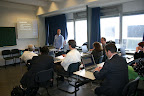
We had a seminar on Internationalising our education at Utrecht University last Thursday. It was great to see the efforts being made at the WUN (World Wide Universities Network) and Penn State. We still have a long way to go...
Together with Lex Hermans I gave a presentation on the use of video in distance education both for a-synchronous and synchronous learning. The slideshare is included below.
David Pilsbury also pointed out the Research channel, a collection of high quality videos covering some serious subject matter. This would require a tad more investment than the simple recordings we have being doing of late and would also require some serious commitment at all levels in the university. Great for your public relations though...
Together with Lex Hermans I gave a presentation on the use of video in distance education both for a-synchronous and synchronous learning. The slideshare is included below.
David Pilsbury also pointed out the Research channel, a collection of high quality videos covering some serious subject matter. This would require a tad more investment than the simple recordings we have being doing of late and would also require some serious commitment at all levels in the university. Great for your public relations though...
Sunday, April 15, 2007
Blackboard and Vista
A quick note for my own use, sorry guys ;-) As we had noticed Microsoft Vista and Blackboard do not always work together well. See Willem van Valkenburg's blog for a list of problems acknowledged by Blackboard.
Attending recorded lectures
An article on the Dutch Edusite pointed out that students still attend lectures when they are recorded, although the (notorious) law students do not always comply ;-)
Leidse student laat opgenomen college soms schieten
This is something we must give a try: we are going to record lectures and evaluate attendance anyway. We must see if under comparable circumstances law students show different behaviour to other students...
Leidse student laat opgenomen college soms schieten
This is something we must give a try: we are going to record lectures and evaluate attendance anyway. We must see if under comparable circumstances law students show different behaviour to other students...
Friday, April 06, 2007
Presenting away for Weblectures
Yes, I know it is getting a bit boring: this blog is getting filled up with the weblectures project. I suppose this is only a correct representation on how I am spending my working hours at present...
The project is now really underway. The buzz is obviously spreading at Utrecht University. I have given presentations for the ICT in ed representatives of all the faculties and for the Heads of Education at Social Sciences. The university board visited Social Sciences and requested a presentation, so that is what I delivered. You will find the presentation here (long live Slideshare). If the embedded presentation won't load visit http://www.slideshare.net/kgrussell/weblectures-presentation-for-university-board/1
Next week there will be a seminar on internationalising our education and we will be present of course ;-).
It is very interesting to see the interest expressed by different departments within the university. It is also interesting to see the differences in motivation. Chemistry wanted to give some part time students a chance to watch lectures, Social Sciences' Graduate School is collaborating in a distance learning programme and they are creating short lectures specifically for this purpose in our studio. Maths wants to document lectures so students can view whenever they want, at any point in their studies, Studium Generale offers public lectures which they want to be accessible to a wider audience, students are bugging teachers to have their lectures recorded so they can revise before exams, and so on....
The project is now really underway. The buzz is obviously spreading at Utrecht University. I have given presentations for the ICT in ed representatives of all the faculties and for the Heads of Education at Social Sciences. The university board visited Social Sciences and requested a presentation, so that is what I delivered. You will find the presentation here (long live Slideshare). If the embedded presentation won't load visit http://www.slideshare.net/kgrussell/weblectures-presentation-for-university-board/1
Next week there will be a seminar on internationalising our education and we will be present of course ;-).
It is very interesting to see the interest expressed by different departments within the university. It is also interesting to see the differences in motivation. Chemistry wanted to give some part time students a chance to watch lectures, Social Sciences' Graduate School is collaborating in a distance learning programme and they are creating short lectures specifically for this purpose in our studio. Maths wants to document lectures so students can view whenever they want, at any point in their studies, Studium Generale offers public lectures which they want to be accessible to a wider audience, students are bugging teachers to have their lectures recorded so they can revise before exams, and so on....
Kick off meeting project group Weblectures
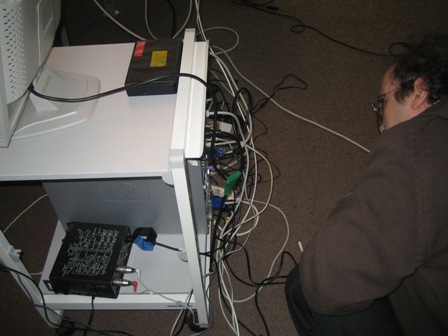
We had a kick off meeting for the project group (and a few other interested staff members) of the Weblectures project. Although the project started back in January it was good to take the time to stand back and look at what everybody had accomplished in only a short time. I am extremely chuffed to see how far we have come! Of course we are not there yet and it isn't perfect but we definitely out on the road recording. (A careful estimate is 30 lectures recorded to date).
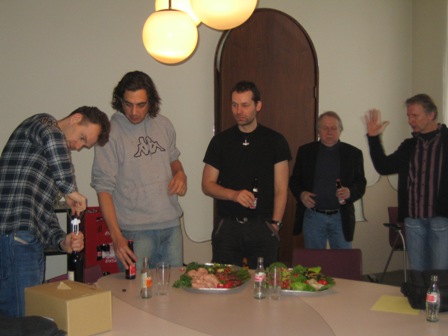
For more information on the project visit http://gathering.let.uu.nl/weblectures soon to be moved to http://www.uu.nl/weblectures
Sakai SIG meeting, Oracle gives its views
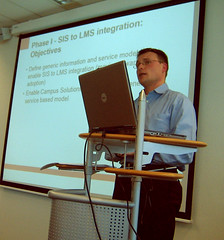
Last Wednesday the 4th of April we had a meeting of the SAKAI Special interest group at SURF in Utrecht. I couldn't attend the whole meeting but I was glad I could at least listen to the presentation given by Peter Bavinck of Oracle. He gave Oracle's plans on their Academic Enterprise Initiative. This is (my interpretation) an iniative to create a SOA framework which will cooperate with the Sakai framework and which can easily exchange information (for example from the Peoplesoft SIS).
Sometimes the smallest titbits of information can be extremely useful. I had been mucking about with the portfolio in Sakai but was stumped by the request for .xsd schema's. In the meeting someone tipped the xsd weaver. It seems brilliant, create your own forms online, save them locally and then add them to Sakai. (I haven't tried the last step out yet, but the rest works!).
The Hogeschool Utrecht is looking for a replacement for their Cascade system. Taking a quick look at their design I was surprised to see that they had not yet looked into LAMS, as they are looking for a system to deliver case based learning through a series of learning activities. And this can be integrated into all sorts of VLEs (not just Sakai ;-)
Blackboard User group meeting on Building Blocks
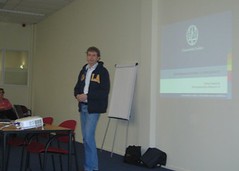
I attended a very interesting meeting on Blackboard Building Blocks organised by the Dutch Blackboard usergroup. It was held Thursday the 29th of March (yes I have some catching up to do:-).
What struck me most was the amount of initiative being put into the development of Building Blocks. If you see what various institutions are creating it is great. Some building blocks are large and very complex and require separate databases (there is even a 'Setter Getter': a building block which collects the settings you need when updating your building block.) One specific example is the Blackboard Management System which has been created by ROC Midden Nederland and Leiden University (also proudly presented at the Nice conference).
On the other hand this made me wonder why these extensive features are not included in the core code of Blackboard. I am pleased to see that Blackboard attended the meeting and I hope they will take the wishes of the Dutch e-learning market into account. This does pose questions as to who ownes the ideas and the code, would it not be fair to reward/gratify the developers that spent so much time developing the building block.
The Dutch situation:
We are at times decentralised, hence the BMS, have large courses (500 plus students) which we subdivide into groups (requires extensive group management and group grading) and we do a lot of Collaborative Learning in our courses. These are just a few differences which make the features available in Blackboard insufficient at times.
Tuesday, March 27, 2007
A day at home with the Net-generation
I was supposed to attend a meeting of the CWIS group today,  but life can take a different unexpected turn. My son caught a tummy bug so I spent the day at home, playing Triominos and other games and giving Second Life a go... So I ended up working with the netgeneration after al, but not quite in the manner I expected . I hope all the attendees had a great time and I really missed the meeting :-( I must look around on some blogs to see how they got on...
 but life can take a different unexpected turn. My son caught a tummy bug so I spent the day at home, playing Triominos and other games and giving Second Life a go... So I ended up working with the netgeneration after al, but not quite in the manner I expected . I hope all the attendees had a great time and I really missed the meeting :-( I must look around on some blogs to see how they got on...
Monday, March 12, 2007
8 days a week, ironing is a chore
Last Thursday was the annual symposium organised by IVLOS at Utrecht University. The theme was 8 days a week, how students and staff can manage to do learning and teaching in the amount of time that seems available for this task. I am pleased to see that the IVLOS has picked up on this (see article by Robert Jan Simons on Edusite). As far as students are concerned the picture is pretty obvious: Students in the Netherlands are trying to combine studying (approximately a meagre 20 hours a week) with all sorts of jobs to add to their grant and support their lifestyle.
Inez Groen gave a presentation (again) on the Einstein Generation. The story did not contain much new information, but it was interesting to hear it again and to add it unto experiences I had gained lately. One interesting aspect was the attitude the new generation of students has regarding university. University is now commonly called school. Spoilt as they are with all the wealth they have been surrounded with they are used to having many choices available. They will choose the easy choice, they expect to be involved and engrossed in the study they have chosen for. (Please note: this does not necessarily mean they are lazy!) They expect good teaching. The teacher should certainly be a subject matter expert, otherwise they might as well spend their time on the internet where you can find almost anything.
And IT is extremely boring, it is a tool not unlike an iron. You plug it in and it works. This does not mean you should not use IT, it means you should only use it if it makes sense, IT for IT's sake is only fascinating for digital immigrants, duh!
Staff on the other hand are suffering from the demand for a more involved style of teaching. In many cases this has been translated into giving the students many more assignments. Sadly this means teachers have an awful lot more checking of papers to get through. There was a session specially directed at this problem which I certainly enjoyed. What about letting students doing the teaching in turn. They are the ones that are setting up the presentation, organising excersises and getting the students involved. It seemed to work really well. It brought back happy memories from a class I attended using the same formula. It was definitely the most interesting and involving module I followed during my masters'.
Inez Groen gave a presentation (again) on the Einstein Generation. The story did not contain much new information, but it was interesting to hear it again and to add it unto experiences I had gained lately. One interesting aspect was the attitude the new generation of students has regarding university. University is now commonly called school. Spoilt as they are with all the wealth they have been surrounded with they are used to having many choices available. They will choose the easy choice, they expect to be involved and engrossed in the study they have chosen for. (Please note: this does not necessarily mean they are lazy!) They expect good teaching. The teacher should certainly be a subject matter expert, otherwise they might as well spend their time on the internet where you can find almost anything.
And IT is extremely boring, it is a tool not unlike an iron. You plug it in and it works. This does not mean you should not use IT, it means you should only use it if it makes sense, IT for IT's sake is only fascinating for digital immigrants, duh!
Staff on the other hand are suffering from the demand for a more involved style of teaching. In many cases this has been translated into giving the students many more assignments. Sadly this means teachers have an awful lot more checking of papers to get through. There was a session specially directed at this problem which I certainly enjoyed. What about letting students doing the teaching in turn. They are the ones that are setting up the presentation, organising excersises and getting the students involved. It seemed to work really well. It brought back happy memories from a class I attended using the same formula. It was definitely the most interesting and involving module I followed during my masters'.
Tuesday, March 06, 2007
Repository on offer...
Surfnet and Kennisnet are two organisations supporting respectively lower and higher ed in The Netherlands. They organised a meeting in which they offered a new repository facility for schools or colleges that might be interested. Moqub has also written about this meeting.
First of all I think it is a very good initiative. It offers schools a chance to try out a new technology they do not yet support. This also has been offered by Surfnet in the past (Breeze for videoconferencing) or JISC (Turnitin for plaguerism detection).
For Utrecht University the offer is less relevant as we are already running DSpace as a repository. Our challenge is to get learning materials into DSpace...
First of all I think it is a very good initiative. It offers schools a chance to try out a new technology they do not yet support. This also has been offered by Surfnet in the past (Breeze for videoconferencing) or JISC (Turnitin for plaguerism detection).
For Utrecht University the offer is less relevant as we are already running DSpace as a repository. Our challenge is to get learning materials into DSpace...
A wiki elsewhere...
When thinking about a new generation VLE, it became clear that are different roads that can be travelled to attain this goal. Typical for early adopters is to go out on the web and find a tool that does it for you, and there are a lot of them around.
I was shown the wiki http://bbamusic.wikispaces.com which was set up by the Burr and Barton academy in the free wikispaces environment. Quite amusing to have a look around and to read their ear training assignments.
In fact I once, long ago, gave two honors students a space in wikispace to write a public essay. It can be found at http://fswhonours.wikispaces.com I must give it a read.
The great advantage of using external facilitues is you can choose just the one you want at no cost. The great disadvantage is that they are not imbedded in your technical and administrative infrastructure. Think about backups and account administration for example...
I was shown the wiki http://bbamusic.wikispaces.com which was set up by the Burr and Barton academy in the free wikispaces environment. Quite amusing to have a look around and to read their ear training assignments.
In fact I once, long ago, gave two honors students a space in wikispace to write a public essay. It can be found at http://fswhonours.wikispaces.com I must give it a read.
The great advantage of using external facilitues is you can choose just the one you want at no cost. The great disadvantage is that they are not imbedded in your technical and administrative infrastructure. Think about backups and account administration for example...
Subscribe to:
Posts (Atom)

 RSS feed for this blog
