The National news showed an item last Monday on the ALPO (Academic Teacher Training Course Primary Education) which has just started here at Utrecht University. I tried to distill the right snippet using the Virtual Cutting machine and it seemed to work. Theoretically you should be able to watch the snippet below:
However the paramaters start=584&end=721.6 are not being passed through properly. The result is that you do not see the entire news, only a selected amount of time starting at the beginning of the video.
ALPO in NOS Journaal 1 sept 18 uur
Thursday, September 04, 2008


Tuesday, September 02, 2008
Animation on Surf media
I have finally got round to trying out Surf Media. It does actually seem to work. As a proof here an embedded video (original was Quicktime). The animation is a product created for the Partner Project to illustrate the concept of a Virtual Knowledge Centre. The animation itself is also quite interesting.
Monday, September 01, 2008
The new strict style?
This morning I attended the introduction lecture for all the students of pedagogical and learning sciences entering the faculty this year. It was extra exciting as the first group of ALPO (Academic teacher training course for primary education) students was present. This course is a first in Dutch Higher education and is a cooperation between the professional (Hogeschool Utrecht) and academic (Universiteit Utrecht) university in Utrecht.
The vice dean did warm all students present about the new 'strictness' which they can expect in their courses. Students are expected to pass enough modules in their first year, plaguerism is a serious offence which will not go unpunished and there is a Dutch language test for all students. This is not compulsory, but is strongly advised. Essays containing several mistakes will be returned ungraded.
And now all the hallways are bustling with firstyear students.
Manual Blackboard Grade Center
Having switched to Blackboard 8 our teaching staff is confronted with the new grade book, now renamed to Grade Center. We have written a quick manual (in Dutch) which can be found here.
Some small observations:
- Uses AJAX technology, and works fine on all platforms. We had slow loading on our (rather old) test server, but this is not a problem on our production server.
- Offers a lot of facilities that teachers do not all need and does confuse a little
- Finally teachers can view and grade the grade list by group(s). This does require creating a 'Custom view' first.
- Does not offer a decent calculated final grade on a score of 1 to 10.
Tuesday, August 26, 2008
Tip for more manuals and instructions

Kelly Sonora was kind enough to send me a link with lots of valuable manuals and instructions for teaching staff using Blackboard. And these are all in English!!
The address of the posting is at:
http://www.smartteaching.org/blog/2008/08/the-ultimate-guide-to-blackboard-100-tips-tutorials/
They certainly have done a great job! I see they are also using the Teams LX building block as a Wiki solution.
Wiki in Blackboard - yet another manual
A well known drawback in most traditional VLE's is the lack of possibilities for structured input by students. One tool which can allow students room to add input in a structured fashion and collaborate on a collection of knowledge is the Wiki.
Sadly Blackboard does not offer this in the core code. Some teachers have requested a Wiki but in first instance it would be best to have a closed wiki for groups of students.
In order to gain some experience we have decided to try out the Teams LX building block offered by Learning Objects. I have ran it through and it seems to be very comprehensive. It allows for private group wikis which will automatically become accesible to the other students in the class after a predefined date. It also allows for commenting and exporting the final product to a public website.
I will be following a number of courses using this Wiki and am very intrigued how students and teachers will respond to this new tool.
The teachers manual (in Dutch) can be found here.
The students manual (in Dutch) can be found here.
Sign up sheets in Blackboard
We are also using the Blackboard Sign-up sheets building block. The teachers manual (in Dutch) can be found here.
The new Peer review module in Blackboard 8
We are now running Blackboard 8 at Utrecht University. On of the great improvements is the Peer Review tool which has been added. It really does seem well thought out and connects well with the practice of Peer reviewing that a number of our teaching staff have adopted. I see a great advantage in the way it can save teachers time in organising the whole process: it enforces deadlines and distributes essays anonymously.
The teachers manual (in Dutch) can be found here.
And the students manual (also in Dutch) can be found here....
If anybody would like the original files, please contact me.
The teachers manual (in Dutch) can be found here.
And the students manual (also in Dutch) can be found here....
If anybody would like the original files, please contact me.
Back from the Queyras

I have just returned from a great holiday hiking in the French Alps, in the Queyras region to be precise. It was great. Amongst other things we hiked to the rifugio Granero and the Rifugio Jervis (both excellent Italian meals), clambered up the Col Selliere, Col Lacroix, Col d'Urine, Col Vieux and some others but finishing off with the peaks: Pic de Foreant and of course the Pain de Sucre. To keep ourselves amused we also did a lovely klettersteig and some very child-friendly rafting.
And now its back to work....
Thursday, July 24, 2008
Another player on the mini laptop market

An add in a local newspaper pointed me at the Acer Aspire One. It is yet another mini notebook. With a weight of under a kilo and 8,9 inch screen it seems quite a nice product. I found a review at cnet. It certainly is a nice price at 299 euros, shame about the trackpad buttons and the weak battery.
I am still happy with my Asus Eee, but the 7 inch screen is still rather small and I am disappointed with the updates Asus has provided for the Xandros operating system. I do hope Acer will do a better job with the Linus Lite OS they are using on the Aspire One. It is interesting that the hardware manufacturers are the ones responsible for supporting open Source operating systems...
Friday, July 11, 2008
Utrecht University has chosen for Blackboard as VLE

It is now (sort of) official: Utrecht University has chosen to use Blackboard as its Virtual Learning Environment. Blackboard is already in use at a number of departments besides WebCT en BSCW.
The decision was prepared by a project group which was asked to compare (the shortlisted options) Sharepoint and Blackboard Next Generation. Important arguments in making a choice where: Blackboard offers all the required functionalities out-of-the-box, whereas using Sharepoint would require a lot of programming and customising. This would not only make it a very expensive option in the short term, but also requires upkeep and adaptations in the longer term. Sharepoint was also considered less suitable due to the steep learning curve for staff. This is related to the fact that it is not purpose-built for teaching and learning and does not fit in the 'classroom metafor'.
The decision is notable if you take into account that Utrecht University will be using Sharepoint for the public website, intranet and (in the future) teamspaces.
Sunday, June 22, 2008
Article in NRC on Weblectures
It is rather frustrating to write a blog entry on a newspaper article which is not freely available online, In this saturday's NRC (Education and Science supplement) there is an article on recording lectures. In this article you can find references to the Dutch 'entrepeneurs' in this field (TU Delft and Triple-L) and to the findings we published at Utrecht University.
Saturday, June 21, 2008
In Twente VLE team advises Blackboard
The quickscan report on Blackboard as a VLE for Twente university is now pulic and can be found at: http://www.utwente.nl/elo/. It is a very interesting report for the Dutch VLE watchers. After havng looked at Sakai and Sharepoint, both received a very critical quickscan. Neither were considered suitable as a VLE for Twente. And at the end of the process Blackboard popped up as an option, and very interestingly students had an important role in this decision. Based on this quickscan Blackboard has proven to be the best option as a VLE for Twente, though the decision will still have to be made by the university board.
Utrecht will be presenting its advice to the university board very soon, the question will be if they arrive at the same conclusion or advise reconstructing Sharepoint into a VLE....
Utrecht will be presenting its advice to the university board very soon, the question will be if they arrive at the same conclusion or advise reconstructing Sharepoint into a VLE....
Sunday, June 15, 2008
Presentation at Biology on Weblectures
Wednesday the 13th of June I was asked to give a presentation on Weblectures at the Biology department. Elly Langewis was kind enough to record the audio during the presentation. Using slideshare I have created a slidecast, you can find it embedded below.
I am very interested in the outcomes of the evaluations after the final exam of the Biology course that has been recorded. In this course both weblectures and audio podcasts were offered. I am very intrigued how students have used these two different solutions and which they preferred.
At the end of the presentation I was not surprised to find that the teachers present were apprehensive. In the past the worry they conveyed was that students would not come to lectures anymore. The evaluations in previous courses quickly dispelled that concern. They found an other worry in its place: Weblectures would prevent students from acquiring the academic skill of sitting still and taking notes in two sittings of three quarters of an hour. This argument was a little strange for me. In evaluations students have answered that they do not make less notes due to Weblectures. As one of the teachers stated: in the old days we had to concentrate for three quarters of an hour, let them learn to do the same... It felt as a slight fear of modern technology and its possibilities. Fortunately slides, overhead sheets, powerpoints and video have already been incorporated into lecture halls, so I do feel that the teachers will need to have the chance to adjust to this new technology and make it their own. A forceful approach does not feel in place in a setting like this one.

Friday, June 06, 2008
One VLE: the preferences from Social Sciences

Here at Utrecht University we are in the process of deciding on one VLE for the university. I have been busy collecting opinions of teachers, students and supporting staff in the previous months. Our findings and some comments students made can be found here.
Some of the most surprising comments: they would rather have clear courses which are easy to navigate, teachers using the same headings for the same matters, don't mix personal with study related matters, the teacher is respected for his expertise: his/her contributions should be clearly distinguished from the contributions of fellow students...
Monday, May 26, 2008
Is creative learning better than competence based learning?
I ran into an interesting announcement of a PhD defense at the University of Tilburg (sorry in Dutch). Paul Denooz decided on a different learning concept than the competence based learning which is so popular in Dutch professional universities. He complains that competence based learning is turning out to be very teacher controlled, students are merely ticking off the skills which the teacher has prescribed. Students are not being creative and they are not being properly prepared for society (although I was under the impression that was exactly what competence based learning was intending to do...)
He has run an experiment for three years in a row using his 'Creative Action Methodology' in which students are encouraged to approach a challenge and use creative thinking. This requires logical and non-logical thinking and being critical of knowledge and reflect on the knowledge acquired.
Slight reflection on my part: It does make me wonder whether the principles of competence based learning are the problem or whether any new methodology for teaching and learning seems to run into the same problem in the end: it is the teacher and the school which has to put it into practice. If a teacher is not willing to offer students the 'learning freedom' required by the methodology, any new approach is bound to fail, certainly in a large scale application...
Sunday, May 25, 2008
Presentation of Accordent recording solution

Thursday JNV and GoTelecom were kind enough to organise a presentation of various technical solutions interesting to those recording lectures.
To start with we had a presentation of the Accordent solution for the recording of lectures. It was a pleasant surprise in many respects. I was impressed by the options for recording and editing a presentation. It does work cross platform. Monitoring is possible, though slightly less central to the recording than in the Mediasite box. By the way don't be limited by the fact they offer it in a big box, you can also get a portable box. One aspect that didn't quite seem to satisfy our demands was the possibility to administer and organise large numbers of recordings. As we are already running three recording boxes at present, we must think ahead and make sure we can find all the presentations.
Besides looking at Accordent, we also came to have a look at a very different approach to recording lectures. Rather than equiping every hall with an (expensive)recording box, you could also choose to screw in a video conferencing set which supports the sending of content as a separate stream and an other set which supports the sending of content as a separate VGA signal (for example a Lifesize box). Of course the total is more expensive than just a recording box, but it offers more facilities: the lecture hall is also equiped for video conferencing and video-linking to a neighbouring lecture hall. It will also facilitate remote monitoring of the capture.
And in the line of automatic capture we had a look at the Vaddio system. This allows for camera tracking of the speaker, either using presets or using track and trace. I am looking forward to glueing our speakers' portable mikes to a small transmitter which the camera can trace (although there are many other solutions).
So perhaps some interesting links for all those people out there working on the recording of lectures. And perhaps interesting input for a Webstroom community ;-)
Wednesday, May 21, 2008
Virtual Knowledge Centre, the new VLE for academics

Yesterday I had a very interesting presentation on the state of affairs regarding the PARTNER project which has been set up by Utrecht University Library. They showed me a very amusing video, but I can't find it on the web. I wrote about their start up session with Etienne Wenger years ago...
I was especially interested because it seems to offer a meaningful alternative to competence based learning for academics. In their approach students all are busy becoming members of the academic community. Society demands knowledge workers that can cope with large amounts of information critically. To achieve this goal students are offered a Virtual Knowledge Centre in which they collaborate on constructing knowledge and building products. Alumni remain members of the community and are requested to remain involved. Experts in the field are welcome to join and contribute to the the Knowledge Centre. In my opinion this can be a frail connection, so it will be important to offer them enough in return for their input into the community. The teachers, experts, alumni and fellow students review the products produced by the students.
The project group realises that critical review is an important skill which is required in the learning process and especially in assessment if you use this approach. The presented pedagogical model is intended to be added parallel to the existing curriculum and the existing assessment. This makes it a safe option, but also could be regarded as a non-assessed extra by the students, which could die a slow death just like the portfolio did.
All in all I find it a very interesting approach to a new type of learning which is specifically suitable for an academic education. The technical solution has been built in Sharepoint, which seems ideal because it offers the very important groupware facilities which are so important for creating a community.
Monday, May 19, 2008
Presentation Blackboard 9 - The next generation
Today Emmanuel Clemot, a Solutions Engineer from Blackboard came to Utrecht University to show off their plans for the Blackboard 9 - Next Generation product. We even got a prototype to look at, a short video will be available on the Blackboard website soon.
A few things that struck me:
Process
- First common APIs so both products can start using intermediate tools (community, content, portfolio and outcomes system).
- Then moving features into Blackboard 8 (is already out)
- And finally building a new shell to access either Vista, Learning system or one of the other tools mentioned above...
That really means as an institution you can choose to keep the old VLEs up and running and migrate gradually. I am not quite sure I would want to, but it is possible.
Look and Feel
Slightly more confusing than Blackboard, but not a lot. Teachers will be quite happy, they will recognise the system. The drag and drop looks good, the contextual menus are alright but they do hide options until teachers find them. Fortunately NO annoying Java Applets (they have learnt their lesson).
I had a big laugh about the WebCT view and the Blackboard classic view feature.
Features
What I like (some of its already in Bb 8) is social bookmarking (Scholar) continued, the facebook connection (though for Holland it is only a start), wikis and blog in the code, add a number of mashups, social learning space in community system, personisable pages, course homepage with more than only announcements (should Sakai or some other VLE sue them? ;-).
They claim Content System allows for student collaboration with versioning and comments. We do not use it at present and it made me rather curious.
All in all a good presentation and an interesting option for Utrecht University, certainly because it allows teachers a careful transition.
Sunday, May 18, 2008
Final report Weblectures - experiences of one year of recording
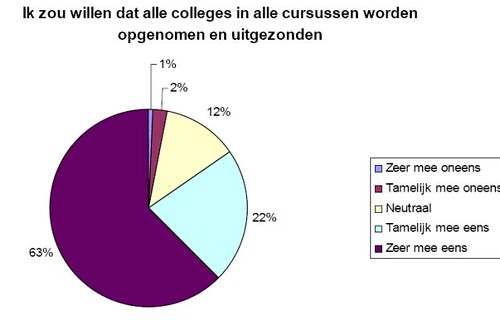
The final report is now out and public. In 2007, with funding from the central IT policy department we set out a pilot for the recording and broadcasting of lectures. When I say we, I mean a collaboration of Social Sciences and Arts, the audiovisual department in the centre of town with the audiovisual department at the Uithof campus.
In the course of one year we recorded approximately 250 hours of lectures. We surveyed students from a number of courses, amounting up to over 1400 students.
Their responses were extremely positive: recorded lectures were seen as a valuable addition to attending the lecture in person. Weblectures were viewed a lot, either just after the lecture, or as revision for the final exam.
You can find the surveys and all the responses from the students in this final report. We have also examined the use of Weblectures in education for parttime students; they were offered recordings of the lectures which were given to the students in full time enrollment. This proved to be a well received approach.
We used Apreso/Echo 360 in the year but also tested two other solutions: Mediasite and Presentations2Go. At the end of the report we give an overview over our findings and explain why we have chosen not to continue using Anystream Apreso/Echo 360.
Links:
- Project website
- The final report (in Dutch)
Subscribe to:
Posts (Atom)

 RSS feed for this blog


